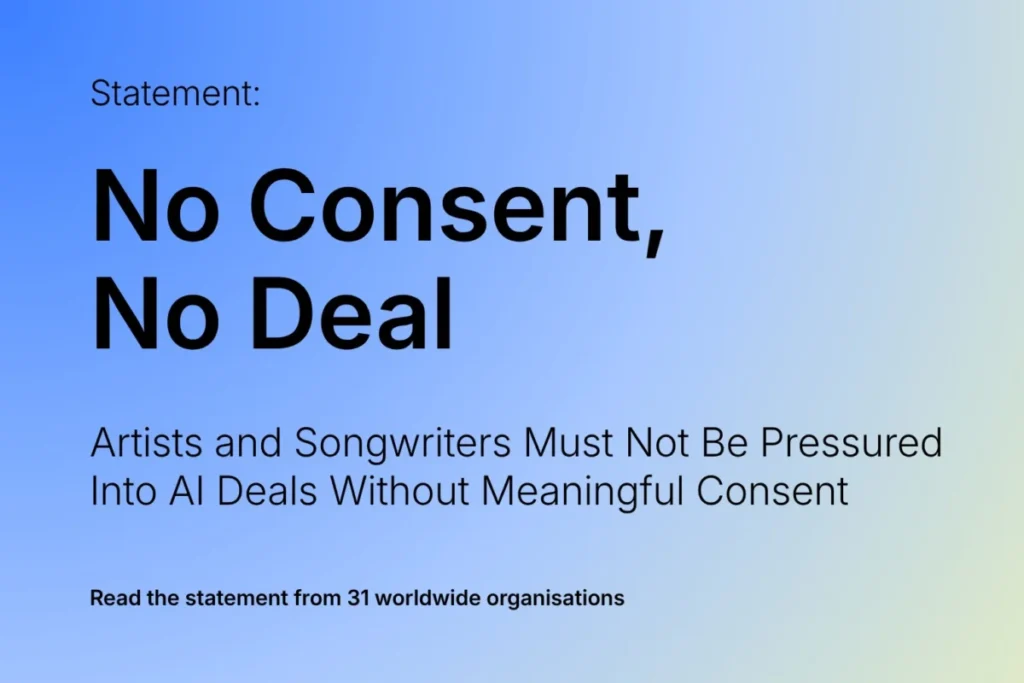

On Monday, June 22nd, a formidable global coalition of artists, songwriters, and managers’ groups united to release a powerful open letter addressed to major record labels and music publishers. The core demand of the missive, as stated in its accompanying press release, is unequivocal: “Stop the misuse of [our] rights in AI deals.” The organizations decried the current practices as “hypocrisy and an injustice which needs to stop now,” highlighting a stark double standard where labels and publishers insist on permission from AI companies to train on their music catalogs, yet refuse to grant artists and songwriters equivalent rights and control over the use of their own work.
This critical intervention comes at a pivotal moment, as the music industry grapples with the rapid integration of artificial intelligence. The past year has witnessed a flurry of high-profile licensing agreements between major music entities and emerging AI music companies. These deals, inked with pioneers like Suno, Udio, ElevenLabs, and others, represent significant shifts in how music is created, consumed, and monetized in the digital age.
A Wave of AI Licensing Deals Sparks Artist Concerns
The landscape of AI music licensing has been rapidly evolving, with several key players forging strategic partnerships. Warner Music Group has been notably active, signing licensing deals with Suno, Klay, and Udio, among others. Universal Music Group has similarly engaged with Udio, Spotify, and Klay, signaling a broad industry recognition of AI’s potential. Sony Music has also entered into an agreement with Klay, while Merlin, representing independent labels, has partnered with Udio and ElevenLabs. These agreements, often made with limited artist consultation, form the backdrop against which the current artist outcry is resonating.
The Unseen Clause: AI Training and Contractual Ambiguities
Compounding the concerns of artists and songwriters is the revelation that common contract language within existing U.S. record deals may be inadvertently, or perhaps deliberately, permitting labels and publishers to grant AI companies permission to train their models on artists’ works without requiring individual artist approval. Reporting from Billboard in April highlighted that many top talent attorneys have been made aware of this potential loophole. Jason Boyarski, founding partner at Boyarski Fritz, commented at the time, "Some of the labels have already taken the position that they technically don’t need special approvals to train." This suggests a proactive interpretation by some record labels of existing contractual frameworks to facilitate AI training.
While many public announcements regarding AI music deals emphasize artists’ opt-out options for the use of their name, image, or likeness in AI-generated outputs, the crucial area of AI training – the foundational process of feeding data into AI models – has largely remained a shadow. Audrey Benoualid, partner at Myman Greenspan Fox Rosenberg Mobasser Younger & Light, pointed out this critical distinction to Billboard in April, stating, "We’re seeing a differentiation between the way training – or inputs – and outputs are treated." This suggests a deliberate strategy to compartmentalize the licensing discussion, allowing for the use of an artist’s work for training purposes without the same level of scrutiny or consent applied to their public-facing persona.

The "Default Opt-In" Dilemma
The open letter from the artist and songwriter groups directly addresses this growing concern. "We are increasingly concerned that artists and songwriters in existing recording and publishing agreements are receiving letters from major labels and publishers informing them that they will be opted in to AI-related uses by default, with little actual choice offered," the letter states. This "default opt-in" approach, where artists are automatically included in AI-related licensing unless they actively opt out, is a significant point of contention. The letter, signed by prominent organizations including the Music Artists Coalition, Songwriters of North America, the Ivors Academy, Black Music Action Coalition, and Artists Rights Alliance, underscores that this is becoming a standard condition for new agreements as well.
Billboard’s previous reporting has shed light on some of these new contractual clauses. For instance, agreements from BMG, Sony, and Believe have included provisions that grant broad rights for AI training. Sony-owned dance label B1 Recordings, in one notable example, secured "unlimited, exclusive rights" to "use the recording in models and systems of generative artificial intelligence and applications based thereon, including generative AI, including [but] not limited to the analysis of the Recording for the purpose of extracting information on patterns, trends and correlations (AI training)." Such clauses, effectively granting perpetual and unrestricted access to an artist’s work for AI development, have fueled the demand for greater artist control.
The artists and songwriters argue that this imbalance leaves them vulnerable, being asked to grant permission without adequate information, clear terms, or guaranteed remuneration. They emphasize that artists are not merely catalog assets, and that the pursuit of innovation should not come at the expense of fundamental creator rights.
Three Pillars for a Fair AI Future in Music
In response to this evolving landscape, the coalition has outlined three core principles that they urge the entire music ecosystem – including record companies, publishers, policymakers, AI companies, and digital platforms – to respect and uphold:
Consent & Control
The cornerstone of the artists’ demand is the principle of active and specific consent. They assert that artists and songwriters must have the unfettered right to explicitly agree before their works, voices, performances, likenesses, or creative identities are used in connection with AI. This consent must be informed, with clear explanations of what is being approved and how it will be utilized. Furthermore, artists must retain control over these uses, rejecting clauses that bury permissions in broad catch-all language or grant rights in perpetuity. The notion of consent being imposed through default opt-ins or as a non-negotiable condition for signing new deals is vehemently opposed. Artists and songwriters must be empowered to say "no" without fear of penalty or professional repercussions.
Fair Compensation
When artists and songwriters do choose to participate in AI-related uses, the demand for fair and meaningful remuneration is paramount. The coalition stresses that creators must share in the value generated by their contributions. AI training and subsequent applications should not be treated as a general label asset, diminishing the creator’s stake. Instead, artists and songwriters must be consulted in these processes, and there needs to be absolute clarity regarding the revenue splits between the creator, the label, and the AI company. This principle aims to ensure that the economic benefits of AI in music are equitably distributed, reflecting the foundational role of the artist.

Clarity & Transparency
The coalition calls for a commitment to clear and transparent communication in all AI-related dealings. Requests for the use of an artist’s work must be purpose-specific. Artists, songwriters, and their managers need to receive clear, timely, and easily understandable information about any AI proposal that might affect their rights. This information should encompass the scope of rights being requested, permitted uses, implemented safeguards, the duration of the permission, and the process for withdrawing consent. This level of transparency is deemed essential for artists to make genuinely informed decisions, rather than being presented with opaque proposals that could have far-reaching and unintended consequences.
A Public Commitment to Ethical AI Integration
Beyond these guiding principles, the coalition is calling on all companies engaged in AI music deals to make a clear and public commitment to three specific guidelines:
- No default opt-ins: Artists and songwriters will not be automatically enrolled in AI-related licensing agreements.
- No forced AI clauses: AI rights will not be presented as mandatory conditions in new contracts.
- No use without meaningful consent, fair remuneration, and full transparency: The use of an artist’s work, voice, performance, likeness, or creative identity in AI will only proceed with explicit, informed consent, equitable compensation, and complete transparency regarding the usage.
The letter concludes with a powerful statement: "The future of music must be built with artists, songwriters and their representatives, not imposed on them." This sentiment underscores the belief that genuine innovation in AI music must be collaborative and respectful of the creators who are its lifeblood.
Broader Implications for the Music Industry and Policy
The organized stance of these global artist and songwriter groups carries significant weight, especially as policymakers worldwide are actively reviewing copyright laws in the context of AI advancements. The demands for consent, fair compensation, and transparency are not merely industry-specific requests; they touch upon fundamental issues of intellectual property rights, digital labor, and the ethical development of emerging technologies.
The current legal and contractual frameworks governing music were largely established before the advent of sophisticated AI music generation and training capabilities. This leaves a significant gap in ensuring that artists’ rights are adequately protected in this new digital frontier. The coalition’s efforts aim to proactively shape these evolving legal and business practices, preventing a scenario where artists’ contributions are leveraged without their informed participation or fair reward.
The success of these demands could have profound implications for the future of music creation, artist compensation models, and the competitive landscape between traditional music companies and AI developers. It signals a growing assertiveness from creators to reclaim agency in an industry increasingly influenced by technological shifts. As the debate around AI and creative rights intensifies, the principles articulated by these artist and songwriter coalitions are likely to become central to ongoing discussions among industry stakeholders and lawmakers alike, potentially setting a new global standard for AI music licensing.