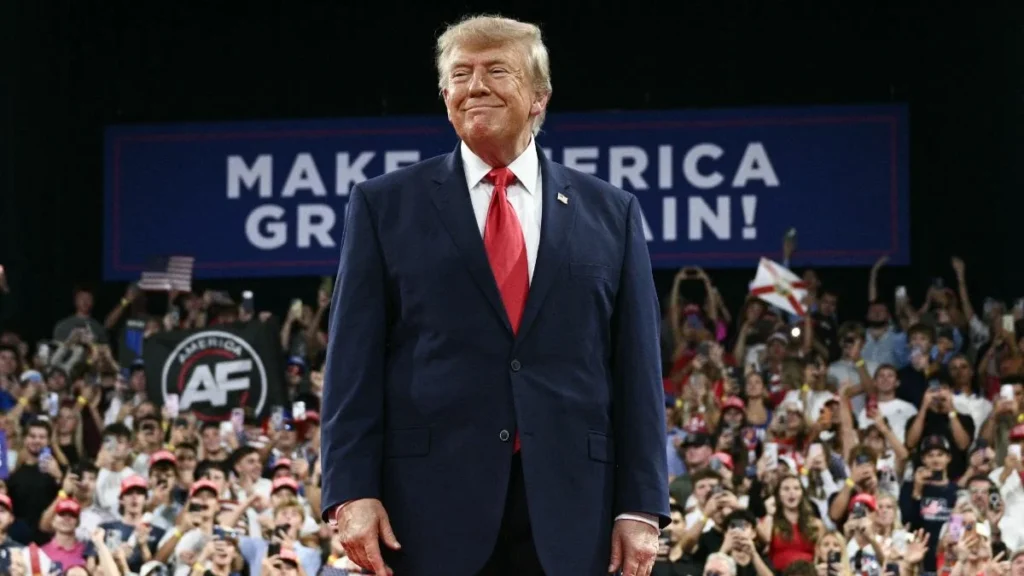

The intersection of modern political campaigning, energy infrastructure debate, and social media reaction converged dramatically following a campaign event in the Lone Star State. Former President Donald Trump, addressing a large gathering of supporters during a swing through Texas to bolster local Republican candidates, delivered a series of remarks concerning renewable energy that quickly ignited a firestorm across digital platforms. Specifically, his assertions regarding the environmental impact of large-scale solar energy installations prompted widespread public disbelief, scientific pushback, and a renewed wave of online discussions invoking the 25th Amendment of the United States Constitution.
The statements, made while Trump was campaigning on behalf of embattled Senate candidate Ken Paxton, diverted sharply from traditional stump-speech talking points centered on the economy and border security into the realm of energy policy. Describing large photovoltaic arrays, Trump claimed that industrial solar farms pose an immediate and lethal threat to regional wildlife, characterizing the dark-tinted panels as thermal traps capable of instantly killing animals that land or jump upon them.
Within hours of the speech, the remarks had circulated widely across social media networks, most notably on X (formerly Twitter), where users dissected the former president’s logic. The commentary rapidly evolved from ridicule into serious constitutional speculation, with numerous accounts trending hashtags and calls for the invocation of the 25th Amendment—the legal mechanism established to address presidential inability, removal, or succession.
This latest controversy unfolds against a tense political backdrop in Texas, where shifting demographics, economic pressures, and high-stakes legislative races have transformed the traditionally solid-red state into a closely watched battleground ahead of the upcoming midterm elections.
Background and Context of the Texas Campaign Swing
The political rally in question was organized as part of a high-profile Republican push to secure key seats in Texas, a state long considered a stronghold for the GOP. Donald Trump traveled to the state primarily to campaign for Ken Paxton, the Republican candidate navigating a challenging political environment complicated by past controversies and tightening poll numbers against his Democratic challenger, James Talarico.
Texas has historically maintained a reputation as a conservative anchor, but recent electoral cycles have revealed shifting political dynamics in suburban and urban districts. Economic anxieties, exacerbated by inflationary pressures and international tensions, including conflicts involving Iran and subsequent energy market volatility, have heightened voter frustration. Democratic candidates have made notable inroads in districts previously considered safe for Republicans, prompting national figures like Trump to make frequent visits to shore up the party’s base and energize conservative turnout.
It was during speeches delivered in Corpus Christi and Lubbock that Trump departed from the prepared script to address the broader landscape of American energy production. While contrasting traditional fossil fuels with renewable energy technologies, the former president turned his focus toward utility-scale solar farms, which have expanded rapidly across the sun-drenched expanse of Texas.
The Specific Claims and Renewable Energy Realities
During the address, Trump attempted to articulate the perceived dangers of large photovoltaic developments. “They have solar, some solar, not those big monsters that they put up all over, they kill all the animals,” Trump told the crowd. Elaborating on the mechanism of harm, he added, “The animals jump on them, and they fry because those black panels are hotter than your stove.”
The assertion that solar panels act as lethal heating elements capable of frying wildlife immediately drew scrutiny from environmental scientists, energy experts, and wildlife biologists. Industrial solar installations—typically composed of photovoltaic silicon panels mounted on metal racks—are designed to absorb sunlight and convert it into electricity via the photovoltaic effect. While dark-colored panels do absorb a high percentage of solar radiation and can become warm to the touch, their surface temperatures do not approach the extreme, instantaneous heat of a household stove, nor do they function as physical traps that attract and incinerate animals in the manner described.
Environmental agencies and researchers who study the intersection of energy infrastructure and wildlife have documented certain ecological impacts associated with large solar developments, though none align with the former president’s description. The primary wildlife concerns regarding solar farms include habitat fragmentation, the loss of migratory corridors, and a phenomenon known as the “lake effect,” where polarized light reflecting off large arrays can attract aquatic insects, occasionally confusing birds that mistake the panels for bodies of water. Furthermore, concentrated solar power (CSP) plants—which use mirrors to focus sunlight onto a central receiver tower—have historically been associated with instances of birds experiencing singeing or mortality when flying through intense flux fields, but standard photovoltaic farms do not share this mechanism.
Independent scientific bodies and energy watchdogs quickly moved to clarify the physics of photovoltaic installations, emphasizing that standard utility-scale panels pose no thermal incineration threat to terrestrial wildlife.
Chronology of Events and Digital Outcry
The sequence of events unfolded rapidly across a single Tuesday, capturing the attention of both mainstream media analysts and digital commentators:
- Morning to Afternoon: Donald Trump arrives in Texas, holding campaign events in Corpus Christi and Lubbock to rally support for Ken Paxton and local Republican candidates.
- Mid-Speech Deviation: During his remarks on energy policy, Trump launches into an impromptu critique of large-scale solar installations, making the claim that animals jump onto the panels and are fried by extreme heat.
- Early Evening: Video clips of the remarks are extracted from live broadcasts and uploaded to social media platforms, particularly X.
- Late Evening: The clips go viral, accumulating millions of views within hours. Users begin posting satirical commentary, expressions of disbelief, and formal invocations of the 25th Amendment.
- Subsequent Days: Political commentators, independent fact-checkers, and energy policy experts analyze the statements, placing them within the broader context of political rhetoric surrounding renewable energy transitions.
Social Media Reaction and the 25th Amendment Debate
The digital response to the rally remarks was swift and multifaceted, ranging from dark humor to constitutional discussions. On X, thousands of users reacted to the video footage by questioning the former president’s grasp of physical science and cognitive fitness.
The 25th Amendment of the United States Constitution—specifically Section 4, which outlines the procedure for declaring a president unable to discharge the powers and duties of office—became a focal point of the online discourse.
“It’s really time for 25th Amendment for real,” one prominent user posted, reflecting a sentiment shared by numerous critics who argued that public officials should possess a foundational understanding of basic science.
Another user wrote, “This man does not live in reality. 25th amendment is never too late to invoke before he does something incredibly stupid.”
The digital reaction also incorporated internet meme culture to mock the scientific inaccuracy of the claims. One widely shared image featured a satirical caption reading, “Supreme Leader, some of your knowledge coming from cartoons,” underscoring the disbelief with which the remarks were received outside of the immediate rally audience.
While legal and constitutional scholars routinely point out that the 25th Amendment was designed for severe medical emergencies, incapacitating strokes, or profound physical and mental inability to govern—and is not applicable to former officeholders or routine political gaffes—the phrase frequently trends on social media as a rhetorical device expressing extreme political opposition and dismay.
Broader Economic and Political Implications
The controversy surrounding the Texas rally remarks highlights the deep polarization and ideological fault lines defining contemporary American energy debates. Renewable energy, particularly solar and wind power, has increasingly become a proxy conflict in national politics. Proponents view the expansion of solar infrastructure as a critical component of economic modernization, job creation, and carbon reduction, while critics often emphasize reliability concerns, land-use conflicts, and the intermittency of generation sources.
In Texas, a state that leads the nation in both traditional petroleum production and renewable energy capacity—ranking first in wind generation and rapidly climbing in solar installations—energy policy carries immense economic weight. The juxtaposition of a massive renewable energy sector with anti-renewable political rhetoric creates a complex landscape for voters navigating the upcoming midterms.
Furthermore, the incident underscores the challenges modern political campaigns face in the age of instantaneous digital distribution. Off-the-cuff remarks made during regional stump speeches are immediately scrutinized by national audiences, codified into viral content, and subjected to intense fact-checking. For candidates relying on national figures to energize local bases, controversial statements can sometimes overshadow core campaign messaging, forcing campaigns to navigate public relations challenges on multiple fronts.
As the political season progresses in Texas and nationwide, the debate over energy infrastructure, scientific accuracy in public discourse, and the tone of political rhetoric will undoubtedly remain central to the national conversation. Whether through formal policy debates or viral social media commentary, the intersection of politics and energy continues to yield high-stakes moments that resonate far beyond the borders of any single campaign rally.