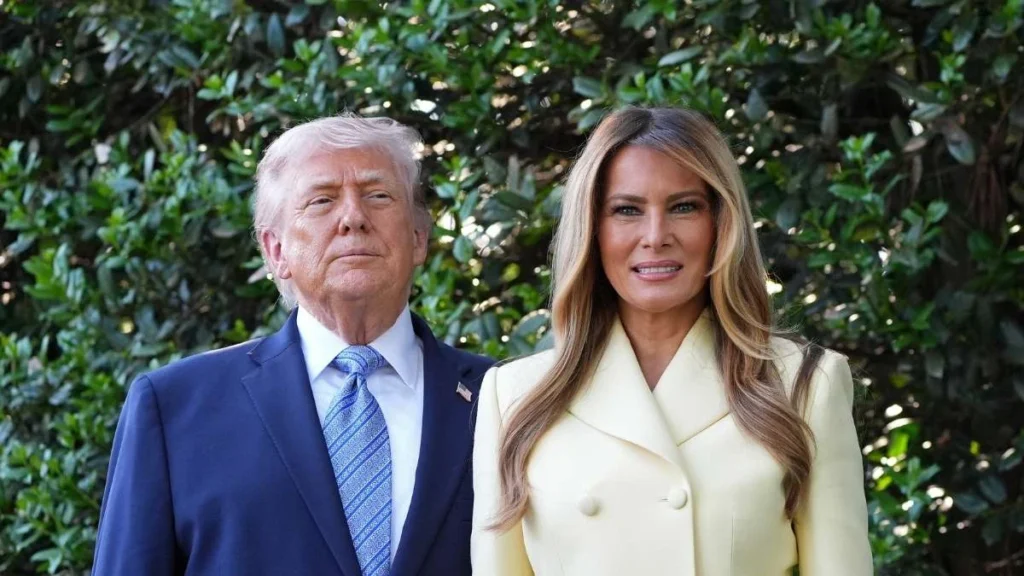

The intersection of high-stakes federal policy and the domestic life of the First Family has come under renewed scrutiny following revelations that President Donald Trump bypassed the objections of First Lady Melania Trump to host tech billionaire Elon Musk at the White House. According to a detailed account in the recently published book Regime Change: Inside the Imperial Presidency of Donald Trump, authored by seasoned New York Times journalists Maggie Haberman and Jonathan Swan, the President’s decision to offer Musk a semi-permanent residence within the Executive Mansion highlights the unprecedented access granted to the Tesla and SpaceX CEO during the administration’s second iteration.
The report details a specific instance in early 2025 where the First Lady reportedly expressed firm reservations regarding the tech mogul’s presence in the private quarters of the White House. Despite her protests, which focused on the preservation of the family’s privacy and the traditional boundaries of the presidential residence, President Trump extended an invitation to Musk to utilize the historic Lincoln Bedroom. This move, according to the authors, underscores a significant shift in the internal power dynamics of the White House, where political and advisory alliances have occasionally taken precedence over familial preferences.
The Genesis of the Invitation: Air Force One and DOGE
The logistics of Musk’s stay reportedly began during a flight on Air Force One. At the time, Musk was serving in a high-profile, albeit controversial, capacity as the head of the newly formed Department of Government Efficiency (DOGE). The initiative, aimed at slashing federal spending and streamlining the bureaucracy, required Musk to spend a significant amount of time in Washington, D.C. During the flight, President Trump reportedly inquired about Musk’s lodging arrangements in the capital. Upon learning that the billionaire had not secured a permanent residence or consistent hotel accommodations, the President offered the White House as a temporary base of operations.
The invitation was not merely a gesture of hospitality but a reflection of the deep-seated "bromance" that has defined the relationship between the two men since the 2024 campaign. However, the proposal met immediate resistance from Melania Trump. Sources cited in Regime Change suggest that the First Lady, who has historically been protective of the Executive Residence’s sanctity, viewed the presence of a high-profile guest—particularly one as idiosyncratic as Musk—as an intrusion. Nevertheless, the President overruled these objections, asserting that Musk’s proximity was essential for the rapid implementation of the administration’s economic agenda.
Living in the Lincoln Bedroom: Late-Night Policy and Ice Cream
Elon Musk’s stay at the White House was far from a quiet affair. In statements made to reporters in 2025, Musk confirmed the arrangement, describing the President as a "very, very good host." Musk’s tenure in the Lincoln Bedroom—a space traditionally reserved for the most distinguished guests of the President—became a hub for late-night discussions that often blurred the lines between social interaction and federal policy-making.
"Sometimes I stay at the White House," Musk told reporters, recounting how the President would frequently ask him to stay over after meetings or shared travel on Marine One. Musk described being given a tour of the Lincoln Bedroom, noting the historical gravity of the space. Perhaps most notably, Musk revealed that he and the President frequently shared late-night ice cream sessions, a detail that humanizes the relationship while also highlighting the informal nature of Musk’s influence. Musk jokingly added, "Don’t tell RFK," a nod to Robert F. Kennedy Jr.’s well-known advocacy for stricter health and dietary standards within the administration.
Despite the comfort of the Lincoln Bedroom, Musk also disclosed that he did not limit his sleeping arrangements to the White House. True to his reputation for a "hardcore" work ethic, the billionaire occasionally slept on the floor of his office in the Eisenhower Executive Office Building (EEOB) or crashed at the homes of various friends in the D.C. area. This nomadic approach to his residency in Washington mirrored his past behaviors at Tesla and X (formerly Twitter), where he famously slept on factory floors and in conference rooms to oversee critical projects.
A Timeline of the Trump-Musk Alliance
The evolution of the relationship between Donald Trump and Elon Musk is a study in political pragmatism and shared interests. To understand the significance of Musk’s White House stay, one must look at the chronology of their alliance:
- 2017–2018: Early friction. Musk initially served on Trump’s business advisory councils but resigned in 2017 after the United States withdrew from the Paris Climate Agreement. For several years, the two maintained a distance, with Trump occasionally criticizing electric vehicle mandates and Musk remaining focused on his private ventures.
- 2022–2023: The pivot. Following Musk’s acquisition of Twitter, his political leanings appeared to shift toward a more populist, anti-establishment stance. Trump, meanwhile, praised Musk’s commitment to "free speech" on the platform.
- 2024 Election Cycle: The formal alliance. Musk officially endorsed Trump following an assassination attempt on the former president in Butler, Pennsylvania. Reports surfaced of Musk contributing significantly to a pro-Trump super PAC, and the two began appearing together at rallies and high-level strategy meetings.
- Early 2025: The DOGE Appointment. Following Trump’s inauguration, Musk was tapped to lead the Department of Government Efficiency alongside Vivek Ramaswamy. This role solidified his position as a central figure in the administration, leading directly to the residency at the White House.
Analysis of Implications: Security, Ethics, and Access
The presence of a private citizen—even one serving in a quasi-official advisory capacity—as a long-term resident of the White House raises several questions regarding ethics and security. While it is not unprecedented for presidents to host close friends or advisors (Harry Hopkins lived at the White House during the FDR administration), the scale of Musk’s business interests introduces a unique set of complications.
1. Conflict of Interest: As the CEO of SpaceX and Tesla, Musk oversees companies that hold billions of dollars in federal contracts. His unprecedented access to the President, coupled with his role in "efficiency" efforts that could impact the regulatory environment for his own businesses, has drawn criticism from ethics watchdogs. Critics argue that the "ice cream summits" in the private quarters provide Musk with an unfair advantage in shaping policy that benefits his corporate empire.
2. Security Protocols: The White House is one of the most secure facilities in the world. Hosting a guest who is not a government employee or a member of the First Family requires rigorous Secret Service screening and creates logistical challenges. Musk’s habit of inviting other tech executives or associates to meet him could potentially compromise the controlled environment of the Executive Mansion.
3. The Domestic Dynamic: The report of Melania Trump’s objections highlights a recurring theme in the Trump presidency: the tension between the "outsider" advisors the President trusts and the traditional structures of the East Wing. The First Lady’s desire for a clear boundary between the administration’s work and the family’s home life appears to have been sidelined in favor of Musk’s "all-access" pass.
Official Responses and Public Perception
While the White House Press Office has not issued a formal line-by-line rebuttal of the claims made in Regime Change, spokespeople for the administration have generally defended the President’s right to host whoever he chooses. A spokesperson for the First Lady’s office declined to comment on specific domestic disagreements but emphasized that Mrs. Trump remains focused on her "Be Best" initiatives and the architectural preservation of the White House.
Public reaction to Musk’s residency has been polarized. Supporters of the administration view the arrangement as a sign of a new, efficient era of governance where the world’s most successful entrepreneur is given the tools and access needed to "fix" Washington. Conversely, detractors see it as a blurring of the lines between the public trust and private gain, characterizing the White House as a "clubhouse" for the billionaire class.
The Broader Impact on Governance
The "Musk at the White House" phenomenon is symptomatic of a broader shift in how the executive branch functions in the mid-2020s. By bringing in figures like Musk and allowing them to bypass traditional bureaucratic hurdles—and even domestic norms—the Trump administration is signaling a preference for an informal, "disruptive" style of management.
As the Department of Government Efficiency continues its work, the physical presence of its leader in the Lincoln Bedroom serves as a potent symbol of the administration’s priorities. Whether this leads to the promised "efficiency" or results in a permanent entanglement of private interest and public policy remains a central question for historians and political analysts. For now, the image of the President and the world’s richest man sharing ice cream in the shadows of Lincoln’s legacy remains one of the most defining and controversial vignettes of the current political era.