
The intersection of Danish design and Chinese aesthetic tradition is a narrative that spans nearly a century, rooted in the mid-1940s when the legendary designer Hans Wegner first looked toward the Ming dynasty for inspiration. Wegner’s creation of the Wishbone chair—a hybrid of imperial Chinese silhouettes and the functional minimalism of Scandinavian modernism—established a cross-cultural dialogue that remains one of the most significant chapters in 20th-century design history. Today, that dialogue has found a new and profound expression in the hills of San Francisco’s Pacific Heights. Architect David Thulstrup has recently completed a comprehensive transformation of a historic residence in the neighborhood, marking his first residential project in the United States. The project serves as a masterclass in "East-meets-West" ingenuity, blending a rigorous Nordic architectural language with the spiritual and aesthetic requirements of a client base deeply invested in Asian art and Buddhist philosophy.

A Vision of Clarity in Pacific Heights
The project, which spanned five years from conception to completion, involved a total gut renovation of a four-story historic home. Before Thulstrup’s intervention, the interior was described as a "labyrinth"—a fragmented series of rooms that failed to capitalize on the property’s significant elevation and natural light. The architect’s primary objective was to deconstruct this internal maze to create a sense of "clarity and calmness." By opening the floor plan and introducing a rear extension with expansive windows, Thulstrup successfully framed the iconic views of the San Francisco Bay and the city’s undulating skyline, effectively bringing the outside environment into the living experience.
The clients, who possess a curated collection of Asian art and a personal devotion to Buddhism, sought a home that reflected a contemporary, pared-back ethos while maintaining a positive, energetic flow. This required Thulstrup to balance his innate Danish sensibilities—characterized by honesty in materials and functionalism—with the ancient principles of Feng Shui and the specific spatial requirements of Eastern rituals.

The Architect’s Pedigree: From Jean Nouvel to Noma
David Thulstrup’s rise to international prominence is rooted in a diverse and prestigious professional background. Born and raised outside Copenhagen, he received his formal education at The Royal Danish Design School. His formative professional years were spent in Paris, working under Pritzker Prize-winning architect Jean Nouvel, and in New York, where he served at the firm of AD100 Hall of Famer Peter Marino.
These two experiences provided a dual foundation for his practice. From Nouvel, Thulstrup inherited an exacting, experimental spirit and a willingness to push the boundaries of material application. From Marino, he gained an immersion into the world of contemporary luxury and the importance of hyper-detailed craftsmanship. Since founding his own firm in 2009, Thulstrup has become a leading figure in Danish design, most notably for his work on the interiors of Noma, the world-renowned restaurant in Copenhagen. His portfolio also includes flagship showrooms for legacy brands like Georg Jensen and Dinesen, as well as hospitality projects such as the Vipp Chimney House. The San Francisco project represents the culmination of these varied influences, applied for the first time to the American residential landscape.

Architectural Centerpiece: The Circular Staircase
Perhaps the most striking architectural intervention in the Pacific Heights residence is the replacement of multiple, disconnected staircases with a single, continuous circular flight. This timber spiral, crafted from Dinesen oak, serves as the home’s primary circulatory artery, connecting all four levels. The design of the staircase is a study in geometric precision: slatted railings provide a sense of transparency and lightness, which then transition into solid balustrades at each landing to ground the structure.
To illuminate this vertical passage, Thulstrup integrated a narrow, multistory window that runs the full height of the ascent. This architectural feature allows natural light to bathe the oak surfaces, creating a shifting play of shadows and highlights that evolves throughout the day. According to Thulstrup, the staircase was not merely a functional necessity but a tool for "creating clarity and calmness through a very detailed, minimal language."

Materiality and the "Champagne" Palette
Thulstrup’s approach to design is famously material-driven. At his studio in the Amager neighborhood of Copenhagen, he maintains an extensive materials library where samples of stone, wood, and metal are arranged into tactile mood boards. For the San Francisco project, he meticulously narrowed the palette to a select group of high-quality surfaces that would provide warmth without sacrificing minimalism.
Key materials include:

- Danish Brick: Long, slender Petersen bricks were used for the exterior and certain interior accents. These bricks, known for their handcrafted quality and unique proportions, provide a textural link to European masonry traditions.
- French Limestone: This stone was utilized for primary surfaces, including the bathrooms, where its soft, matte finish complements the home’s quiet atmosphere.
- Dinesen Oak: A staple of Danish high-end design, the hard oak provides a consistent warmth across the floors and millwork.
The color scheme was intentionally kept within a range of warm beige tones. Thulstrup avoided sterile whites or cool greys, opting instead for what he describes as "the color of champagne"—a hue that appears in everything from the diaphanous Jim Thompson silk curtains to the custom upholstery. This tonal consistency ensures that the focus remains on the architectural forms and the clients’ art collection.
Integrating Feng Shui and Eastern Rituals
The design process was deeply collaborative, involving not only the clients but also a Feng Shui expert to ensure the home’s energy (Chi) was managed according to ancient principles. This influence led to several specific architectural choices that deviate from standard modern luxury trends. For instance, the architect eschewed a traditional skylight at the top of the stairwell to prevent Chi from escaping upward. Similarly, corner windows and sharply pitched roofs were avoided in favor of more grounded, stable forms.

On the upper level, the attic ceiling was gently curved to soften the room’s volume, creating a sanctuary-like meditation space. This room features textile panels with circular motifs inspired by the sun, further emphasizing the home’s connection to natural cycles. On the exterior terrace, a bespoke water fountain was installed to circulate water, a key Feng Shui element intended to foster prosperity and positive energy.
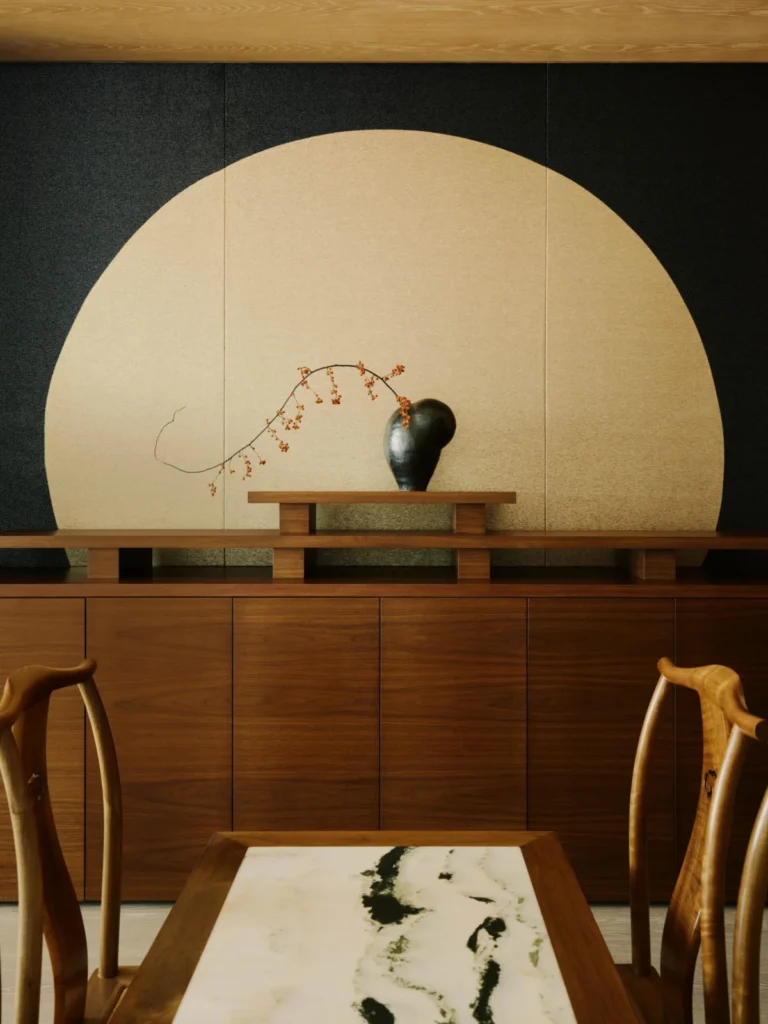
The home also features a dedicated tea ceremony room. Thulstrup spent time studying the rituals of the tea ceremony to ensure the space provided the necessary "tranquility and focus." The room is framed by slatted oak millwork and furnished with rare Chinese antique chairs made from the same precious woods once reserved for imperial use.

A Curation of Design Icons
The interior design is a sophisticated blend of Thulstrup’s custom furniture, Chinese antiques, and icons of Danish modernism. This curation reinforces the historical link between the two cultures.
- Furniture Icons: The residence includes lighting by Poul Henningsen, tables by Poul Kjærholm, and desks by Bodil Kjær. Arne Jacobsen and Hans Wegner chairs are placed strategically throughout the home, serving as functional sculptures.
- Custom Thulstrup Designs: The architect integrated several of his own furniture pieces, including the dining suite he originally designed for Noma and a bathroom perch conceived for the Copenhagen restaurant Alouette.
- Art and Antiquity: At the base of the staircase sits a stainless-steel sculpture by Zhan Wang, which reinterprets the traditional Chinese "scholar’s rock" in a modern, reflective medium. Antique Indian stone doors flank the entry, and a Sam Falls artwork provides a pastoral backdrop in the breakfast room.
Timeline and Project Scope
The project represents a significant investment in time and craftsmanship, characterized by the following milestones:

- 2018-2019: Initial design phase and consultation with Feng Shui experts.
- 2020-2022: Extensive gut renovation and construction of the rear extension and the Dinesen oak staircase.
- 2023: Final interior curation, installation of custom millwork, and landscaping of the rear terrace.
- 2024: Completion and debut as Thulstrup’s first US residential masterpiece.
Broader Impact and Global Implications
The completion of the Pacific Heights project marks a pivotal moment in David Thulstrup’s career, signaling his successful expansion into the North American market. It also reflects a broader trend in high-end residential architecture: the move away from "minimalism for minimalism’s sake" toward a more "soulful minimalism" that incorporates heritage, spirituality, and tactile warmth.
Thulstrup’s ability to navigate the complex requirements of Feng Shui while maintaining a rigorous Scandinavian aesthetic has already led to new commissions globally. His firm is currently working on residential and hospitality projects in Germany, Indonesia, and the Faroe Islands. As the architect reflects on the San Francisco project, he notes that the principles of "good Chi" and spiritual tranquility have become a permanent part of his design vocabulary. This cross-cultural synthesis, pioneered by Wegner in the 1940s, continues to evolve, proving that the dialogue between East and West remains one of the most fertile grounds for architectural innovation in the 21st century.