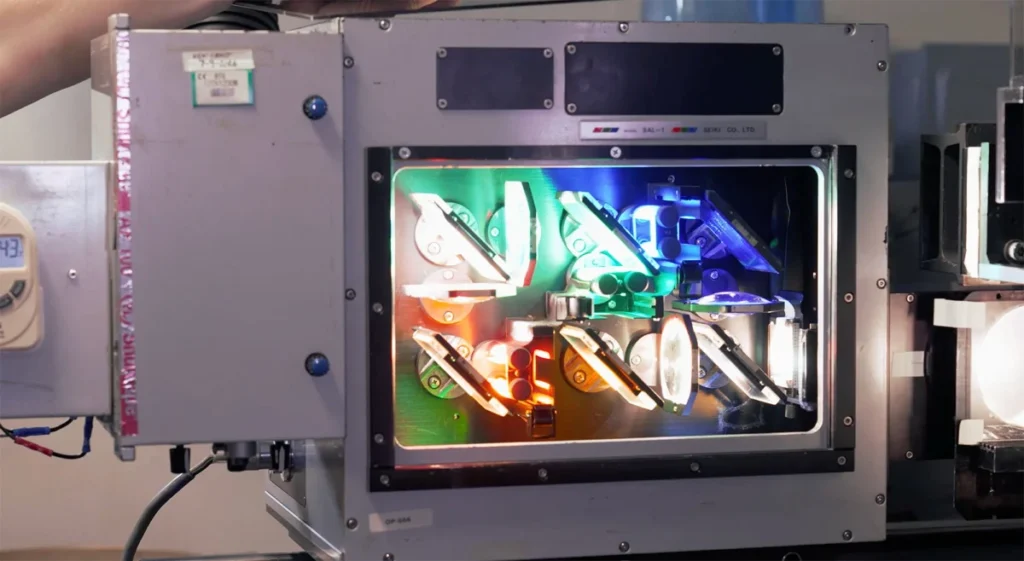

For cinephiles and technical purists, the magic of the moving image has always lived in the physical chemistry of celluloid. While the commercial film industry has almost universally embraced digital acquisition and projection, a dedicated ecosystem of laboratories, technicians, and preservationists continues to champion the analog medium. A recent behind-the-scenes feature produced by Adam Savage’s digital platform, Tested, has offered audiences a rare, unvarnished look into this hidden world. The featurette transports viewers directly into the optical recording laboratories of FotoKem, a legendary post-production facility in Burbank, California, to reveal the intricate, frame-by-frame process of blowing up a standard 35mm film print into a sweeping 65mm format suitable for massive 70mm theatrical presentation.
The video, which debuted in November 2026, serves as both a technical masterclass and a tribute to the specialized machinery and human expertise required to keep large-format cinematic traditions alive. Guided by Andrew Oran of FotoKem and veteran technician Jeremy Miller, Savage walks viewers through a room that very few people outside the professional post-production community will ever set foot in. The segment highlights the specialized optical printers, the sophisticated physics of analog projection, and the painstaking labor involved in bridging different eras of filmmaking technology.
Main Facts of the Process: The Mechanics of the Optical Blow-Up
At the heart of the FotoKem facility lies a specialized piece of equipment known as a multi-format optical printer. Equipped with precision-engineered apertures capable of accommodating both 35mm and 70mm film stock, the machine operates on a deceptively simple yet mechanically demanding concept rooted in early cinema history. Instead of utilizing digital algorithms or software-based upscaling to transition from a smaller negative to a larger screen format, the optical printer relies entirely on physical light and optics.
The process involves physically projecting an existing film print through a series of high-precision lenses directly onto a second, unexposed strip of film. This is executed frame by frame, requiring absolute mechanical synchronization and calibration to ensure that the image geometry, focus, and alignment remain pristine. Adding to the complexity of the operation is an integrated "lamp house" system designed to perform live color correction as the light passes through the film. Technicians can adjust color balances and exposure parameters in real time, ensuring that the visual integrity of the original cinematography is preserved, enhanced, or accurately translated to the expanded canvas of a 70mm presentation.

When studios decide to re-release classic films or mount special theatrical runs of legacy titles in large format—often heralded by modern audiences as premium cinematic experiences—it is frequently this exact room at FotoKem where the physical release prints are manufactured. The conversion from 35mm to 65mm (which yields 70mm prints when the four magnetic or optical sound stripes are added to the outer edges) is not merely a technical upgrade; it is a translation of light, grain, and physical texture designed to fill massive curved screens with rich, immersive detail.
Chronology and Background: The Legacy of Film Preservation and FotoKem
To fully understand the significance of the Tested featurette, it is necessary to examine the historical context of FotoKem and the evolution of film processing laboratories. Founded in 1963, FotoKem has grown from a local commercial processing lab into one of the most respected independent post-production and film restoration facilities in the world. Over the decades, the company has worked alongside major Hollywood studios, independent filmmakers, and prestigious archival institutions such as the Academy Film Archive and The Film Foundation to protect, restore, and mint release prints for generations of cinema.
In the late 20th century, the dominance of 35mm film as the global standard for production and exhibition was virtually unchallenged. However, the rapid digitization of the film industry throughout the 2000s and 2010s led to the widespread closure of traditional film laboratories worldwide. Facilities capable of developing, timing, and printing photochemical film shrank dramatically in number. FotoKem stands as one of the crucial survivors of this industrial shift, maintaining its physical infrastructure, chemical processing lines, and optical printing capabilities at a time when most of the industry moved entirely to ones and zeros.
The resurgence of interest in analog formats—fueled in part by filmmakers like Christopher Nolan, Paul Thomas Anderson, and Quentin Tarantino, who continue to champion shooting and projecting on physical celluloid—has placed facilities like FotoKem back in the spotlight. The meticulous workflows demonstrated in Adam Savage’s video represent decades of accumulated institutional knowledge. The technicians operating these machines are not merely machine operators; they are specialized craftspeople whose expertise is passed down through mentorship, safeguarding a technical art form that cannot be easily replicated by digital automation.
Supporting Data and Technical Precision

The conversion of 35mm film to 65mm is an exercise in extreme physical tolerances. When a 35mm image is blown up to a 65mm negative, the surface area of the film frame increases significantly, which naturally magnifies any imperfections present in the source material, including grain structure, dust particles, and minor focus slips. Consequently, the optical printing process demands extraordinary environmental and mechanical controls.
The optical printers used in these laboratories are housed in climate-controlled, dust-mitigated environments to prevent microscopic debris from settling on the emulsion during the exposure process. The mechanical registration pins that hold each frame of film in place during exposure must operate with tolerances measured in microns. If a pin is off by even a fraction of a millimeter, the resulting projected image will suffer from jitter or weave—defects that become glaringly obvious when projected onto a multi-story IMAX or grand-format screen.
Furthermore, the choice to use analog optical printing rather than digital intermediate (DI) scanning and laser recording stems from a commitment to maintaining the pure photochemical response of the medium. When light passes through film stock, the silver halide crystals react in a non-linear fashion that creates the characteristic organic look, dynamic range, and highlight roll-off associated with classic cinema. By keeping the workflow entirely within the photochemical domain during the blow-up process, laboratories like FotoKem ensure that the physical DNA of the original recording is maintained without the intervention of digital sampling or compression.
Official Responses and Industry Perspectives
While the technical details of film processing are traditionally kept behind closed doors, independent digital platforms like Adam Savage’s Tested have increasingly bridged the gap between highly specialized industrial trades and the general public. Adam Savage, widely known for his extensive background in practical effects, prop-making, and scientific curiosity, approached the facility with a palpable enthusiasm for mechanical engineering and cinematic heritage.
Industry professionals and post-production specialists have largely welcomed these educational windows into their workspaces. Representatives for FotoKem and other specialty laboratories have noted that public interest in physical media and projection formats has experienced a notable generational shift. Younger audiences, having grown up in an era dominated by streaming compression and digital files, have developed a distinct fascination with the tangibility and permanence of physical film.

By pulling back the curtain on processes like optical blow-ups, technical creators help demystify the labor behind premium theatrical experiences. When moviegoers purchase a ticket for a 70mm large-format screening, they are rarely aware of the physical journey the print undertook—from an archival vault or standard negative, through a multi-format optical printer in Burbank, California, and finally threaded onto a projector platter in a theater projection booth. Features like the Tested tour contextualize this journey, transforming an abstract cinematic format into a human story of engineering and artistry.
Broader Impact and Implications for the Future of Cinema
The documentation of FotoKem’s optical printing operations arrives at a crucial juncture for the film industry. As major studios continue to balance the economic efficiencies of digital distribution with the prestige marketing of limited analog and large-format theatrical releases, the physical infrastructure supporting film projection remains under constant economic pressure. Specialized film stock must be manufactured in limited batches, processing chemicals must be carefully managed and disposed of according to strict environmental regulations, and the aging machinery required for optical printing must be meticulously maintained by a dwindling pool of specialized mechanical engineers.
Despite these challenges, the cultural demand for authentic analog exhibition has proven remarkably resilient. The success of large-format retrospective screenings, film festivals dedicated to celluloid, and the advocacy of prominent directors have created a sustainable, albeit niche, market for photochemical post-production services. Facilities like FotoKem serve as vital cultural repositories; without their operational capacity, the physical restoration and large-format expansion of classic cinema would effectively grind to a halt.
Moreover, the educational impact of media features highlighting these trades cannot be understated. By demystifying the labor of film technicians, projects like Adam Savage’s tour inspire a new generation of filmmakers, engineers, and archivists to take an interest in the physical sciences of motion pictures. The preservation of these skills ensures that the cinematic heritage of the 20th century—and the ongoing analog experiments of the 21st century—can continue to be experienced by audiences in the exact manner their creators intended: projected as pure, unfiltered light through celluloid, one frame at a time.