
The completion of a newly constructed 15,000-square-foot estate in the Hamptons marks a significant moment in contemporary residential architecture, representing a sophisticated bridge between early 20th-century British heritage and 21st-century American luxury. Situated on five leafy acres within walking distance of the Atlantic Ocean, the residence serves as a profound case study in how historical architectural movements—specifically the Arts and Crafts movement championed by Sir Edwin Lutyens—can be reinterpreted to meet the rigorous demands of a modern family. The project brought together an "all-star" team of designers, including the architectural firm Kligerman Architecture & Design, interior designer Bryan O’Sullivan, and landscape architect Deborah Nevins, resulting in a property that is as much a curated art gallery as it is a functional home.

The Architectural Genesis and the Lutyens Legacy
The vision for the estate began with the homeowner’s deep dive into architectural history. Seeking a structure that felt rooted in the landscape rather than imposed upon it, she looked to the work of Sir Edwin Lutyens (1869–1944). Lutyens was a seminal figure in British architecture, known for his ability to blend traditional vernacular styles with a grand, almost eccentric sense of proportion. His signature elements—steeply pitched rooflines, massive, weighty chimneys, and intricate brickwork—became the primary inspiration for the Hamptons project.

To execute this vision, the homeowner commissioned Kligerman Architecture & Design, a firm widely recognized for its mastery of traditional forms and its ability to adapt classical proportions for modern use. Joe Carline, a partner at the firm, noted that the project was an exercise in "the quiet perfection of proportion." The resulting structure utilizes local stone, brick, and carefully considered window patterns to create a façade that feels timeless. By adhering to the Lutyens philosophy, the architects ensured that the 15,000-square-foot volume did not overwhelm the five-acre site, but rather integrated seamlessly with the surrounding greenery.

Bridging the Atlantic: The Search for a Design Partner
While the architectural direction was established early, the search for an interior designer proved more complex. The homeowner sought a rare combination of high-level creativity and the organizational rigor required to manage a project of this scale. After meeting several domestic candidates, she looked toward London, eventually discovering the work of Bryan O’Sullivan. O’Sullivan, known for his high-profile hospitality projects such as the revamp of Claridge’s in Mayfair and the Westmoreland Café at the Frick Collection, offered a European sensibility that resonated with the homeowner’s aesthetic goals.

The collaboration began unconventionally via an Instagram message, leading to a meeting in New York City just days later. For O’Sullivan, the project was transformative; the commission not only allowed him to apply his hospitality-honed discipline to a residential setting but also prompted him to open a Manhattan office and eventually relocate his family to New York. This transatlantic partnership ensured that the interiors would avoid the "shingle-style" clichés often found in the Hamptons, opting instead for a curated, international approach.

A Chronology of Craftsmanship: From Italian Quarries to New York Forges
The timeline of the project was defined by a series of global shopping and sourcing expeditions, emphasizing the commitment to authenticity and custom work. A pivotal moment in the design process was a three-day intensive trip to Italy, where O’Sullivan and the client visited numerous quarries to select specific slabs of marble. This journey, which O’Sullivan described as "going to a sweets shop," resulted in the unique, heavily veined green and grey marbles that define the home’s bathrooms and powder rooms.

Back in the United States, the focus shifted to bespoke metalwork and artisanal finishes. David DeSantis of Forged Artistry, based in Upstate New York, was commissioned to create custom staircase balusters and unique metal-framed beds. In the dining room, artist Maria Redondo spent weeks hand-painting a geometric mural directly onto wood-paneled walls, a modern nod to the decorative traditions of the Arts and Crafts era. These elements highlight a growing trend in luxury real estate: a move away from ready-made furniture toward "one-of-one" artisanal pieces that increase the property’s intrinsic value.

Materiality and the Mellow Palette
The interior design is anchored by a color palette that O’Sullivan and the client described as "mellow." Dusty peach, sage green, and burnt ochre are used throughout the home, providing a warmth that complements the extensive use of exposed walnut and oak. This choice of colors serves a dual purpose: it echoes the natural tones of the Hamptons landscape and provides a sophisticated backdrop for a family with three teenagers.

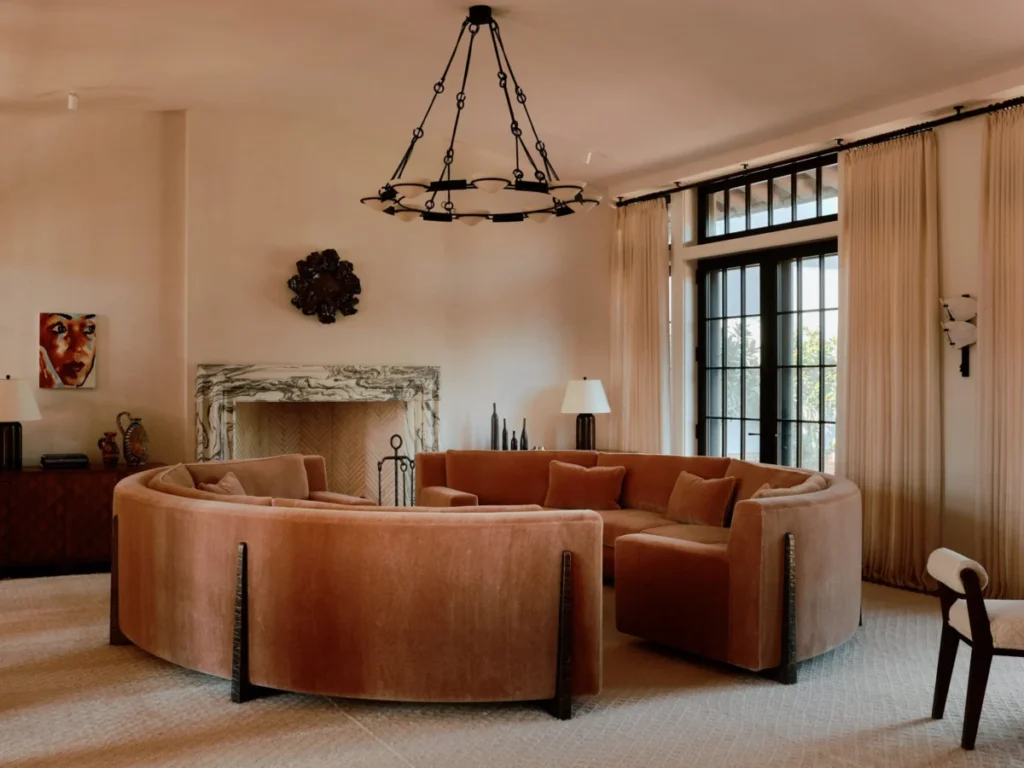
The foyer sets the tone for the residence, featuring a vintage marble console and 1940s Gio Ponti vessels. In the "summer sitting room," the design team moved away from formal seating arrangements, opting instead for a custom curved sofa and 1970s rocking chairs upholstered in Pierre Frey fabric. This emphasis on "enveloping" spaces is further seen in the living room, where O’Sullivan designed a "conversation pit" consisting of two semicircular sofas in apricot-tinted mohair. These design choices reflect a broader shift in high-end residential design toward "functional luxury"—spaces that are visually stunning but also durable and inviting for daily use.

The Intersection of Hospitality and Domestic Life
One of the project’s most successful aspects is the integration of hospitality-level amenities within a family home. The ground floor features a dedicated cocktail bar, an element the homeowner specifically requested to feel "sexy and surprising." Wrapped in crimson brocatelle fabric from Métaphores and featuring a custom velvet banquette, the bar has become a central hub for dinner parties and social gatherings.

The homeowner noted that O’Sullivan’s background in hotel design was a significant asset. "I loved that they did hospitality; it gives you discipline in terms of budget, execution, and timing," she remarked. This professional rigor is evident in the layout of the 15,000-square-foot space, which manages to feel intimate despite its size. From the mezzanine home office with its custom brass and walnut desk to the basement level featuring bunk beds for sleepovers and a Togo sectional sofa by Michel Ducaroy, every square foot is programmed for specific family needs.

Landscape as Architecture: The Nevins-Jekyll Connection
The relationship between the house and its grounds was managed by Deborah Nevins, a landscape architect known for her ability to create naturalistic, deeply layered environments. Her work on this estate draws a direct line back to the collaboration between Sir Edwin Lutyens and Gertrude Jekyll, the legendary British garden designer. Jekyll and Lutyens pioneered the idea that the garden should be an "outdoor room" that reflects the architectural language of the house.

Nevins established a dialogue between the structure and the plantings through an orangerie-style gallery. This sun-drenched hallway, featuring brick floors and French doors, opens onto a garden filled with lemon trees and meticulously planned vistas. The gallery has become the homeowner’s favorite part of the house, offering a transition zone that feels both interior and exterior. Additionally, the estate features a swimming pool with a unique conceptual twist: the bottom is painted with a work by the late artist Lawrence Weiner, a project overseen by art consultant Ivy Shapiro.

Broader Implications for the Hamptons Design Market
This project arrives at a time when the Hamptons real estate market is seeing a move toward more architecturally diverse and historically informed new builds. For decades, the "McMansion" or standard shingle-style home dominated the East End. However, this Lutyens-inspired estate suggests a growing appetite for homes that offer a narrative and a connection to global design history.

The project also highlights the increasing globalization of the interior design industry. The homeowner’s decision to source a designer from London via social media reflects a shift in how high-net-worth individuals curate their design teams. By bypassing local conventions and seeking out a specific aesthetic "fluency," homeowners are creating residences that are unique and highly personalized.

Conclusion: A Modern Interpretation of Memory
Ultimately, this Hamptons home is a testament to the idea that memory and history can enrich modern life without making it feel dated. It is not a "period piece" but a vibrant, living environment that uses the past as a springboard for contemporary innovation. By combining the architectural rigor of Kligerman Architecture & Design with the creative whimsy of Bryan O’Sullivan and the naturalistic vision of Deborah Nevins, the project stands as a definitive example of transatlantic collaboration. It proves that when the "quiet perfection of proportion" is met with "the surprise of the new," the result is a residence that is both historically significant and perfectly suited for the rhythms of a modern family.