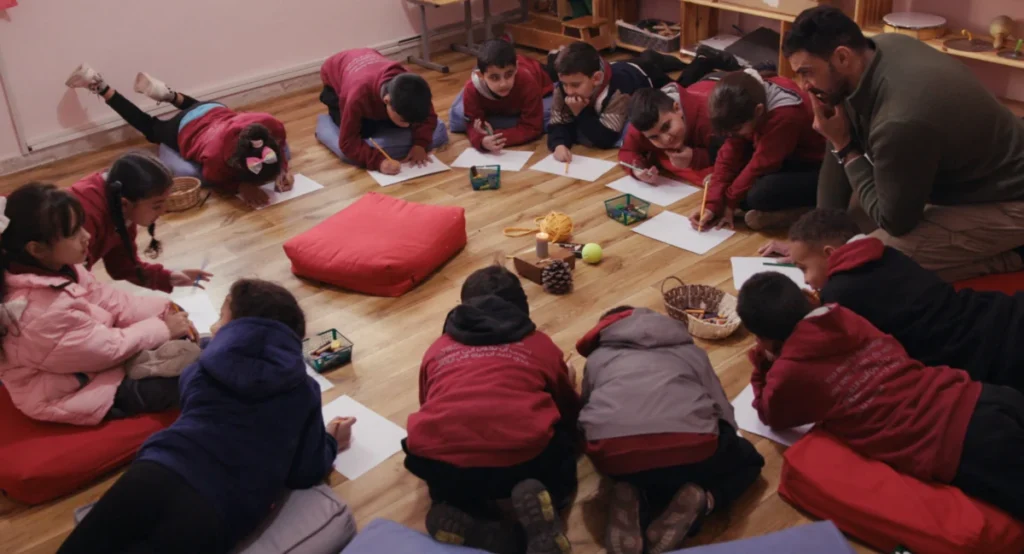

Marjolein Busstra’s compelling documentary, House of Hope, a poignant exploration of non-violent resistance in the occupied West Bank, has been awarded the prestigious Best International Feature Documentary prize at the Hot Docs Canadian International Documentary Festival. The significant win, announced on Friday night, immediately propels the Palestine-Netherlands co-production into contention for the Academy Awards, qualifying it for consideration in the highly competitive Best Documentary Feature category. The film, which had its world premiere at the esteemed IDFA festival in Amsterdam, delves into the lives of a Palestinian couple dedicated to teaching young students the principles of non-violent resistance within the confines of an elementary school, offering a powerful narrative of resilience and hope amidst challenging circumstances.
A Glimpse into the ‘House of Hope’ and its Profound Message
House of Hope transcends mere observation, immersing viewers in the daily lives of its protagonists, a Palestinian couple who have chosen education as their primary tool for advocacy and change. Their elementary school in the occupied West Bank serves as more than just a place of learning; it is a sanctuary where children are nurtured in an environment that champions peace, understanding, and the strategic application of non-violent principles. In a region often characterized by conflict and tension, the film highlights the extraordinary courage and unwavering commitment of individuals who believe in the transformative power of education and peaceful protest. The documentary meticulously captures the nuances of their teaching methods, showing how they empower young minds to understand their rights, articulate their grievances, and pursue justice without resorting to violence. This includes fostering critical thinking, promoting empathy, and encouraging creative expression as forms of resistance. The film thus offers a rare and intimate look at the human spirit’s capacity for hope and defiance in the face of adversity, making a compelling case for the enduring relevance of non-violent action.
The occupied West Bank, a territory central to the Israeli-Palestinian conflict, has been under Israeli occupation since 1967. Life for Palestinians in this region is marked by significant restrictions on movement, limited access to resources, and the constant presence of military checkpoints and settlements. Within this complex socio-political landscape, educational initiatives like the one depicted in House of Hope become vital bastions of cultural preservation and identity formation. Busstra’s film skillfully navigates these sensitivities, providing essential background context without editorializing, allowing the narrative of the couple and their students to speak for itself. The documentary underscores that "non-violent resistance" in this context is not a passive surrender but an active, strategic, and deeply ethical choice to challenge occupation through methods that uphold human dignity and international law. For instance, the film may show students learning about historical figures of non-violence, engaging in community-building activities, or practicing peaceful demonstrations, all within the framework of their elementary education.
The film’s journey, from its world premiere at IDFA (International Documentary Film Festival Amsterdam)—one of the world’s most prestigious documentary festivals known for showcasing groundbreaking non-fiction cinema—to its triumph at Hot Docs, signals its critical acclaim and universal resonance. Its qualification for the Academy Awards is not merely an accolade for Marjolein Busstra and her team; it represents a significant opportunity for the story of these Palestinian educators and their students to reach a truly global audience. An Oscar nomination, or even a win, would dramatically increase the film’s visibility, potentially influencing public discourse, fostering greater understanding of the Palestinian experience, and inspiring similar initiatives worldwide. It also highlights the growing importance of documentaries in shedding light on complex geopolitical issues and humanizing the narratives often obscured by headlines.
Hot Docs: A Beacon for Documentary Filmmaking
The Hot Docs Canadian International Documentary Festival, celebrating its 31st edition this year, stands as North America’s largest and most influential documentary film festival. Established in 1993, the festival has grown exponentially, becoming a crucial platform for filmmakers, industry professionals, and audiences alike to engage with the art and craft of non-fiction storytelling. Each year, it showcases hundreds of films from Canada and around the globe, covering a vast spectrum of subjects, from pressing social issues to intimate personal stories, scientific discoveries, and cultural explorations. Hot Docs is not just a screening event; it is also a vital marketplace, hosting the Hot Docs Industry Forum, which facilitates co-production deals, sales, and networking opportunities that are instrumental for the funding and distribution of documentary projects worldwide.
The festival’s commitment to fostering a vibrant documentary community is evident in its diverse programming, robust industry initiatives, and its significant impact on the international documentary landscape. A win at Hot Docs, particularly in a top jury prize category like Best International Feature Documentary, carries immense prestige and often serves as a powerful launchpad for films seeking wider distribution and awards recognition. The festival’s rigorous selection process, overseen by experienced programmers and adjudicated by esteemed juries composed of filmmakers, critics, and industry leaders, ensures that only the most compelling and expertly crafted documentaries receive its coveted awards. Past winners and selections from Hot Docs have frequently gone on to achieve significant international success, including Oscar nominations and wins, underscoring the festival’s role as a reliable barometer for excellence in documentary filmmaking. Its annual timing, typically in late April and early May, positions it perfectly in the documentary festival circuit, following major events like Sundance and preceding others, allowing for a strategic flow of new and impactful films into the global consciousness.
Other Notable Victories at the 2024 Hot Docs Festival
While House of Hope captivated the international jury, the festival celebrated a diverse array of documentary excellence across various categories, highlighting the depth and breadth of contemporary non-fiction cinema.
The prize for Best Canadian Feature Documentary was awarded to Saigon Story: Two Shootings in the Forest Kingdom. Directed by the Oscar-nominated filmmaker Kim Nguyen, known for his work on Rebelle (War Witch), the film delves into a complex narrative that connects two families through the lens of Eddie Adams’ iconic, Pulitzer Prize-winning photograph from the Vietnam War. Adams’ "Saigon Execution" photo, taken in 1968, depicted a South Vietnamese general executing a Viet Cong prisoner, becoming a powerful symbol of the war’s brutality. Nguyen’s documentary embarks on a profound investigation, tracing the reverberations of this single, indelible image through generations and across continents, exploring themes of legacy, memory, and the lasting impact of conflict on individual lives and collective histories. The film’s intricate storytelling and sensitive approach to a historically charged subject earned it high praise from the Canadian jury.
The Best Emerging International Filmmaker trophy was presented to Dawood Hilmandi for his film Paikar. Another strong showing from the Netherlands, Paikar offers a deeply personal and reflective account of a filmmaker’s life in exile. Hilmandi, who fled Iran and Afghanistan, now resides in Amsterdam, from where he critically examines his past and present, the experience of forced migration, and the complexities of building a new identity while grappling with the loss of one’s homeland. The documentary is celebrated for its intimate perspective, poetic narrative, and its ability to humanize the often-abstract concept of the refugee crisis, providing a vital counter-narrative to prevalent stereotypes. It underscores the universal human desire for belonging and the resilience required to navigate displacement.
Further recognition included the Special Jury Prize for a Canadian Feature Documentary, which went to Banchi Hanuse for Ceremony. This powerful film sheds light on an indigenous community in Canada’s remote northern regions, exploring their cultural practices, traditions, and the challenges they face in preserving their heritage in the modern world. Ceremony had previously garnered an audience prize at the SXSW festival, indicating its strong emotional appeal and critical resonance with diverse viewers. Hanuse, a member of the Nuxalk Nation, brings an authentic and deeply empathetic voice to her storytelling, contributing significantly to the growing body of Indigenous cinema that seeks to reclaim narratives and foster understanding.
The Special Jury Prize for an International Feature Documentary was awarded to Heidrun Holzfeind for The 49th Year. This unique documentary presents a profound reflection on radicalism, imprisonment, and personal transformation through the eyes of an anarchist who has been incarcerated since 1980. The film utilizes a series of letters penned by the protagonist over decades, offering an intimate and unfiltered glimpse into his evolving philosophies, regrets, and steadfast beliefs. The 49th Year challenges viewers to confront complex questions about justice, political dissent, and the passage of time within the confines of a correctional system, providing a rare window into a life lived outside societal norms and within the institutional framework.
In the realm of social impact, the Best Social Impact Documentary trophy was jointly awarded to directors Chul Young Cho, Shin Wan Kim, and Jong Woo Kim for The Seoul Guardians. Hailing from South Korea, the film is set against the backdrop of protests over martial law declared in 2024, depicting a night of chaos and collective citizen resistance. While the specific events of 2024 are presented within the film’s narrative, drawing on South Korea’s historical experiences with authoritarianism and robust pro-democracy movements, the documentary captures the raw energy and profound implications of civic action in defense of democratic principles. It serves as a powerful testament to the enduring spirit of collective defiance and the critical role citizens play in shaping their political destiny, resonating with a nation that has a deep history of popular uprisings against oppressive regimes.
The festival also announced that its highly anticipated audience award winners would be unveiled on May 3. Audience awards, voted on by festival attendees, often reflect a film’s broader popular appeal and emotional impact, adding another layer of recognition to the critical acclaim bestowed by the juries.
Broader Implications for Documentary Filmmaking and Global Discourse
The diverse and impactful slate of winning films at Hot Docs 2024 underscores the vital role that documentary filmmaking plays in contemporary global discourse. Films like House of Hope, Paikar, and The Seoul Guardians exemplify how non-fiction cinema can transcend geographical boundaries to shed light on complex geopolitical realities, humanize marginalized communities, and challenge dominant narratives. These films serve as powerful tools for raising awareness, fostering empathy, and stimulating critical dialogue on issues ranging from occupation and displacement to indigenous rights and democratic resistance.
The success of international co-productions, as seen with House of Hope (Palestine-Netherlands) and Paikar (Netherlands), highlights the collaborative spirit within the documentary community and the benefits of diverse perspectives in storytelling. Such collaborations often enable filmmakers to access broader funding, distribution networks, and a wider range of creative and technical expertise, ultimately enriching the final product and enhancing its global reach. This collaborative model is increasingly crucial for bringing nuanced and authentic stories from regions facing significant socio-political challenges to the international stage.
Moreover, the recognition of films addressing indigenous narratives (Ceremony) and personal reflections on political history (The 49th Year) signals a growing appreciation for diverse storytelling forms and subjects. These films contribute significantly to cultural preservation, historical understanding, and the ongoing dialogue about social justice and human rights. Festivals like Hot Docs are not merely showcases for finished works but critical incubators for ideas, providing platforms where these important stories can gain traction and influence public opinion.
Looking ahead, House of Hope‘s qualification for the Academy Awards marks a significant moment for the film and for the representation of Palestinian narratives on a global platform. The journey towards an Oscar nomination is arduous, involving extensive campaigning and critical scrutiny, but the Hot Docs win provides invaluable momentum. Should it secure a nomination, it would undoubtedly amplify the film’s message of non-violent resistance and human resilience to an unparalleled audience, potentially inspiring further dialogue and action. The collective success of the films celebrated at Hot Docs 2024 reaffirms the enduring power of documentary cinema to inform, provoke, and ultimately, to inspire change in a world grappling with multifaceted challenges.