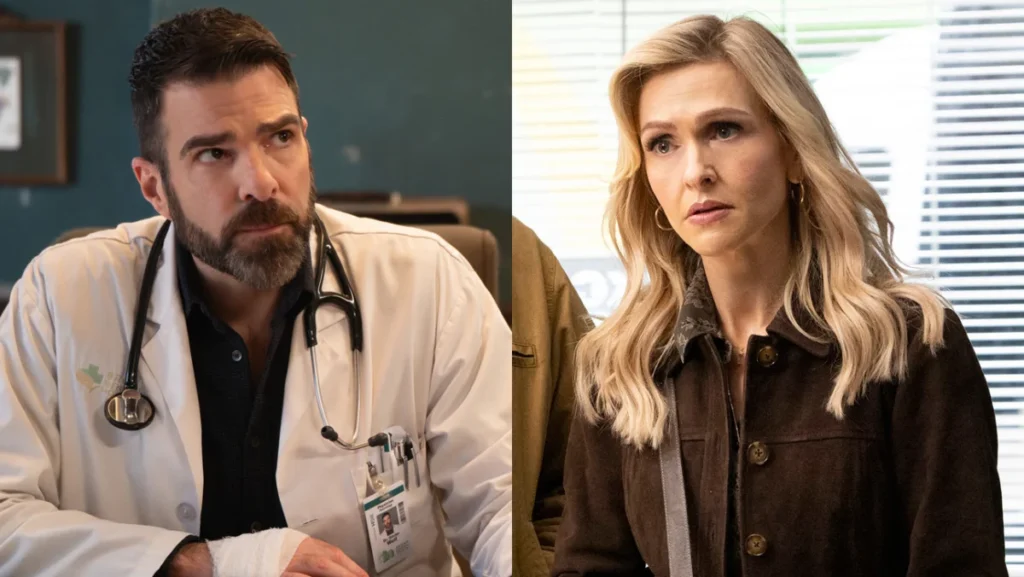

NBC has officially announced the cancellation of two scripted series, the medical drama Brilliant Minds and the mockumentary comedy Stumble, just weeks before its crucial annual upfront presentation to advertisers. This move clears the network’s slate and signals a strategic recalibration as it prepares to unveil its programming schedule for the upcoming 2026-27 season. The decisions underscore the cutthroat nature of network television, where even shows with established talent struggle to find an audience in an increasingly fragmented media landscape.
The End of the Line: Key Cancellations
The medical drama Brilliant Minds, starring Zachary Quinto, will conclude after its second season. The network had previously signaled its dwindling confidence in the series by pulling it from its coveted post-Olympics schedule earlier in the year. Its remaining, and now final, episodes are slated to air during the summer programming block, beginning May 27. The series, loosely based on the compelling work of neurologist Oliver Sacks, attempted to blend intricate medical cases with character-driven storytelling but ultimately failed to secure the viewership necessary for renewal.
Concurrently, the freshman comedy Stumble, a mockumentary centered on a college cheer squad and its determined coach portrayed by Jenn Lyon, has been canceled after a single season. The series, which aimed to capture the comedic essence of competitive subcultures, aired its final episode in March. Despite its unique premise and a cast including Taran Killam and a recurring role for Kristin Chenoweth, Stumble struggled to break through the crowded comedy market.
These cancellations are not isolated incidents but rather reflective of the ongoing performance evaluation that all major broadcast networks undertake ahead of the upfronts, a pivotal event where networks present their new and returning shows to advertisers. The timing allows NBC to finalize its schedule and make room for a new slate of pilots, several of which are currently in contention for the next season.
A Chronology of Performance and Decisions
The journey for both Brilliant Minds and Stumble highlights the precarious path of new series on network television.
Brilliant Minds was an ambitious project from its inception. Created by Michael Grassi, the drama aimed to explore the complexities of the human brain through the lens of a brilliant neurologist, drawing inspiration from the real-life work of Oliver Sacks. The series, a co-production between Warner Bros. Television and Universal Television, launched with a strong lead in Zachary Quinto, a known entity for audiences. Its first season garnered moderate attention, but maintaining audience engagement proved challenging. The initial decision by NBC to remove it from its post-Olympics schedule, a slot often used to boost new or struggling series with a high-profile lead-in, was a clear indicator of the network’s concerns regarding its performance trajectory. This pre-upfront move essentially served as a soft cancellation, setting the stage for the official announcement.
Stumble, produced by Universal TV, entered the scene with a different challenge: establishing a fresh comedic voice. Mockumentaries, while having a proven track record of success with shows like The Office and Parks and Recreation, require a delicate balance of humor, character development, and relatable situations. Created and executive produced by Jeff and Liz Astrof, alongside Jeff Blitz, Dana Honor, and Monica Aldama, the series sought to tap into the high-stakes world of collegiate cheerleading. Despite a talented ensemble cast and the recurring presence of Kristin Chenoweth, the show struggled to build a consistent viewership base throughout its single season, leading to its quiet conclusion in March and the subsequent confirmation of its cancellation.
These decisions are part of a broader pattern of content curation by NBCUniversal, balancing the need for linear viewership with the growing demands of its streaming platform, Peacock. Every slot on the broadcast schedule is valuable, and underperforming series are often the first to go when new content is being evaluated.
The Ratings Imperative: A Deeper Dive
The primary driver behind these cancellations, as is almost always the case in network television, was viewership. Both Brilliant Minds and Stumble were identified as among NBC’s least-watched scripted series of the current season.
Brilliant Minds averaged "just above 3 million viewers" when accounting for seven days of linear viewing (Live+7). This metric, which includes DVR playback within a week of the original broadcast, is a more comprehensive measure than live-same-day ratings but still reflects a significant challenge. For context, established network dramas often aim for 5-7 million viewers or more in this metric, especially when factoring in the crucial 18-49 demographic (which, while not provided for these specific shows, is typically low for underperforming series). The fact that Brilliant Minds recorded a smaller total than any other drama on NBC this season underscores its difficulty in attracting and retaining an audience in a competitive landscape dominated by long-running procedural franchises.
Stumble fared even less favorably, coming in at an average of 2.24 million viewers (Live+7). This figure places it at the lower end of network comedy performance. Comedies, especially those without strong lead-ins or established fan bases, often struggle to gain traction, and Stumble‘s numbers reflect the steep climb it faced.
These linear viewership figures, while still important for advertisers buying commercial slots, tell only part of the story in today’s multiplatform environment. Networks are increasingly looking at total audience across linear, DVR, and streaming platforms like Peacock. However, strong linear performance often translates to better streaming engagement, and a weak linear showing can indicate broader disinterest. The advertising model for broadcast television still heavily relies on these traditional viewership metrics, making low numbers a direct threat to a show’s financial viability. When a show consistently fails to deliver a substantial audience, the cost of production outweighs the revenue generated, making cancellation an inevitable business decision.
Industry Reactions and Inferred Statements
While official statements from NBC typically remain concise regarding cancellations, the underlying rationale is clear: strategic portfolio management driven by audience engagement and financial viability. An NBC executive, speaking on background, might emphasize the network’s ongoing commitment to delivering compelling content while also making tough, data-driven decisions necessary to maintain a robust and competitive schedule. The focus would invariably shift to the promising new pilots and the strength of the network’s returning flagship series.
From the perspective of the production studios, Warner Bros. Television and Universal Television, cancellations represent a loss of potential future revenue and a shift in focus for their creative teams. While the immediate impact is a cessation of production, studios are always developing new projects and would quickly pivot to pitching fresh concepts to NBC and other networks or streamers. For the creators, Michael Grassi (for Brilliant Minds) and Jeff and Liz Astrof (for Stumble), and the respective casts and crews, the news signifies the end of one chapter and the beginning of the search for new opportunities. Talented individuals like Zachary Quinto and Jenn Lyon are likely to quickly find new roles, but the broader crew faces the more immediate challenge of job insecurity.
Industry analysts would likely interpret these cancellations as standard operating procedure for a network preparing for its upfronts. "NBC, like its competitors, is in a constant battle for eyeballs," comments one anonymous television analyst. "When a show consistently underperforms, especially in a competitive genre, it becomes a liability. The decision to cut these shows, particularly before the upfronts, is a clear signal that NBC is serious about revitalizing its schedule and investing in content that can deliver stronger returns across all platforms, including Peacock." The analyst would also highlight the trend of networks ordering more pilots, indicating a greater willingness to experiment in hopes of finding the next big hit.
Broader Impact and Implications for NBC’s Future
The cancellation of Brilliant Minds and Stumble has significant implications for NBC’s overall programming strategy and its competitive standing in the evolving media landscape.
Firstly, it creates valuable open slots on the schedule. NBC still has three other shows awaiting their fate for the 2026-27 season: the long-running procedural drama Law & Order, the newer drama The Hunting Party, and the first-year comedy The Fall and Rise of Reggie Dinkins. The network’s decisions on these series, especially Law & Order, will further shape its upcoming schedule. The network’s strategy appears to be a blend of relying on its established, highly successful franchises—like the Law & Order and Chicago universes—while actively seeking new content that can break through.
The news that NBC has ordered eight pilots—a higher than usual number for recent years—is a strong indicator of this aggressive search for new blood. This increased investment in development suggests that the network is keen to refresh its lineup and is willing to take more swings at finding a breakout hit. This could mean exploring new genres, formats, or focusing on talent that can attract a broader audience across both linear television and the Peacock streaming service. The network is likely looking for shows that resonate not just with older linear viewers but also with younger demographics who are increasingly gravitating towards streaming.
The broader context is the ongoing shift in television consumption. Linear viewership continues to decline across all networks, making it harder for new shows to find a foothold. NBCUniversal’s dual strategy of maintaining a strong broadcast presence while investing heavily in Peacock means that shows must ideally perform well enough on linear to justify their production costs AND drive subscriptions or engagement on the streaming platform. Cancellations like these free up budget and creative resources that can be reallocated to either more promising linear pilots or exclusive content for Peacock, signaling a unified content strategy.
For NBC, these cancellations are not merely about removing underperforming shows but are a strategic maneuver to optimize its content portfolio for maximum impact ahead of its May 11th upfront presentation. The network will aim to present a compelling vision for its future, one that balances the comfort of beloved franchises with the excitement of new, potentially groundbreaking series, all while navigating the complex financial realities of a media industry in constant flux. The success of this strategy will be measured not just in linear ratings but in the overall health of the NBCUniversal entertainment ecosystem.
For those tracking the dynamic world of network television, keeping an eye on these developments is crucial. The Hollywood Reporter‘s network scorecard for 2026 remains an essential resource for monitoring all broadcast cancellations, renewals, and new series pickups as the industry moves forward.