
The cinematic world mourns the loss of Dean Tavoularis, the legendary production designer whose unparalleled craft transformed film sets into immersive artistic landscapes, who passed away on Thursday at the age of 93. Tavoularis, an artisan who transcended his role to become an artist, left an indelible mark on some of the most iconic films in history, including Bonnie and Clyde, The Godfather trilogy, and Apocalypse Now. His passing signifies the departure of a pivotal figure whose work defined an era of American filmmaking, ushering in a new standard of realism and psychological depth in visual storytelling.
From Humble Beginnings to Disney’s Creative Crucible
Born the son of Greek immigrants, Dean Tavoularis’s early life unfolded against the stark backdrop of the Great Depression, a period that undoubtedly shaped his pragmatic approach to artistry. His journey into the visual arts began with a youthful ambition to paint, a dream he would eventually realize in his later years. Before becoming a titan of production design, Tavoularis honed his skills during a formative period at Walt Disney Studios in the 1950s. Here, he served as a budding animator and later an assistant art director, often working directly under the discerning eye of Walt Disney himself. This apprenticeship exposed him to the meticulous detail and imaginative world-building inherent in animation, providing a foundational understanding of visual narrative and the precise execution required to bring fantastical visions to life. The Disney studio, with its emphasis on intricate storyboarding and character design, instilled in Tavoularis a discipline that would prove invaluable in his later career, even as he gravitated towards the gritty realism of live-action cinema.
The Dawn of New Hollywood: Redefining Realism

The late 1960s marked a seismic shift in American cinema, giving rise to the "New Hollywood" era. This period challenged the conventional studio system, prioritizing auteur directors and a more gritty, authentic approach to storytelling. Tavoularis, with his burgeoning talent and dissatisfaction with the artificiality of traditional studio sets, was perfectly positioned to become a vanguard of this movement. His breakthrough came with Arthur Penn’s seminal 1967 film, Bonnie and Clyde, a project that cemented his reputation as a revolutionary production designer.
At the time, the role was still primarily credited as "art director," but Tavoularis’s contributions were unequivocally that of a production designer, responsible for the overall visual concept of the film. For Bonnie and Clyde, Tavoularis rejected the confines of the Warner Bros. backlot. Instead, he meticulously scouted and photographed the actual Texas towns where Bonnie Parker and Clyde Barrow committed their infamous robberies in the 1930s. This commitment to on-location shooting was a radical departure from studio norms, infusing the film with an unprecedented sense of authenticity. He also consciously designed the film’s interiors to reflect the characters’ desperate circumstances, employing deliberately low ceilings to create a feeling of claustrophobia and entrapment within their "crummy hotels." This innovative approach directly challenged the prevailing "beefed up" aesthetic of older Hollywood productions, where oversized décor was believed necessary for the camera to "pick it up" – a notion Tavoularis dismissed as "100% bullshit." His work on Bonnie and Clyde was instrumental in shifting American cinema from illusion to realism, from the grandiosity of old Hollywood to the stark veracity of the streets.
A Legendary Collaboration: Dean Tavoularis and Francis Ford Coppola
Tavoularis’s career reached its zenith through his prolific and profoundly impactful collaboration with director Francis Ford Coppola, a partnership that spanned an astonishing 13 feature films. This enduring creative synergy yielded some of cinema’s most enduring visual masterpieces, showcasing Tavoularis’s versatility and his profound ability to translate a director’s vision into tangible, evocative spaces.
The most iconic fruit of this collaboration is undoubtedly The Godfather trilogy. For the Corleone saga, Tavoularis masterfully crafted a world that was simultaneously opulent and menacing, capturing the old-world grandeur and moral decay of a powerful crime family. From the dark, richly appointed interiors of Don Corleone’s office, exuding authority and hidden menace, to the sun-drenched Sicilian landscapes and the bustling streets of Little Italy, every set piece contributed to the saga’s immersive atmosphere. His designs for The Godfather (1972) and The Godfather Part II (1974) were crucial in establishing the films’ timeless aesthetic, earning widespread critical acclaim and solidifying their place in cinematic history. These films, widely considered among the greatest ever made, owe much of their visual power to Tavoularis’s meticulous attention to historical detail and his understanding of how environments shape character and narrative.

The collaboration continued with the epic and famously challenging production of Apocalypse Now (1979). For this harrowing journey into the heart of darkness, Tavoularis was tasked with creating surreal, nightmarish landscapes that mirrored the psychological disintegration of its characters. His designs for Colonel Kurtz’s temple, a monolithic and terrifying structure deep within the Cambodian jungle, became an iconic symbol of the film’s descent into madness. The sheer scale and logistical complexity of building these environments in challenging real-world locations underscored Tavoularis’s philosophy that "the job is roughly 20% creativity and 80% logistics." It was on the set of Apocalypse Now that Tavoularis met his future wife, the French actress Aurore Clément, further intertwining his personal and professional life with the fabric of his most ambitious projects.
His work with Coppola extended to other critically acclaimed films, including the paranoid thriller The Conversation (1974). Here, Tavoularis demonstrated his ability to create subtle, psychologically resonant spaces, meticulously crafting the isolated and increasingly claustrophobic world of surveillance expert Harry Caul.
The Art of Unseen Detail and Radical Experimentation
Tavoularis’s genius lay not only in grand, sweeping designs but also in his obsessive attention to minute, often unseen, details that profoundly enhanced the authenticity and psychological depth of his films. This commitment to realism extended far beyond what the camera explicitly captured.
A striking example of this meticulousness comes from his work on Roman Polanski’s Carnage (2011), his final film. The movie takes place entirely within a Brooklyn condo, which Tavoularis masterfully recreated on a soundstage outside Paris. To ensure absolute verisimilitude, every furnishing, down to doorknobs, light fixtures, and electrical outlets, was shipped from the United States. Even more remarkably, American appliances were imported, necessitating the rewiring of the entire set to accommodate a US-compatible circuit – all for the slim possibility that Jodie Foster’s character might use a hairdryer in the bathroom. Such an extreme dedication to detail exemplifies his belief that authenticity, even if unseen, contributes to the overall immersive experience for both actors and audience.

Beyond realism, Tavoularis was also a master of cinematic experimentation. One of his most memorable and mesmerizing contributions was the series of slow-motion explosions that conclude Michelangelo Antonioni’s 1970 countercultural film, Zabriskie Point. This sequence, depicting the destruction of a desert house and various consumer goods, served as a powerful visual metaphor for the anti-establishment sentiment of the era. Tavoularis, largely left to his own devices for this sequence, orchestrated the construction of a life-size model house in the Arizona desert, which was then spectacularly blown up. He also oversaw the destruction of televisions, tomatoes, and even raw chickens on the MGM backlot, stuffing explosives, compressed air, and gas jets into sewer pipes to achieve the desired effect. This radical fusion of practical effects and symbolic imagery showcased Tavoularis’s willingness to push cinematic boundaries, embodying the raw, experimental spirit of New Hollywood.
His dedication to "unseen details" extended to actor immersion. For The Conversation, Tavoularis subscribed Harry Caul’s character to dozens of periodicals before filming began, placing them in desk drawers on set. When Gene Hackman first arrived, he discovered these spy magazines with his character’s name on the mailing labels. While never explicitly filmed, Tavoularis believed this subtle immersion could "do something to him as an actor." Similarly, for William Friedkin’s The Brink’s Job, he had his art department crush garlic and oregano onto the floor of an Italian grocery store set, ensuring it smelled authentically like a real market. Even in costume design, a role he took on for Apocalypse Now, he insisted on filling actors’ pockets with character-appropriate items like Tums or heavy keys to enhance their physical and psychological portrayal. These ingenious concepts, often unnoticed by the casual viewer, underscore the profound depth of his artistry.
Tributes, Legacy, and a Life Lived in Art
Dean Tavoularis was held in the highest esteem by his collaborators, including Francis Ford Coppola, Warren Beatty, cinematographer Vittorio Storaro, and costume designer Milena Canonero. Coppola, reflecting on their extensive partnership, once remarked, "Everything that people see in a movie, as opposed to hear, comes from a collaboration with the production designer." He further praised Tavoularis’s ability to create "brilliant visual ideas of illusion," recognizing his unique blend of creativity, meticulous research, and willingness to experiment. The consistent praise from such revered figures underscores Tavoularis’s status as a pivotal creative force, not merely a technician.
Tavoularis, alongside figures like the great Richard Sylbert (Chinatown), is celebrated as a conceptual artist whose visual creations fundamentally altered American cinema. He championed a shift towards authentic, psychologically driven environments, moving away from the artificiality of earlier studio productions. His work demonstrated how production design could be a powerful narrative tool, subtly influencing audience perception and deepening character understanding.

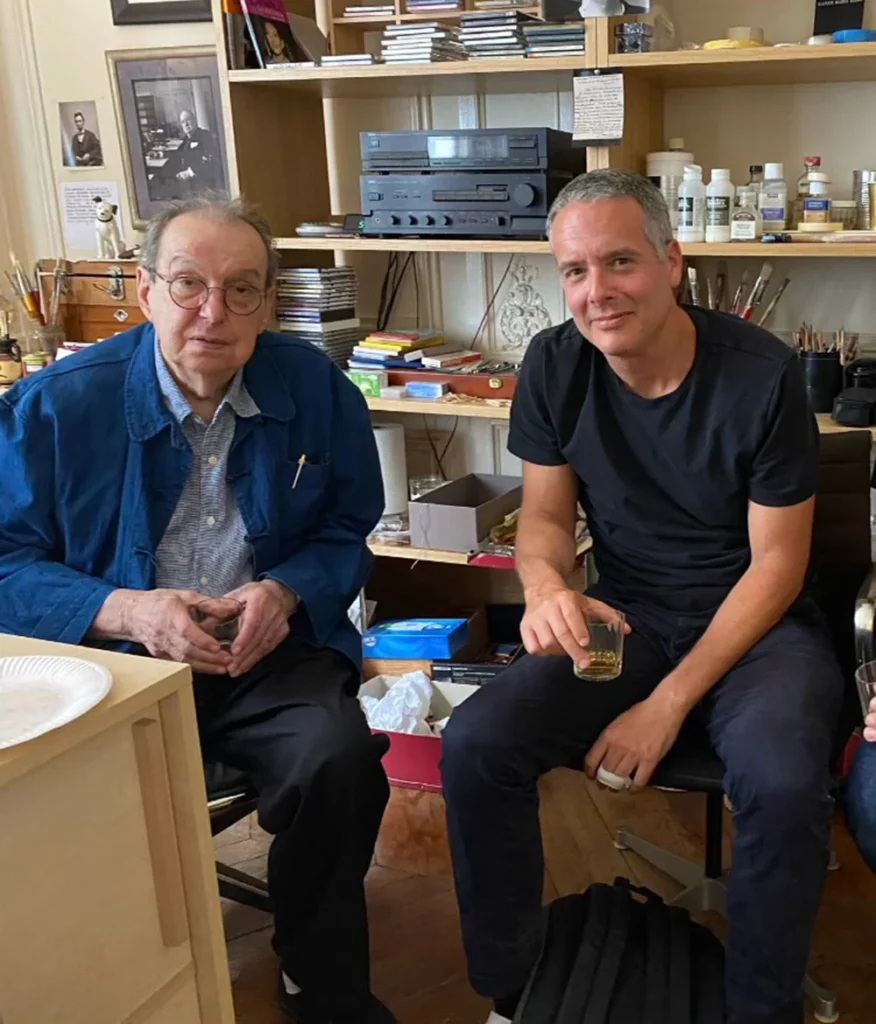
In his later years, after selling his gorgeous Hancock Park home in 2020, Tavoularis moved permanently to Paris with his wife, Aurore Clément. There, he fulfilled a lifelong dream, converting a ground-floor apartment in the calm 17th arrondissement into an artist’s studio. Surrounded by paint, turpentine, brushes, and canvases, he spent his days painting, a return to his earliest artistic aspirations. The author of this article, Jordan Mintzer, had the privilege of spending countless hours with Tavoularis in this studio, resulting in a book, "Conversations with Dean Tavoularis," which delves into his remarkable career. These discussions, often accompanied by scotch and Fritos imported from the U.S., continued until just weeks before his passing. Tavoularis, sharp and humorous even in his late 80s, shared insights into his craft and his life, famously quipping, "How do you think we made all these movies we’re talking about?" when urged to slow his whiskey consumption.
Dean Tavoularis’s passing marks the end of an era for a true master craftsperson who became an artist, leaving an indelible imprint on the visual language of cinema. His legacy is etched in the enduring imagery of films that continue to captivate audiences worldwide, a testament to his genius, his relentless pursuit of authenticity, and his profound understanding of how to build worlds, seen and unseen, that resonate long after the credits roll. He was not just a designer of sets, but a designer of experiences, a friend, and an enduring inspiration.