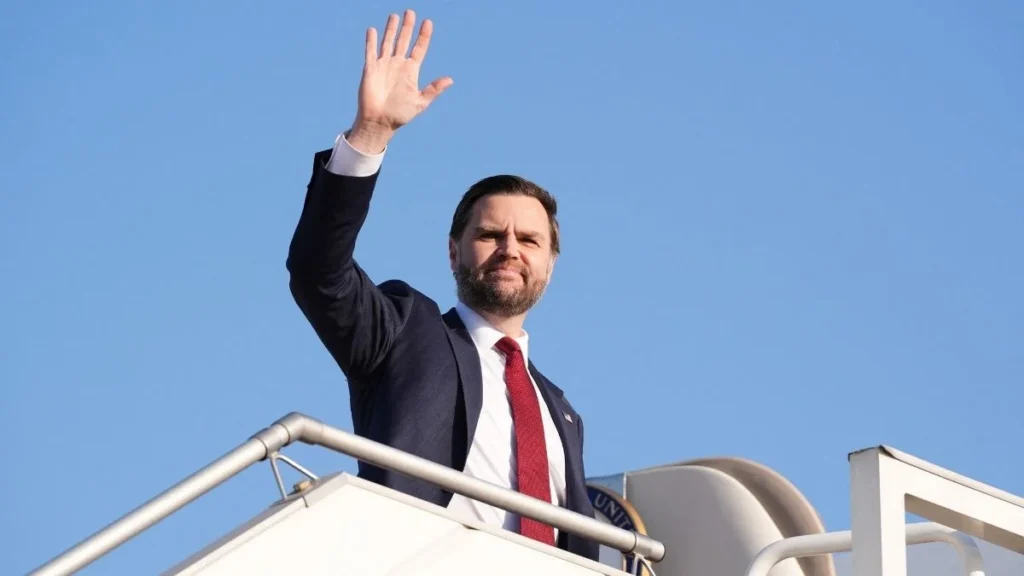

Vice President JD Vance moved to de-escalate a burgeoning diplomatic and ideological rift between the White House and the Holy See on Saturday, signaling a desire for reconciliation after days of public friction. In a social media post shared late on April 18, 2026, Vance expressed gratitude toward Pope Leo for his clarifying remarks regarding a recent sermon that many interpreted as a direct rebuke of President Donald Trump’s military strategy in the Middle East. The Vice President’s intervention comes at a critical juncture for the administration as it navigates the complex geopolitical and domestic fallout of the ongoing conflict with Iran.
The tension reached a boiling point earlier this week following a series of pointed exchanges between the Vatican and the Oval Office. However, following Pope Leo’s statement during his 11-day apostolic journey through Africa—in which he denied any interest in engaging in a political debate with the American president—Vance sought to bridge the gap between the administration’s pragmatic military objectives and the moral mandates of the Catholic Church.
The Genesis of the Conflict: A Clash of Moral and Political Wills
The friction between the Trump administration and the Vatican originated from a sermon delivered by Pope Leo at St. Peter’s Basilica, in which the pontiff addressed the human cost of the Iran war. During the address, the Pope issued a stern warning, suggesting that the divine ignores the prayers of world leaders who prosecute wars with "hands full of blood." While the Pope did not mention President Trump by name, the timing of the remarks—coming just forty-eight hours after a significant escalation in aerial operations over Tehran—led many analysts and media outlets to conclude the message was a direct criticism of U.S. foreign policy.
President Trump responded to the sermon with characteristic vigor on his Truth Social platform. In a series of posts, the President characterized the pontiff’s stance as unrealistic and detrimental to global security. "The Pope should focus on the Church and leave the defense of the civilized world to those of us who actually have to fight the terrorists," Trump wrote, adding that the Vatican was being "WEAK on Crime, and terrible for Foreign Policy."
The exchange immediately sparked a firestorm of media commentary, with critics of the administration accusing the President of alienating a key moral authority, while supporters argued that the Vatican’s "pacifist" stance failed to account for the existential threats posed by the Iranian regime.
Vice President Vance Steps in as Mediator
As a prominent Catholic within the administration, Vice President JD Vance has often served as a liaison between the MAGA movement and religious institutions. His post on X (formerly Twitter) on Saturday night appeared carefully calibrated to validate the Pope’s moral authority while defending the administration’s difficult policy choices.
"I am grateful to Pope Leo for saying this," Vance wrote, referring to the Pope’s refusal to enter a debate. "While the media narrative constantly gins up conflict—and yes, real disagreements have happened and will happen—the reality is often much more complicated. Pope Leo preaches the gospel, as he should, and that will inevitably mean he speaks to the conscience of the world. The President—and the entire administration—work to apply those moral principles in a messy world. He will be in our prayers, and I hope that we’ll be in his."
Vance’s statement is being viewed by political analysts as an attempt to "compartmentalize" the dispute. By framing the Pope’s role as purely spiritual and the President’s role as purely practical, Vance attempted to lower the temperature of a conflict that threatened to erode support among Catholic voters in the United States, a demographic that remains pivotal for the administration’s 2026 midterm prospects.
Chronology of the Dispute: From Sermon to Social Media
The escalation of the feud followed a rapid timeline that gripped international headlines for nearly a week:
- April 12: Pope Leo delivers a Sunday Angelus address focusing on the "tragedy of modern warfare," specifically citing the "bloodied hands" of those who choose weapons over dialogue.
- April 13: The White House Press Secretary is asked for a response; she initially declines to comment, stating the President respects all religious leaders.
- April 14: President Trump releases a statement on Truth Social accusing the Vatican of being "out of touch" with the realities of the Iran conflict.
- April 15: Catholic organizations in the U.S. and Europe issue conflicting statements, with some defending the Pope’s "Just War" doctrine and others supporting the U.S. right to self-defense.
- April 17: During a press conference in Nairobi, Kenya, Pope Leo is asked by reporters if he is "debating" the American president. He clarifies that his remarks were universal and not directed at a specific individual.
- April 18: Vice President Vance issues his statement on X, thanking the Pope and calling for mutual prayer.
Pope Leo’s Clarification from Africa
The cooling of tensions was largely facilitated by the Pope’s own comments during his current tour of the African continent. Speaking to a group of international journalists, Pope Leo expressed frustration with how his message had been distilled into a partisan narrative.
"There’s been a certain narrative that has not been accurate in all of its aspects," the Pope remarked. He emphasized that his role is to speak on global peace from a theological perspective, rather than a geopolitical one. He characterized the media coverage of the spat as "commentary on commentary," suggesting that the original intent of his message had been lost in the shuffle of political punditry.
Crucially, the Pope explicitly stated that he had no desire for a public confrontation with the White House. "And yet as it happens, it was looked at as if I was trying to debate again the president, which is not in my interest at all," he said. This statement provided the necessary "off-ramp" for the administration to move past the controversy without appearing to back down on its military stance.
Supporting Data: The Strategic and Religious Landscape
The stakes of this disagreement are underscored by both the military data coming out of the Iran conflict and the demographic data of the American electorate.
As of April 2026, the U.S.-led coalition has been engaged in "Operation Persistent Shield" for seven months. According to Department of Defense reports, the conflict has seen the deployment of approximately 45,000 U.S. personnel to the region, with casualty figures and civilian displacement reaching levels not seen since the early 2000s. A recent Pew Research Center poll conducted in March 2026 indicated that while 52% of Americans supported the administration’s "Maximum Pressure" military stance, that support dropped to 38% among practicing Catholics, many of whom cited the Vatican’s calls for peace as a factor in their skepticism.
Furthermore, internal administration memos leaked earlier this year suggested that the "religious vote" is considered a critical pillar for the upcoming legislative sessions. In states like Pennsylvania, Ohio, and Wisconsin—Vance’s home turf—the Catholic vote represents nearly 25% of the active electorate. A prolonged war of words with the Holy See was viewed by Republican strategists as a significant political liability.
Reactions from Religious and Political Leaders
The reaction to Vance’s mediation has been largely positive among mainstream political circles, though some fringes remains unsatisfied.
Senator Marco Rubio, a key ally of the administration on the Senate Foreign Relations Committee, echoed Vance’s sentiments. "The Vice President is exactly right. We can respect the moral clarity of the Holy Father while also recognizing that the President has a constitutional duty to protect the American people from a regime in Tehran that has repeatedly called for our destruction," Rubio said in a televised interview Sunday morning.
Conversely, some progressive Catholic groups argued that Vance’s response was an attempt to "muzzle" the Pope’s moral authority. "The Vice President is trying to have it both ways," said a spokesperson for Catholics for Global Peace. "You cannot claim to apply moral principles in a ‘messy world’ while ignoring the Pope’s direct plea to stop the bloodshed."
In Rome, Vatican observers noted that the Pope’s "commentary on commentary" remark was a classic diplomatic maneuver intended to maintain the Church’s neutrality while still holding firm to its pacifist roots.
Broader Implications and Future Outlook
The resolution of this specific spat does not necessarily signal an end to the underlying tension between the Trump administration’s "America First" foreign policy and the Vatican’s globalist, humanitarian approach. As the Iran war continues, the moral justifications for military action will likely remain a point of contention.
However, JD Vance’s role in this episode highlights his growing importance as the "diplomatic face" of the MAGA movement. By using his platform to bridge the gap between the President’s combative rhetoric and the Pope’s spiritual concerns, Vance has positioned himself as a pragmatist capable of managing high-stakes cultural and religious conflicts.
For the Trump administration, the goal remains the successful conclusion of military objectives in Iran without alienating the moral and religious base that brought them to power. For Pope Leo, the challenge is to continue preaching a message of peace in a world that is increasingly polarized and militarized.
As the Pope continues his Africa tour and the administration prepares for its next phase of operations in the Middle East, both sides seem content, for now, to let the "debate" rest. As Vance noted in his closing remarks, the hope is that through prayer and mutual respect, the "messy reality" of the world can eventually find a path toward the peace the Pope so frequently advocates.