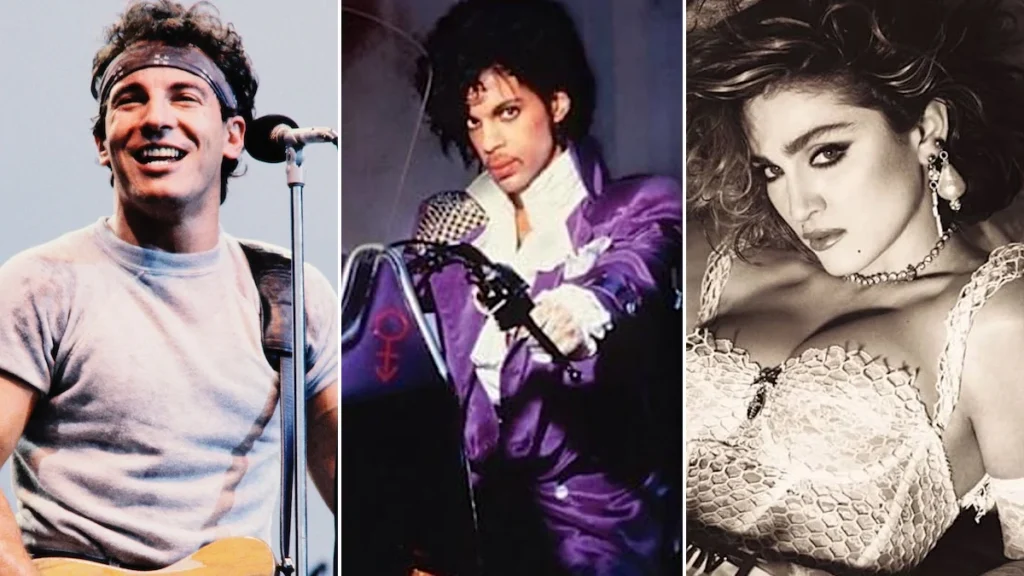

The enigmatic nature of Prince, a musical icon revered for his unparalleled artistry and distinctive persona, continues to unfold through the recollections of those closest to him, even years after his passing. A recent revelation from his onetime drummer, Bobby Z, offers a compelling anecdote that underscores Prince’s unique approach to celebrity interactions, particularly his discomfort with fellow superstars. According to Bobby Z, both Bruce Springsteen and Madonna, two of the most colossal figures in music history, were once denied access to Prince’s private dressing room bathroom, instead being directed to the band’s facilities. This incident, brought to light as the 10th anniversary of Prince’s death approaches, paints a vivid picture of an artist who operated strictly on his own terms, even when faced with industry peers of comparable stature.
The Revelation: A Glimpse into Prince’s Private World
Bobby Z, born Robert Rivkin, who served as the drummer for Prince’s legendary backing band, The Revolution, from 1978 through 1986, shared this insight in a recent interview with The Guardian. The extensive piece, published ahead of the solemn April 21st anniversary of Prince’s passing, gathered reflections from various associates who knew the artist intimately. Bobby Z’s account provides a rare, candid look into Prince’s often-guarded personality, revealing his complex relationship with fame and his peers.
"He found meeting other celebrities very uncomfortable unless he was a fan," Bobby Z recollected, elaborating on the nuanced social dynamics that governed Prince’s interactions. "He could get bashful or embarrassed, or there could be huge stars and he just wouldn’t give them the time of day. So besides shaking Elizabeth Taylor’s hand I don’t know if he’d be interested in chatting." This selective engagement highlights Prince’s deeply personal and artistic criteria for connection, often prioritizing genuine admiration or a sense of creative parity over mere professional courtesy.
The particular incident involving Springsteen and Madonna stands out as a memorable illustration of this characteristic. "Once there was a hilarious moment when Bruce Springsteen and Madonna came backstage but Prince’s dressing room was off limits to them, so they had to use the band’s toilet," Bobby Z recounted. He humorously suggested the scenario "could have very well made a great Chappelle’s Show sketch," referencing Dave Chappelle’s iconic portrayal of Prince. This anecdote, devoid of malice but rich in comedic irony, perfectly encapsulates Prince’s singular approach to his personal space and boundaries, even within the typically open environment of a backstage area where artists often mingle freely.
Chronology of a Legend: Prince’s Legacy and Passing
The timing of Bobby Z’s revelation adds a poignant layer to the narrative, coinciding with the 10th anniversary of Prince Rogers Nelson’s death on April 21st, 2016. His unexpected passing at the age of 57 sent shockwaves across the globe, robbing the music world of one of its most innovative and influential figures. The decade since his death has been marked by continuous tributes, re-evaluations of his vast catalog, and a steady stream of posthumous releases that underscore his prolific genius.
Bobby Z’s tenure with The Revolution spanned a pivotal period in Prince’s career, encompassing the creation of seminal albums like Dirty Mind (1980), Controversy (1981), 1999 (1982), and the cultural phenomenon Purple Rain (1984). As a core member of the band during Prince’s meteoric rise to global superstardom, Bobby Z witnessed firsthand the transformation of a prodigious talent into an unparalleled icon. His insights, therefore, carry significant weight, offering an authentic perspective on the artist behind the mystique. The incident with Springsteen and Madonna likely occurred during this period or shortly thereafter, when all three artists were at or near the zenith of their respective careers, making the backstage dynamic even more intriguing.
Superstars in the Same Orbit: Context of the Incident
To fully appreciate the significance of this anecdote, it’s essential to consider the distinct personas and career trajectories of the three artists involved.
Prince: From his earliest days, Prince cultivated an image of artistic independence and mystique. He was notoriously private, often shunning interviews and public appearances that didn’t directly serve his artistic vision. His creative hub, Paisley Park Studios in Chanhassen, Minnesota, became his sanctuary and fortress, a place where he could control every aspect of his musical output and personal environment. This reclusive tendency, combined with his uncompromising artistic standards, often translated into a guarded approach to social interactions, especially with other celebrities whom he might perceive as rivals or simply as distractions from his creative focus. His discomfort with "meeting other celebrities unless he was a fan" was a defining trait, setting him apart from many peers who embraced the social circuit of the music industry.
Bruce Springsteen: Known affectionately as "The Boss," Bruce Springsteen embodies a different kind of rock stardom. His music, deeply rooted in American working-class narratives, has forged a powerful connection with millions worldwide. Springsteen’s stage presence is legendary for its raw energy and communal spirit, and off-stage, he is often perceived as approachable and grounded. By the time of the reported incident, Springsteen was a colossal figure, having released iconic albums like Born to Run (1975) and Born in the U.S.A. (1984), and was synonymous with stadium-filling, electrifying performances. His persona stood in stark contrast to Prince’s, often favoring direct, heartfelt communication over enigmatic distance.
Madonna: The "Material Girl" and "Queen of Pop," Madonna reinvented the landscape of popular music and celebrity culture throughout the 1980s and beyond. Known for her chameleon-like ability to transform her image and sound, her fierce independence, and her provocative artistry, Madonna built an empire on pushing boundaries. Like Prince, she exerted immense control over her career and image, but she often engaged with celebrity culture on her own terms, embracing its power and visibility. By the late 1980s, Madonna was a global phenomenon, constantly in the media spotlight, making her interaction with Prince’s guarded world particularly noteworthy.
The confluence of these three titans backstage at an unspecified event—likely a major award show, a benefit concert, or a shared festival bill during their overlapping peak periods—would have created a unique atmosphere. For Prince to assert such a boundary, even against artists of Springsteen and Madonna’s magnitude, speaks volumes about his unwavering commitment to his personal space and comfort, regardless of industry norms or perceived social hierarchy.
The Nuances of Celebrity Interaction: Equality and Admiration
Bobby Z’s anecdote also provides crucial insight into Prince’s selective admiration. While he might have kept Springsteen and Madonna at arm’s length regarding his private facilities, his interactions with other legends demonstrated a different dynamic. "When he met David Bowie at Paisley Park it was a warm moment, because he felt that they were equals," Bobby Z stated. This distinction is vital. Prince and Bowie, both pioneers of musical and visual artistry, shared a common ground of innovation, pushing gender boundaries, and maintaining tight creative control over their careers. Their meeting, likely held within the sacred confines of Paisley Park, suggests a mutual respect and understanding that transcended typical celebrity superficiality.
Similarly, Bobby Z’s mention of Prince being willing to shake Elizabeth Taylor’s hand hints at another category of celebrity that Prince might have engaged with – those whose legendary status transcended the contemporary music industry’s competitive landscape. Taylor, a Hollywood icon whose career spanned decades, represented a different echelon of fame, perhaps viewed by Prince with reverence rather than the potential for perceived rivalry. This distinction underscores that Prince’s guardedness was not universal disdain but a carefully curated filter, applied based on his personal criteria of artistic respect, historical significance, or genuine fan admiration.
Mutual Respect: Springsteen, Madonna, and Prince’s Artistic Bonds
Despite the curious backstage incident, the artistic respect among Prince, Bruce Springsteen, and Madonna remained evidently strong. This anecdote, while humorous, did not overshadow their mutual appreciation for each other’s groundbreaking work.
Bruce Springsteen’s Tribute: Following Prince’s tragic death in April 2016, Bruce Springsteen honored the fallen legend by performing a poignant cover of Prince’s signature anthem, "Purple Rain." This heartfelt tribute was rendered during Springsteen’s "The River Tour" and became a staple in many of his subsequent shows. Most recently, Springsteen performed "Purple Rain" again at the Minneapolis kickoff of his current US tour, a gesture deeply resonant in Prince’s hometown. Such acts of homage from an artist of Springsteen’s caliber speak volumes about the profound impact Prince had on the musical landscape, transcending any minor backstage quirks. It signifies a recognition of Prince’s genius that far outweighed any personal eccentricities.
Madonna’s Collaboration: Perhaps the most compelling evidence of a deeper connection between Prince and Madonna lies in their professional collaboration. The two pop titans famously joined forces on Madonna’s seminal 1989 album, Like a Prayer. Prince co-wrote and produced the track "Love Song," a distinctive blend of their individual styles that showcased their collaborative chemistry. This artistic partnership on a high-profile album demonstrates that despite any personal boundaries Prince might have maintained, he recognized and valued Madonna’s creative talent enough to engage in a significant musical endeavor. Their collaboration resulted in a unique piece of pop history, proving that artistic respect could bridge any social divides.
Madonna, who continues to push boundaries in her career, recently announced a new album, Confessions II, slated for release on July 3rd, and has already dropped the new single "I Feel So Free." Her ongoing creative output, much like Prince’s legacy, underscores a relentless pursuit of artistic evolution.
Implications: Understanding the Iconoclast
Bobby Z’s revelation, while seemingly minor, offers significant implications for understanding Prince’s enduring legacy and his unique place in music history.
Prince’s Uniqueness: The incident reinforces Prince’s reputation as an uncompromising artist who lived and worked entirely on his own terms. In an industry often driven by networking and social capital, Prince frequently defied expectations, prioritizing his creative sanctuary and personal comfort above all else. This stance contributed to his mystique and cemented his image as an iconoclast, an artist who was truly one-of-a-kind.
Power Dynamics Among Superstars: The anecdote subtly highlights the intricate power dynamics that can exist even among global superstars. For Prince to assert such a boundary against two of the biggest names in music speaks to his self-assuredness and his absolute conviction in controlling his environment. It suggests that his artistic genius granted him a unique authority, allowing him to set rules that others might not dare to impose.
Artistic Integrity vs. Social Graces: Prince often appeared to prioritize his artistic integrity and mental space over conventional social graces. His focus was almost entirely on his music, his performances, and his creative output. Distractions, even from fellow legends, might have been perceived as impediments to his intense creative process or simply an invasion of his carefully guarded privacy. This dedication, while sometimes manifesting in unconventional ways, ultimately fueled his prolific output and groundbreaking innovations.
Enduring Fascination: These types of anecdotes continue to captivate audiences because they offer rare, humanizing glimpses into the lives of figures who often seem larger than life. They provide context to the legends, revealing the quirks and complexities that made these artists so extraordinary. Even a story about a bathroom becomes a testament to Prince’s distinct personality and his unwavering commitment to his own singular path.
In conclusion, as the world commemorates the 10th anniversary of Prince’s passing, anecdotes like Bobby Z’s serve to enrich our understanding of the man behind the music. They remind us that while Prince was an otherworldly talent, he was also a complex individual with very human preferences and boundaries. His refusal to grant Bruce Springsteen and Madonna access to his private dressing room bathroom, far from being a slight, becomes another intriguing detail in the rich tapestry of a legend who always marched to the beat of his own drum, leaving an indelible mark on music and culture that continues to resonate today.