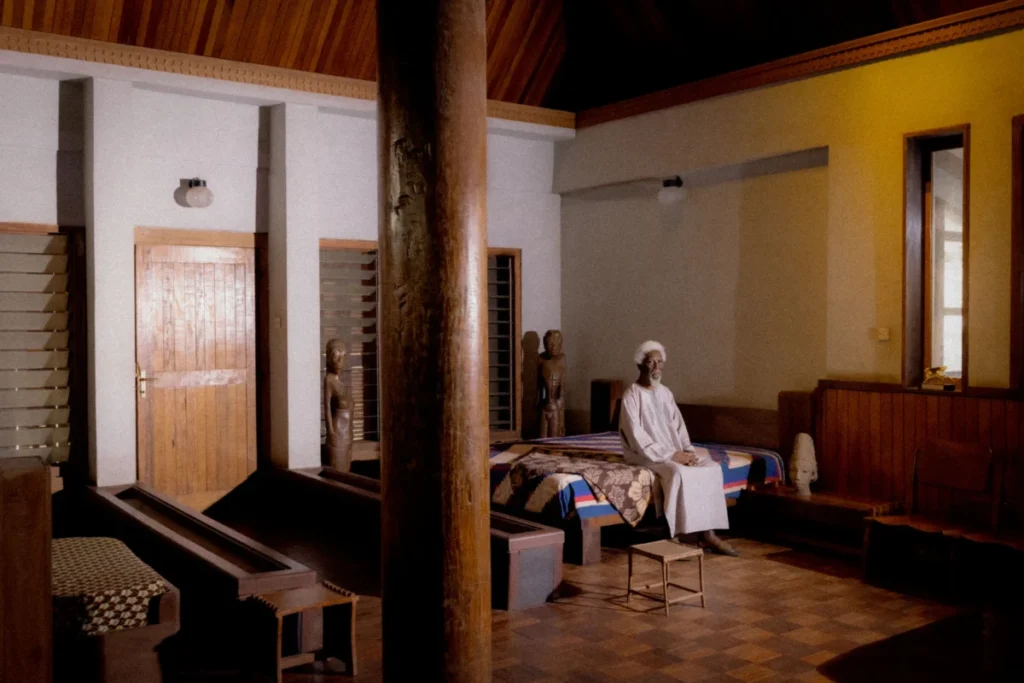

At 90 years old, Nigerian architect Demas Nwoko’s legacy extends beyond his art—it is embedded in the walls of his rural sanctuary in Idumuje-Ugboko, a historic town in the north of Nigeria’s Delta State. To reach this architectural landmark, one must navigate a landscape defined by red laterite soil, dense palm groves, and low, spreading trees that cast long, irregular shadows across the terrain. In this region, houses rise modestly from the earth; some are finished with smooth clay, while others remain bare, exposing the texture of sunbaked brick and timber. Bold geometric patterns adorn several facades, and intricately carved wooden doors serve as silent testaments to the skill and pride of local craftsmen. It is here, at the end of a winding path, that the residence of one of Africa’s most influential creative minds comes into view, standing as a physical manifestation of a philosophy that has challenged Western architectural hegemony for over half a century.

Nwoko was raised in the royal household of Idumuje-Ugboko as the son of Obi Nwoko II, a traditional ruler. This upbringing provided him with an intimate understanding of power, tradition, and the spatial dynamics of African royalty. Now a nonagenarian, he has been described by historians and peers as a polymath—artist, master builder, sculptor, architect, designer, and teacher. However, to apply a single label to Nwoko is to overlook the cohesive nature of his work. His varied pursuits form a unified creative legacy that continues to shape generations of artists and architects far beyond the borders of Nigeria, advocating for a "natural synthesis" of traditional African aesthetics and modern functional requirements.
A Philosophy Rooted in Tradition and Geography
Nwoko’s architectural journey began with the inspiration he drew from the Idumuje-Ugboko palace and the surrounding structures commissioned by his father. These buildings were deeply rooted in the design traditions of neighboring Benin City. While similar styles were often reserved exclusively for royal palaces in the Yorubaland region—which spans southwestern Nigeria, Benin, and Togo—in the Benin tradition, these elements were integrated into domestic life. Nwoko notes that this model was the primary architectural language of his childhood.

Before transitioning into architecture, Nwoko’s early career focused on theater and scenography. He later taught drama at the University of Ibadan, a period that informed his understanding of space, lighting, and human movement. Despite his success in the performing arts, he remained committed to honoring the design traditions of his heritage. He famously stated that he had examined the architecture of Benin from every angle and concluded that no other style offered the same level of environmental and cultural resonance.
This commitment led to the construction of his own home in 1978. The residence bears clear structural markers of ancient Benin City: ridged exterior columns at the entrance echo the fluted walls of the Oba’s Palace, while the pitched, overhanging roof serves as a signature element across his projects, nodding to traditional housing in Nigeria’s southeast. Nwoko designed and built every element of the home himself, utilizing traditional methods and local materials to prove that African building techniques were not only viable but superior for the tropical climate.

Technical Innovation: The Invention of Laticrete
One of Nwoko’s most significant contributions to the field of sustainable building is his development of "laticrete." During the mid-20th century, colonial-era regulations and subsequent post-independence laws often prohibited the use of local laterite soil in permanent structures, favoring imported cement and steel. Nwoko challenged these regulations by experimenting with soil stabilization. By mixing local laterite soil with a small percentage of cement, he created laticrete—a material that maintained the thermal properties and aesthetic of traditional mud-brick while meeting modern structural standards.
"There is nothing wrong with mud," Nwoko has frequently argued, pointing to three-story homes across Yorubaland that have stood for decades using readily available earth. His philosophy posits that a building is not economically or environmentally viable if it ignores local materials. This approach anticipated the modern "green building" movement by decades, emphasizing low embodied carbon and natural climate control.

Inside the Nwoko residence, the atmosphere is one of "sacred silence," where natural light is kept deliberately low to combat the harsh tropical sun. The open-plan layout reflects indigenous social structures, allowing for free movement between distinct zones. The dining area features stained-glass panels reminiscent of his earlier masterpiece, the Dominican Chapel in Ibadan. The furniture, including his signature interlocking wooden chairs, is crafted without a single nail, relying instead on sophisticated joinery techniques.
Chronology of a Creative Pluralist
The trajectory of Demas Nwoko’s career is marked by a series of pivotal moments that helped define modern African art and architecture:

- 1950s: Nwoko studied at the Nigerian College of Arts, Science, and Technology in Zaria. He became a founding member of the Zaria Art Society, a group of students known as the "Zaria Rebels" who rejected the purely Western-centric art education of the time.
- 1960s: He moved to Paris to study theater architecture and set design, returning to Nigeria to become a leading figure in the post-independence cultural renaissance.
- 1970-1975: Construction of the Dominican Chapel in Ibadan. This project remains one of his most celebrated works, blending Christian liturgical needs with African structural forms.
- 1978: Completion of his personal residence in Idumuje-Ugboko, which served as a laboratory for his theories on tropical architecture.
- 1980s-Present: Establishment of New Culture Studios and the subsequent architectural firm, New Culture Designs. Nwoko focused on teaching and writing, cementing his role as a philosopher of the built environment.
Supporting Data and Structural Impact
Nwoko’s work is characterized by the use of the "impluvium," a fiberglass-lined funnel designed to carry a controlled stream of rainwater from the roof into an indoor courtyard. This feature serves a dual purpose: it provides natural cooling through evaporation and acts as a central aesthetic focal point. In the context of tropical geography, Nwoko argues that replicating glass-heavy Western architecture is a fundamental error.
According to data from architectural surveys in Sub-Saharan Africa, buildings designed with Nwoko’s principles—thick earthen walls and high-pitched roofs with natural ventilation—can maintain interior temperatures up to 5 to 8 degrees Celsius cooler than standard concrete-and-glass structures without the need for mechanical air conditioning. This efficiency is critical in a region where energy infrastructure is often inconsistent.
.jpg)
Upstairs in his home, Nwoko utilizes the Igbo architectural tradition of the "conical square," a pitched roof anchored by a single structural pillar at the center. This design allows for massive interior volumes without the need for multiple load-bearing walls, facilitating the open-plan lifestyle he advocates.
Broader Impact and Global Recognition
The significance of Nwoko’s work was recently recognized on the global stage when he was awarded the Golden Lion for Lifetime Achievement at the 18th International Architecture Exhibition of La Biennale di Venezia in 2023. The jury praised him for his "pioneering role in the field of modern African architecture," noting that his work represents a profound critique of the "international style" that often ignores local context.

Bofu Nwoko Ugbodaga, the designer’s daughter and senior partner at their architectural firm, New Culture Designs, emphasizes that every choice in her father’s home was intentional. "It is an ageless building," she says, noting that the structure has remained largely unchanged since the 1970s, save for the addition of a second floor to serve as private quarters.
The implications of Nwoko’s work extend into the realm of decoloniality. By proving that indigenous materials and forms can be adapted to modern life, he has provided a roadmap for African architects to reclaim their cultural identity. His influence is seen in the works of contemporary architects like Francis Kéré and Mariam Kamara, who also prioritize earth-based construction and community-centric design.

The Future of Tropical Architecture
Even at 90, Nwoko’s momentum remains undiminished. He recently inaugurated a new church tower in his community and is currently finalizing a book on tropical architecture, which aims to codify his decades of practical experience into a formal theory for future students. Working alongside younger collaborators, he continues to push the boundaries of what is possible with the red earth of the Delta State.
"The least I can do is to help as much as I can," Nwoko says. "As long as there is work to do, how do I stop?"

His life’s work stands as a reminder that architecture is not merely about aesthetics or engineering; it is about geography, history, and the protection of the human spirit within its specific environment. As the world increasingly looks toward sustainable and localized solutions for the climate crisis, the lessons embedded in the laticrete walls of Idumuje-Ugboko have never been more relevant. Demas Nwoko has not just built a home; he has built a bridge between Africa’s past and its sustainable future.