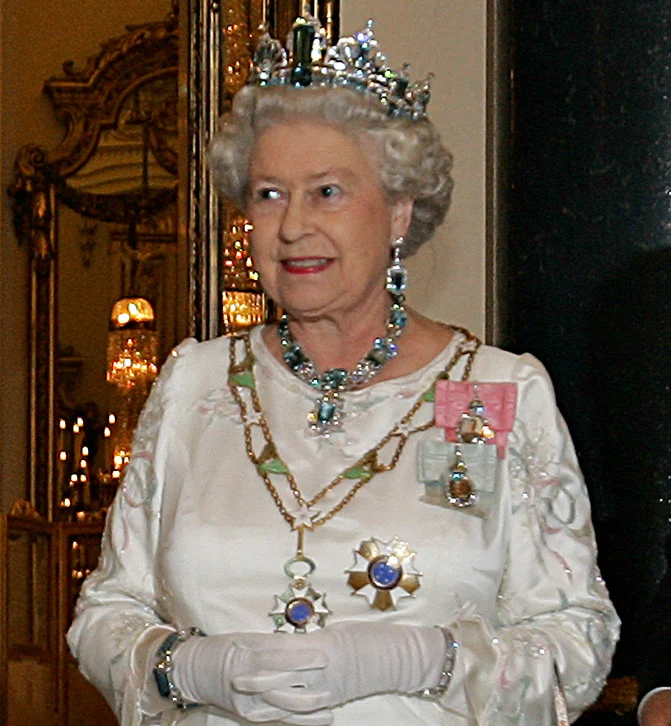

Three of the most historically significant and personally cherished tiaras worn by Queen Elizabeth II throughout her remarkable reign are now captivating audiences in London. These dazzling diadems are not merely exquisite pieces of jewellery; they serve as deeply personal touchstones within a compelling exhibition, "Queen Elizabeth II: Her Life in Style," which charts the monarch’s extraordinary life through the lens of her enduring sartorial choices. The exhibition, hosted at The King’s Gallery, Buckingham Palace, offers an unprecedented opportunity for the public to connect with the Queen’s legacy, with these three tiaras—representing red, white, and blue—forming a central and poignant display. Their inclusion provides a unique insight into key moments of her life, from her wedding day to her personal design contributions, underscoring their status as heirlooms reserved for queens.
The Queen Mary Fringe Tiara: A Symbol of Resilience and Royal Succession
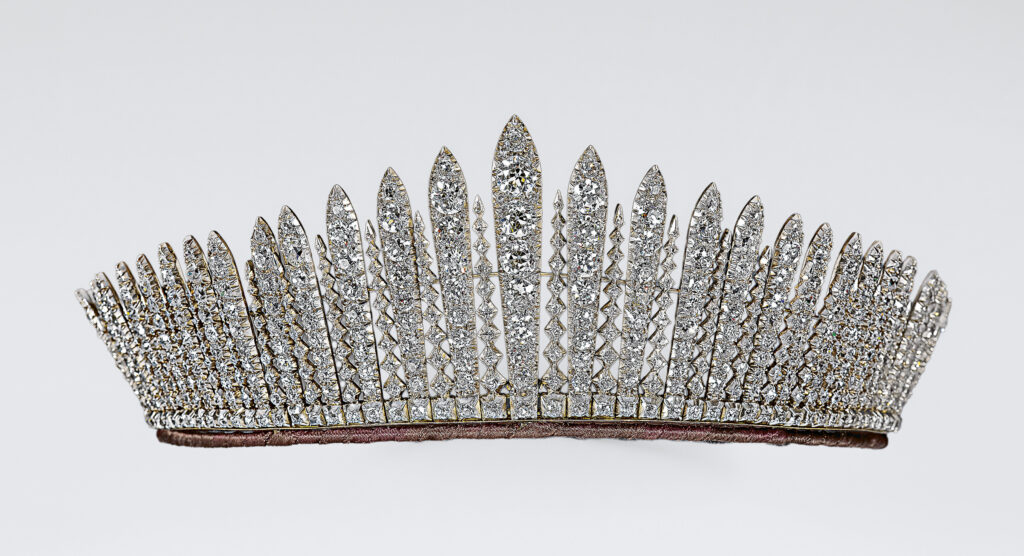
For the first time in two decades, the breathtakingly beautiful all-diamond tiara worn by the then Princess Elizabeth on her wedding day is accessible to the public. This iconic piece, originally belonging to Queen Mary, is a star attraction alongside the Queen’s celebrated wedding dress, as part of the Royal Collection Trust’s exhibition. Its presence evokes the romantic grandeur of the most famous royal wedding of the 20th century, which took place at Westminster Abbey on November 20, 1947.
The history of the Queen Mary Fringe Tiara is as fascinating as its intricate design. Originally fashioned from a necklace gifted by Queen Victoria to Queen Mary in 1893, it was transformed into a stunning fringe tiara by E. Wolff & Co. for Queen Mary in 1919. This transformation involved dismantling the necklace and utilizing its diamonds to create the delicate, radiating spikes that characterize its unique appearance. The tiara’s journey to the wedding day of Princess Elizabeth was almost derailed by a moment of unexpected drama. Just hours before the ceremony, the tiara reportedly snapped in the middle, a testament to its age and perhaps a sign of its preciousness. Accounts from the time detail the swift and skillful intervention of royal jewelers, who managed to repair the tiara just in time for the procession. Close examination of wedding photographs from the event reveals the subtle, yet present, evidence of this hasty repair, a poignant reminder of the Queen’s composure and determination on her most significant day. This incident, far from diminishing the tiara’s significance, has become an integral part of its storied past, symbolizing the Queen’s grace under pressure and her unwavering commitment to tradition.
The Queen Mary Fringe Tiara has since transitioned from a symbol of a royal wedding to a symbol of royal succession. It has been loaned to other female members of the Royal Family for their own wedding days, most notably to Princess Anne for her first marriage in November 1973, and more recently to Princess Beatrice when she married Edoardo Mapelli Mozzi in July 2020. This practice highlights the tiara’s enduring importance as a symbol of continuity and familial connection within the British monarchy.
The Burmese Ruby Tiara: A Fusion of Diplomacy and Design
Adding a vibrant splash of red to the exhibition’s regal palette is the striking Burmese Ruby Tiara, a piece imbued with both diplomatic significance and the Queen’s personal vision. The tiara is composed of 96 Burmese rubies, a remarkable gift from the people of Burma (now Myanmar) to Princess Elizabeth in 1947, coinciding with her marriage. These rubies are steeped in local folklore, believed to possess protective qualities against illness and misfortune, bestowing good luck upon their wearer.
As Queen Elizabeth II’s reign approached its 25th anniversary, she commissioned Garrard & Co., the Crown Jewellers and a long-standing favourite of the Royal Family, to transform these precious stones into a tiara. The resulting design, first unveiled in 1973, presents a modern aesthetic, yet it is rich with historical symbolism. The 96 rubies were artfully arranged to form the shape of Tudor roses, a direct nod to England’s dynastic history and a symbol of the nation itself.
In a remarkable display of her resourcefulness and appreciation for legacy, Queen Elizabeth II repurposed diamonds from another significant tiara to complete the Burmese Ruby Tiara. The diamonds from the Nizam of Hyderabad Tiara, originally a wedding gift to the Queen from the Nizam of Hyderabad in 1947, were meticulously dismantled and incorporated into the new design. This act of "royal recycling" not only demonstrates a keen understanding of material value but also weaves together disparate threads of royal history into a single, cohesive masterpiece.
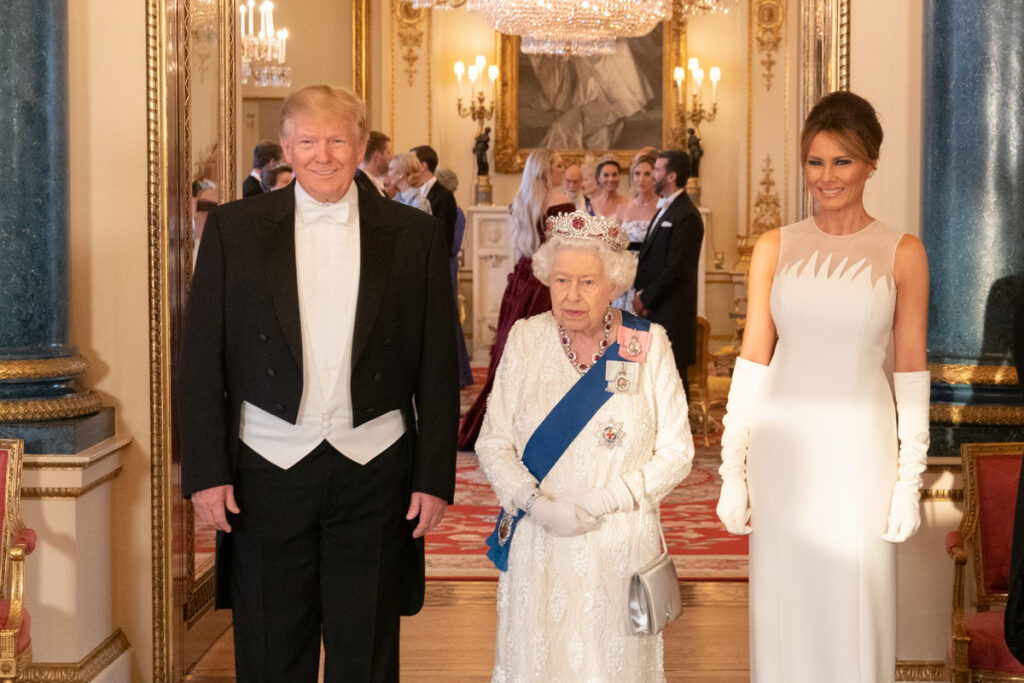
The Burmese Ruby Tiara became a favoured choice for the Queen for many significant state occasions, including state banquets and formal receptions. Its prominent role was underscored when she wore it for the final incoming State Visit of her reign, receiving then-US President Donald Trump and First Lady Melania Trump at Buckingham Palace in June 2019. The tiara’s exclusivity is further emphasized by its status as a "queens only" piece, a tradition continued by Queen Camilla, who has also worn this magnificent diadem.
The Brazilian Aquamarine Tiara: A Monumental Creation of Royal Taste
Completing the "red, white, and blue" theme is the magnificent Brazilian Aquamarine Tiara, a testament to Queen Elizabeth II’s evolving personal style and her engagement with the art of jewellery design. This impressive jewel, often described as a "skyscraper" of a tiara, is a striking example of the Queen’s ability to commission and evolve significant pieces of the Royal Collection.
The origin of this grand tiara lies in a generous gift from the President of Brazil in 1953, coinciding with Queen Elizabeth II’s Coronation. The President presented the new Queen with a set of exquisite aquamarines, a gemstone famously abundant in Brazil. Initially, these stones were fashioned by Garrard & Co. into a matching necklace and pendant earrings. However, the Queen’s vision extended beyond these initial creations.
In 1957, Queen Elizabeth II returned to Garrard & Co. with a desire to incorporate more of the Brazilian aquamarines into a grand tiara. The initial design featured a delicate bandeau of aquamarines and diamonds, adorned with a central aquamarine topper for height, and two smaller toppers positioned towards the rear. This iteration already showcased the striking beauty of the gemstones and the Queen’s preference for clean, elegant lines.
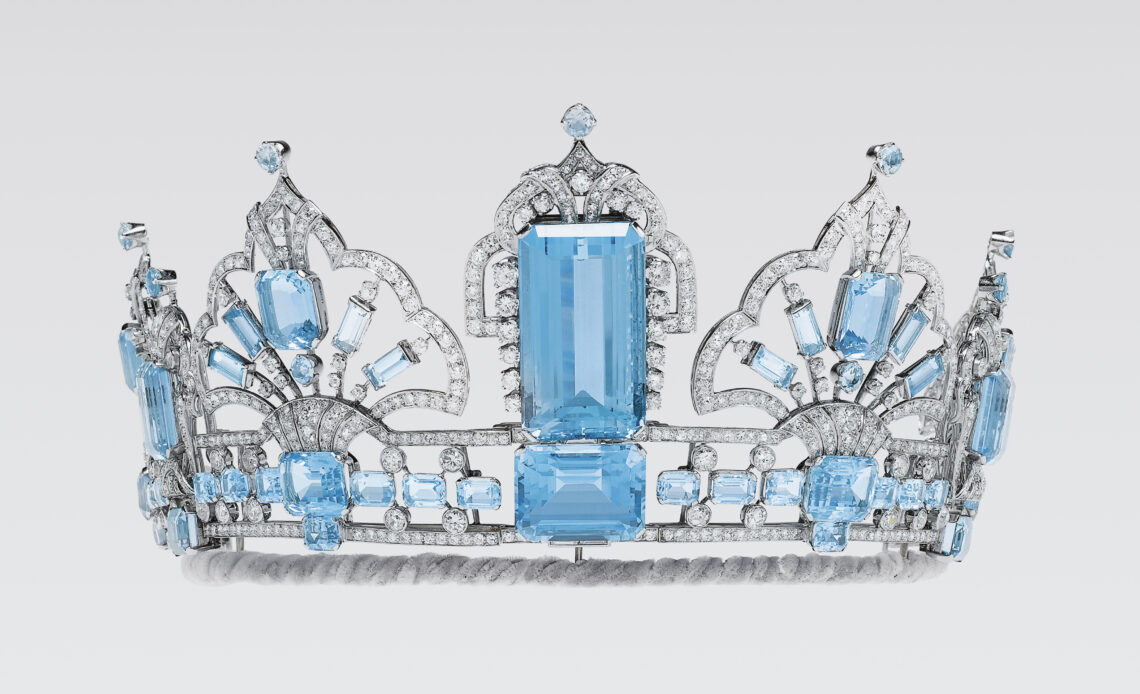
A significant transformation occurred in 1971, when the Queen commissioned further modifications, utilizing additional aquamarines gifted to her. This resulted in the creation of a much larger, central topper, a breathtaking focal point that featured four fan-shaped motifs, intricately crafted from aquamarines and diamonds, arranged around it. This evolution of the tiara resulted in one of the most substantial and visually arresting pieces within Queen Elizabeth II’s extensive jewellery collection.
The Brazilian Aquamarine Tiara became a signature piece for the Queen, often chosen to make a powerful statement at major state banquets. It was notably worn during the State Banquet for King Felipe VI and Queen Letizia of Spain in July 2017, marking the last documented public appearance of Queen Elizabeth II wearing this magnificent tiara. Like the Burmese Ruby Tiara, this piece is also reserved for queens, and as of 2026, Queen Camilla has yet to wear it publicly. Given the tiara’s prominent display at The King’s Gallery until October 2026, coinciding with the centenary year of Queen Elizabeth II’s birth, it is unlikely to be seen on Queen Camilla during this special commemorative period.
"Queen Elizabeth II: Her Life in Style" – An Exhibition of Personal and National Significance
The exhibition "Queen Elizabeth II: Her Life in Style" at The King’s Gallery, Buckingham Palace, provides a unique opportunity to explore the personal narrative of a monarch who reigned for over seven decades. Beyond the glittering allure of the displayed tiaras, the exhibition delves into the Queen’s profound connection to her wardrobe and its role in projecting an image of stability, duty, and national identity. The carefully curated displays showcase not only iconic garments and jewellery but also personal photographs, correspondence, and archival material, offering a holistic portrait of Queen Elizabeth II’s life and her unwavering dedication to service.
The selection of these three specific tiaras is particularly poignant. The Queen Mary Fringe Tiara represents the beginning of her public life and her enduring connection to family heritage. The Burmese Ruby Tiara embodies a fusion of international diplomacy, personal taste, and the symbolic power of gemstones. The Brazilian Aquamarine Tiara stands as a monument to her evolving style, her commissioning of significant works of art, and her understanding of the impact of grand jewellery. Together, these pieces offer a compelling narrative of a life lived in the public eye, where personal choices in style intersected with the weighty responsibilities of the Crown.
The exhibition runs from April 10 to October 18, 2026, providing ample opportunity for visitors to experience this extraordinary collection. Tickets are available for purchase through the Royal Collection Trust website, allowing the public to engage directly with the tangible legacy of Queen Elizabeth II and her remarkable reign. The exhibition serves as a fitting tribute to a monarch whose life was as intricately designed and as enduringly brilliant as the jewels she wore.