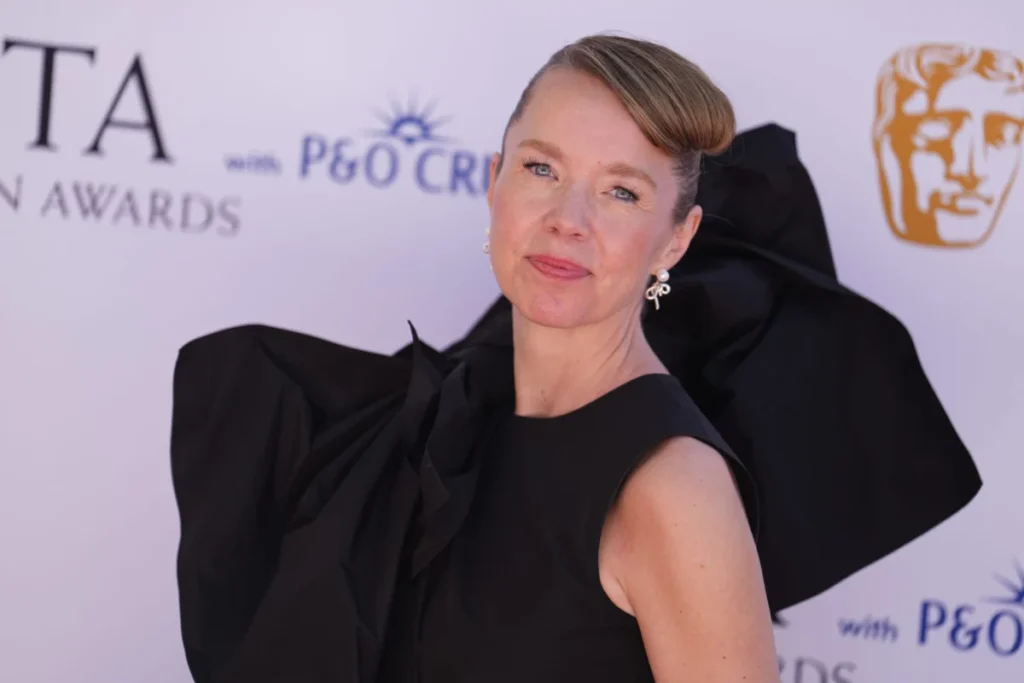

Bafta-winning actress Anna Maxwell Martin has openly stated that the demanding late-night filming schedule of The Traitors celebrity spin-off was the primary deterrent preventing her participation, citing a personal preference for an 8 pm bedtime. The candid revelation, made during an appearance on ITV’s The Jonathan Ross Show, offers a rare glimpse into the logistical challenges and personal sacrifices often required of high-profile personalities engaging with reality television, even for a show as critically acclaimed and popular as the BBC’s psychological thriller.
Maxwell Martin, 48, whose distinguished career includes lauded performances in Bleak House, Poppy Shakespeare, and Line Of Duty, confirmed that she would have otherwise been inclined to join the star-studded cast of The Traitors. However, her observation of the civilian version’s intense filming hours, particularly those extending deep into the night for the designated ‘Traitors,’ quickly dampened any enthusiasm. "I want to be in bed by 8pm," she declared, a statement that resonated with many and underscored a pragmatic approach to her professional life.
The Demands of Ardross Castle: Filming Under the Scottish Summer Sky
The Traitors, a show renowned for its dramatic setting in Ardross Castle in the Scottish Highlands, pits a group of contestants against each other in a game of deception and detection. Hosted by the inimitable Claudia Winkleman, the format sees ‘Faithfuls’ attempting to identify and banish ‘Traitors’ hidden among them, all while the Traitors secretly ‘murder’ Faithfuls each night. The game culminates in a significant cash prize for the victors.
Maxwell Martin’s insights into the production schedule were particularly telling. Reflecting on the "civilian one," she noted, "I can see from the civilian one how late it gets on that show. That’s a Scottish summer and they’re not leaving that castle until it gets dark, that’s 11pm, 12am… if you’re a traitor it’s 1am… 2am…" Her assessment highlights a crucial, yet often overlooked, aspect of filming in high-latitude locations like the Scottish Highlands during summer. During this period, daylight hours are exceptionally long, meaning that true darkness, essential for the clandestine nocturnal meetings of the Traitors, often doesn’t descend until very late, pushing filming well past midnight. For Traitors, who must convene in secret to decide their next ‘murder’ and strategize, this translates into even later nights, potentially extending into the early hours of the morning.

This demanding schedule is not unique to The Traitors but is a common characteristic of reality television, especially formats that rely on specific environmental conditions or a continuous narrative flow. The remote location of Ardross Castle further compounds logistical complexities, requiring extensive planning for crew, equipment, and contestant welfare over prolonged periods. The intense psychological nature of the game itself, coupled with sleep deprivation, can significantly impact participants, making the prospect of late-night filming particularly daunting for those accustomed to more conventional production hours.
A Phenomenon Explained: The Traitors’ Ascent to Television Stardom
The Traitors has rapidly ascended to become one of the BBC’s most successful and talked-about programmes. Originating from the Dutch format De Verraders (The Traitors), the show has been adapted in numerous countries worldwide, including highly popular versions in the United States and Australia, cementing its status as a global television phenomenon. The UK iteration, in particular, has captivated audiences with its blend of strategic gameplay, psychological intrigue, and compelling human drama.
The show’s success can be attributed to several factors:
- Unique Format: Its social deduction game, where trust is constantly tested, creates an unparalleled level of suspense and engagement.
- Claudia Winkleman’s Hosting: Her distinctive style, a blend of glamour, wit, and genuine enthusiasm, has been widely praised, adding a layer of charm and gravitas to the proceedings.
- Dramatic Setting: Ardross Castle provides an atmospheric, almost gothic backdrop that enhances the show’s mysterious and high-stakes feel.
- Critical Acclaim and Ratings: The civilian series consistently drew millions of viewers, garnering critical praise for its innovative format and gripping storytelling. A recent celebrity iteration, which saw Jonathan Ross among the star-studded cast (likely referring to the highly successful Comic Relief specials featuring stars like Ross, Alan Carr, and Cat Burns), brought in an average audience of 14.9 million people, making it one of the biggest television audiences of the year it aired. This figure underscores the immense public appetite for the show, particularly when celebrity faces are involved.
Celebrity Allure and Aversion: Why Stars Embrace or Eschew Reality TV
The discussion on The Jonathan Ross Show also featured comic actress Catherine Tate, who offered her own nuanced perspective on joining The Traitors. Tate, known for her iconic sketch comedy and character work, expressed a strong desire to play the game itself, but with a significant caveat: "I 100 percent would do it – if it wasn’t on the telly. If I could just go to the castle… I’d love to play the game." Her statement highlights the complex relationship many established actors have with reality television. While the challenge and strategic elements of a show like The Traitors might be appealing, the intense public scrutiny, the potential for misrepresentation, and the impact on one’s carefully cultivated professional image can be significant deterrents.

Celebrities participate in reality television for a multitude of reasons:
- Career Reinvigoration or Exposure: For some, it offers a chance to connect with new audiences or showcase a different side of their personality.
- Financial Incentives: The appearance fees for high-profile celebrities can be substantial.
- Charitable Causes: Many celebrity specials are tied to fundraising efforts, providing a strong philanthropic motivation.
- Personal Challenge: The unique environments and competitive nature of shows like The Traitors can appeal to a star’s adventurous spirit.
- Fun and Experience: Some genuinely enjoy the experience, viewing it as a break from traditional acting roles.
However, the downsides are equally potent:
- Loss of Privacy: Every action and word is scrutinised by millions.
- Impact on Image: Public perception can be drastically altered, for better or worse.
- Mental and Emotional Strain: The pressures of competition, isolation, and constant surveillance can take a significant toll.
- Demanding Schedules: As Maxwell Martin pointed out, the filming hours can be gruelling.
Catherine Tate’s desire to participate "off-camera" perfectly encapsulates this dichotomy, valuing the game’s intellectual challenge over the public spectacle. It suggests a broader trend among certain actors who cherish their craft and privacy, carefully curating their public appearances.
Jonathan Ross’s Insider Perspective: A Celebrity Traitor’s Take
Jonathan Ross, who hosted the show where Maxwell Martin and Tate made their comments, is himself an insider, having participated as a Traitor in a celebrity special of The Traitors (likely the Comic Relief special alongside Alan Carr and singer Cat Burns). His experience lends a particular weight to the discussion, as he would have firsthand knowledge of the demanding schedule and psychological pressures of the game.
Ross’s role as a Traitor in that special highlights the unique demands placed upon those chosen for the deceptive role. Traitors are required to maintain a facade, conspire in secret meetings, and orchestrate ‘murders,’ all while trying to evade detection from the Faithfuls. This requires constant vigilance and mental fortitude, often extending late into the night. His presence on the sofa, having lived through the very experience Maxwell Martin was describing, undoubtedly added an authentic layer to the conversation, validating her concerns about the late hours and the intensity of the game.

The Balancing Act: Celebrity Life vs. Production Schedules
Anna Maxwell Martin’s revelation brings to light a perennial challenge in television production: balancing the desire to secure high-profile talent with the practicalities of filming schedules. For a show like The Traitors, which relies heavily on its unique setting and the cloak-and-dagger nature of its game, certain elements of the production schedule, such as late-night filming for Traitor meetings, are non-negotiable.
This creates a dilemma for producers. While the allure of having a beloved and respected actress like Anna Maxwell Martin on screen is immense, adapting the entire production schedule to accommodate one individual’s preferences, even a star of her calibre, can be logistically complex and financially prohibitive. It raises questions about the extent to which production teams can or should bend to the demands of celebrity participants. In an era where reality television is increasingly a platform for established actors to connect with wider audiences, finding a workable compromise between star power and production realities will become ever more crucial.
Anna Maxwell Martin: A Career Defined by Craft, Not Cameras
Maxwell Martin’s stance is entirely consistent with her established public persona and career trajectory. Known for her powerful, nuanced performances, she has carved out a reputation as a serious actress deeply committed to her craft. Her two Bafta awards stand as testament to her talent: one for her portrayal of Esther Summerson in the BBC adaptation of Bleak House and another for her role as N in the Channel 4 adaptation of Poppy Shakespeare. More recently, she has captivated audiences as Detective Chief Superintendent Patricia Carmichael in the acclaimed BBC One crime drama Line Of Duty, a role that showcased her ability to convey intense authority and subtle menace.
Beyond her dramatic roles, Maxwell Martin has also found immense success in comedy, notably as the lead in the hit BBC comedy Motherland. She reflected on her "amazing time" working on the show, which brilliantly explores the often-unvarnished realities of middle-class motherhood. "Loved that show, all the cast, very close. Really proud of the girls," she shared, adding, "It’s just daft. I think people thought it was a comedy about parenting, which it isn’t really. It’s about adults behaving like children really. We had a real laugh."

Her enjoyment of Motherland‘s grounded, relatable humour, and its exploration of adult behaviour, contrasts sharply with the high-stakes, psychologically intense world of The Traitors. Her preference for an early bedtime, particularly in the context of her busy acting career and likely family commitments, underscores a desire for routine and a clear distinction between her professional and personal life. For an actress who consistently delivers compelling performances, preserving her energy and mental well-being is paramount, and a gruelling, unpredictable reality TV schedule might simply not align with her professional values or personal priorities. The award-winning Motherland concluded in 2022, and its legacy continues with the spin-off Amandaland, starring Lucy Punch, further cementing its cultural impact.
The Broader Implications for Reality Television
Anna Maxwell Martin’s candid comments, while seemingly simple, carry broader implications for the landscape of reality television. As more A-list celebrities are courted for such programmes, the industry may need to adapt its production models. Will future celebrity reality shows consider more flexible filming schedules? Or will the allure of participating in a massively popular show continue to outweigh personal comfort for many stars?
The success of The Traitors has proven that audiences are eager for high-quality, engaging reality content. However, securing top-tier talent like Maxwell Martin often requires understanding and accommodating their professional and personal boundaries. Her decision highlights a refreshing honesty in an industry often characterised by guarded responses. It serves as a reminder that even for the most celebrated figures, a good night’s sleep can be a non-negotiable luxury, and sometimes, the drama of reality television simply cannot compete with the comfort of an 8 pm bedtime.
The Jonathan Ross Show where these insights were shared airs on Saturdays at 10 pm on ITV1 and ITVX, providing a platform for such candid industry discussions.