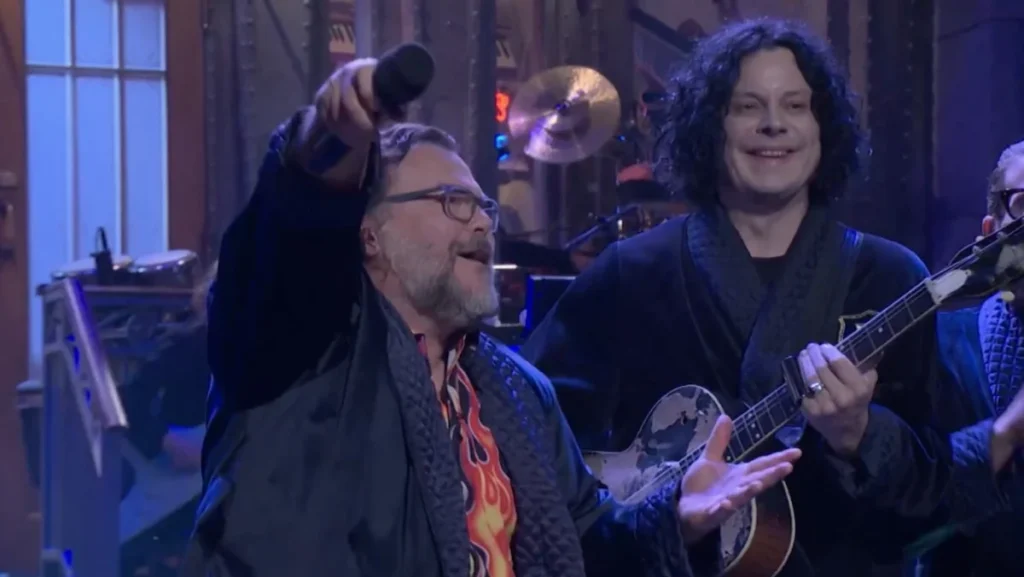

The highly anticipated convergence of two distinct titans of entertainment, Jack Black and Jack White, culminated in a memorable and musically charged opening to a recent Saturday Night Live episode. The April 2026 broadcast, which saw Jack Black celebrate his induction into the venerable Five-Timers Club, delivered on its promised crossover potential with a revamped rendition of The White Stripes’ iconic anthem, “Seven Nation Army,” performed jointly by the two celebrated Jacks. This unexpected collaboration not only paid homage to a classic rock track but also creatively integrated it into one of SNL‘s most cherished recurring sketches, setting a unique tone for the evening and generating significant cultural buzz.
A Convergence of Jacks: The Anticipation Builds
The announcement of both Jack Black as host and Jack White as musical guest for the same Saturday Night Live episode immediately sparked widespread speculation and excitement across social media and entertainment news outlets. Fans and critics alike anticipated how the show would capitalize on the titular coincidence, a booking strategy that, while not unprecedented in SNL‘s long history, rarely involves two figures of such individual magnitude and distinct artistic profiles. Jack Black, renowned for his dynamic presence in film (e.g., School of Rock, Jumanji franchise), television, and as one half of the comedic rock duo Tenacious D, brought his characteristic high-octane energy and comedic timing to the hosting duties. Jack White, on the other hand, a prodigious guitarist, singer, and songwriter, first rose to global prominence with The White Stripes and has since cultivated a prolific solo career, alongside projects like The Raconteurs and The Dead Weather, cementing his status as one of modern rock’s most influential figures. The prospect of these two "Jacks" sharing the stage was a creative gamble that promised either comedic gold or an awkward misfire; the show’s producers, it appears, aimed squarely for the former.
The Illustrious Five-Timers Club: A Meta-Commentary on SNL Tradition
Central to the episode’s opening was Jack Black’s long-awaited induction into the SNL Five-Timers Club, a fictional but revered institution within the show’s lore. The club, traditionally reserved for hosts who have graced the SNL stage five or more times, began as a one-off gag during Tom Hanks’s monologue in December 1990. In that initial sketch, Hanks was welcomed into a dimly lit, exclusive lounge by fellow four-time hosts Steve Martin, Paul Simon, and Elliott Gould, complete with smoking jackets and an air of old-school exclusivity. What started as an inside joke quickly evolved into one of SNL‘s most beloved recurring traditions, symbolizing a host’s enduring popularity, comedic versatility, and a deep connection to the show’s legacy. Membership in the club is a badge of honor, signifying not just repeated appearances but a consistently high standard of performance that resonates with both audiences and the show’s demanding production team.
For Black’s induction, SNL leaned into a meta-commentary on the club’s own longevity and occasional overuse. The sketch humorously portrayed the club as having fallen into disrepair, a self-aware nod to how even the most cherished traditions can become a bit worn over time. Black was greeted by a cadre of esteemed previous inductees, including SNL alumna Tina Fey, known for her sharp wit and numerous hosting stints; actor Jonah Hill, a frequent and popular host; veteran actress Candice Bergen, one of the earliest female members; and comedic powerhouse Melissa McCarthy. Tina Fey’s line, "What started off as a one-off joke in a Tom Hanks monologue has been brought back so many times, it has literally been run into the ground. For example, this is my fifth Five-Timers Club stint," perfectly encapsulated the self-deprecating humor that allowed the sketch to acknowledge its own history while still delivering fresh comedic beats. This established a playful tone, setting the stage for Black’s ambitious plan to "fix" the club.
"Seven Nation Army": An Anthem Reimagined
It was at this point that the highly anticipated Jack-on-Jack action truly ignited. Jack Black, in character as the enthusiastic, can-do showman, declared his intention to revitalize the dilapidated club by "singing the world’s most rockin’ song." This proclamation served as the cue for Jack White to emerge, guitar in hand, joining Black for a truly unique performance of "Seven Nation Army." The choice of song was particularly astute. Released in 2003 by The White Stripes, "Seven Nation Army" quickly transcended its indie rock origins to become a global cultural phenomenon. Its instantly recognizable, driving bass riff (actually played on a guitar with a pitch shifter) is one of the most iconic in modern music, adopted worldwide as a chant at sporting events, protests, and celebrations. Its ubiquitous presence made it a perfect choice for a mass-appeal moment on SNL.
The collaboration saw Black and White, affectionately dubbed "Jack Zebra" in a preceding promotional gag (a nod to their monochromatic surname distinction), perform the track with entirely reworked lyrics. Instead of the original enigmatic verses, the new lyrics directly addressed the Five-Timers Club, its storied history, and the specifics of the night’s episode. This lyrical re-contextualization showcased the clever writing of SNL‘s team, transforming a rock anthem into a bespoke comedic tribute. The performance itself was a masterclass in blending their distinct styles. Jack Black, with his characteristic theatricality and powerful, often operatic vocal delivery, brought a boisterous energy to the lead vocals, while Jack White, the architect of the song, provided the unmistakable guitar riff and his signature raw, blues-infused vocal harmonies. The juxtaposition of Black’s comedic exuberance with White’s rock authenticity created a dynamic and visually engaging spectacle that captivated the audience, both live in the studio and watching at home. The synergy between the two artists, despite their disparate career paths, was palpable, highlighting their shared passion for music and performance.
Jack White’s Electrifying Solo Showcase
Beyond the headline-grabbing crossover, Jack White fulfilled his traditional role as the musical guest, delivering two electrifying performances of his new singles: "Derecho Demonico" and "G.O.D. and the Broken Ribs." These performances served as a powerful reminder of White’s continued artistic evolution and his unwavering commitment to raw, visceral rock and roll. "Derecho Demonico," a title hinting at a fierce, perhaps chaotic, sonic landscape, showcased White’s intricate guitar work and his band’s tight musicianship, reaffirming his status as a premier live performer. "G.O.D. and the Broken Ribs" likely delved into his characteristic blend of blues, garage rock, and experimental flourishes, often imbued with a sense of the poetic and the profound.
White’s solo sets were a testament to his ability to command the stage, distinct from the comedic collaborative energy of the monologue. They provided a stark, yet complementary, contrast to the opening sketch, allowing him to present his latest musical endeavors with unadulterated artistic integrity. The choice of performing new material on SNL is a time-honored tradition for musical guests, offering a massive platform to reach a broad audience and define their current artistic direction. For an artist of White’s caliber, these performances are not just promotional tools but extensions of his creative output, meticulously crafted and executed.
Audience and Critical Acclaim: A Resounding Success
The episode, and particularly the "Jack Black and Jack White" segment, garnered immediate and overwhelmingly positive reactions. Social media platforms buzzed with excitement during and after the broadcast, with "Seven Nation Army" and "#FiveTimersClub" trending topics. Fans lauded the creativity of the crossover, the unexpected synergy between the two performers, and the clever re-imagining of a beloved song. Critics echoed this sentiment, praising SNL‘s ability to capitalize on its unique booking, deliver strong comedic performances, and create a truly memorable musical moment. Many reviews highlighted the segment as a prime example of SNL at its best: innovative, culturally aware, and capable of generating genuine watercooler moments. The episode was widely considered a ratings success, drawing in a significant viewership driven by the allure of the double-Jack bill. This type of high-profile, viral-ready segment is precisely what SNL strives for in an increasingly fragmented media landscape, proving that live television can still create shared cultural experiences.
Implications and Legacy: A Blueprint for Future Success
The Jack Black/Jack White crossover episode carries several significant implications for Saturday Night Live and its approach to booking and content creation. Firstly, it reaffirms the show’s enduring cultural relevance and its capacity to attract top-tier talent from across the entertainment spectrum. In an era where many traditional television formats struggle to maintain audience engagement, SNL continues to leverage its live format and comedic prowess to create must-see television. The success of this episode, particularly the innovative handling of the "Jack" theme, could serve as a blueprint for future themed bookings, encouraging producers to explore other creative pairings or narrative hooks beyond simply a popular host and musical guest.
Secondly, for Jack Black, his fifth hosting appearance solidifies his place as a cherished member of the SNL family and further cements his reputation as a versatile entertainer capable of both broad comedy and genuine musical performance. His willingness to fully commit to the show’s sketches, even those that involve self-deprecating humor about a cherished tradition, speaks to his professionalism and comedic generosity. For Jack White, the exposure for his new singles on such a high-profile platform is invaluable, reaching millions of viewers who might not otherwise be exposed to his latest work. It also showcased his adaptability, participating in a comedic sketch while still delivering his signature, uncompromising musical artistry.
The "Seven Nation Army" performance, specifically, is likely to be remembered as one of the most iconic musical moments in recent SNL history. It transcended a simple musical performance, becoming a piece of meta-commentary, a comedic highlight, and a genuine rock and roll spectacle all at once. It demonstrated SNL‘s continued ability to innovate within its established format, ensuring that even its most enduring traditions, like the Five-Timers Club, can be refreshed and revitalized for new generations of viewers. The episode stands as a testament to the power of creative synergy, proving that sometimes, two Jacks are indeed better than one.