
The trajectory of 20th-century design is often defined by the tension between mass production and artisanal craftsmanship, but few figures navigated this divide as transformatively as Jean Prouvé. Often describing himself as a "constructeur" rather than merely an architect or designer, Prouvé’s work bridged the gap between the industrial factory floor and the refined domestic interior. Today, his architectural components—once intended for mass-market schools, hospitals, and emergency housing—have ascended to the highest echelons of the global art and collectibles market. From the minimalist boutiques of Paris to high-rise Manhattan penthouses, the "tactical" aesthetic of Prouvé’s steel and aluminum panels is being rediscovered not as industrial waste, but as a profound manifesto of modernist integrity.
The Genesis of a Material Revolution: 1925–1929
The origin of Prouvé’s distinctive style can be traced back to 1925, a pivotal year for European modernism. At the Exposition Internationale des Arts Décoratifs et Industriels Modernes in Paris—the very event that gave the Art Deco movement its name—Prouvé was commissioned to create two monumental wrought-iron doors for the Pavilion de Nancy. While the exposition celebrated the ornamental and the luxurious, it served as a catalyst for Prouvé’s shift toward a more utilitarian vernacular.
During this period, Prouvé moved away from the traditional blacksmithing techniques of his youth and developed what historians often call a "material crush" on sheet steel. Unlike cast iron, which was heavy and brittle, or wood, which was subject to environmental decay, sheet steel offered a unique combination of extreme strength and malleability. By 1929, Prouvé was aggressively experimenting with this medium, applying it to the design of doors, partitions, windows, and even elevator shafts. His goal was to move beyond the bespoke and toward the reproducible, envisioning a world where high-quality architectural components could be manufactured with the same precision and speed as an automobile.
The Ateliers Jean Prouvé: A Factory of Innovation
By the early 1930s, Prouvé had established the Ateliers Jean Prouvé in Nancy, France. This facility became a laboratory for what would become his hallmark: the "catalog of parts." His philosophy was rooted in the idea that a building should be a "machine for living," composed of standardized elements that could be easily transported, assembled, and replaced.

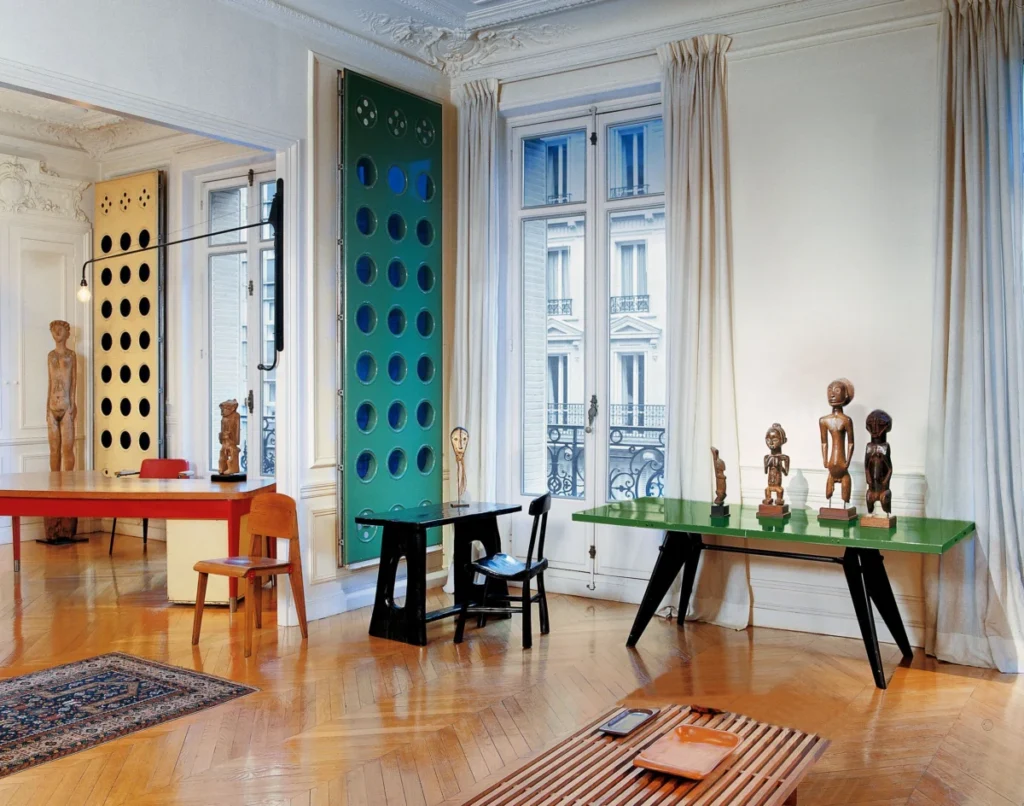
One of the most recognizable features to emerge from this era was the integrated door and panel system, often characterized by the use of "porthole" windows. These circular apertures were not merely a stylistic nod to the streamlined aesthetics of ocean liners; they served a dual functional purpose. First, they provided essential natural light without compromising the structural integrity of the steel sheet. Second, by removing material from the center of the panel, they reduced the overall weight—a critical factor for structures intended for rapid deployment or transport to remote locations.
The Chronology of Prouvé’s Industrial Expansion
To understand the scale of Prouvé’s impact, one must look at the timeline of his production and the subsequent shift in his career:
- 1924: Prouvé opens his first workshop in Nancy, focusing initially on wrought iron.
- 1930: Becomes a founding member of the Union des Artistes Modernes (UAM), an organization dedicated to the marriage of art and industry.
- 1931: Establishes "Les Ateliers Jean Prouvé" and begins mass-producing furniture and architectural elements.
- 1939–1945: During World War II, Prouvé pivots to wartime production, creating portable barracks and stoves. After the liberation, he is appointed Mayor of Nancy and focuses on housing the displaced.
- 1947: Moves his factory to Maxéville, expanding production of demountable houses, including the famous 6×6 and 6×9 meter emergency shelters.
- 1953: Following a financial takeover by the aluminum conglomerate Cégédur, Prouvé loses control of his factory and is forced to leave his own company.
- 1954: Prouvé builds his private residence, the Maison Prouvé, on a steep hillside in Nancy using salvaged materials and rejected components from his former factory.
The Maison Prouvé: A Manifesto of Resilience
The loss of his factory in 1953 was a professional tragedy, but it led to the creation of what many consider his masterpiece: his personal home in Nancy. Operating on a restrictive budget and stripped of his industrial resources, Prouvé utilized "castoffs"—panels, doors, and structural ribs that were deemed seconds or were left over from previous commissions.
Patrick Seguin, the preeminent gallery owner and specialist in Prouvé’s work, notes that the Maison Prouvé serves as a "personal manifesto." It demonstrated that the components designed for mass-market schools and offices could be reintegrated into a warm, domestic setting. The house proved that industrial modularity did not have to result in cold, impersonal spaces. Instead, the honesty of the materials—the visible bolts, the folded steel, and the unadorned surfaces—created a new kind of architectural beauty.
Technical Specifications and Material Integrity
Prouvé’s technical brilliance lay in his understanding of the "folded sheet" technique. By folding thin sheets of steel or aluminum, he could create structural rigidity without the need for heavy internal framing. This is a principle borrowed from aeronautical engineering.

The data supporting the efficiency of his designs is remarkable. His 1944 demountable houses, designed for the Ministry of Reconstruction, could be assembled by three people in a single day. The panels used in these structures were often filled with glass wool or other insulating materials, making them remarkably energy-efficient for their time. As aluminum became more available in the post-war period, Prouvé transitioned many of his designs to this lighter, corrosion-resistant metal, particularly for projects in tropical climates like the "Maison Tropicale" (1949–1951), which featured adjustable sun shutters and sophisticated ventilation systems.
From the Factory Floor to the Gallery Pedestal
While Prouvé’s vision of a fully pre-fabricated, mass-produced architectural world never fully materialized in the way he hoped, his individual components have gained a second life. In the late 20th and early 21st centuries, a robust collector market emerged, driven by a growing appreciation for mid-century modernism and industrial design.
Today, an original Prouvé door or partition panel can fetch tens of thousands of dollars at auction. This shift from "surplus industrial material" to "fine art" is evidenced by the inclusion of his work in the permanent collections of the Museum of Modern Art (MoMA) in New York and the Centre Pompidou in Paris.
In contemporary interior design, these pieces are being utilized in two distinct ways:
- Functional Reintegration: AD100 designer Steven Volpe recently made headlines for integrating an original Prouvé door into a high-end Manhattan apartment. By using the door as a functional entryway rather than a static wall hanging, Volpe honors the architect’s original intent.
- Architectural Branding: The luxury fashion house The Row incorporated Prouvé panels into their Paris boutique. In this context, the industrial "tactical" look of the steel serves as a backdrop for high-fashion, highlighting the contrast between raw industrialism and refined luxury.
Expert Perspectives and Implications
The resonance of Prouvé’s work in the 21st century can be attributed to several factors. According to Steven Volpe, "These fragments aren’t decorative—they carry history, material integrity, and a modernist vision that still resonates today." This sentiment is echoed by architects who see Prouvé as a precursor to the "High-Tech" movement of the 1970s and 80s, led by figures like Renzo Piano and Richard Rogers.

The implications of Prouvé’s legacy extend into modern discussions about sustainability and modular construction. As the construction industry grapples with its carbon footprint, the Prouvé model of "demountability"—the ability to take a building apart and move it or recycle its components—is being re-examined as a viable solution for the future. His work suggests that if we build with enough quality and material integrity, the components of our buildings can outlive the structures themselves, eventually becoming the "antiques" of a new industrial age.
The Future of the Prouvé Market
As the supply of original 1940s and 50s components dwindles, the market is seeing a rise in high-quality re-editions, most notably through the Swiss furniture company Vitra, which works closely with the Prouvé family. However, for serious collectors, the "patina of use"—the scratches, the original factory paint, and the signs of age on a steel panel—remains the ultimate prize.
Jean Prouvé’s journey from a Nancy blacksmith to a global icon of modernism is a testament to the power of material honesty. He did not seek to hide the industrial nature of his work; he sought to celebrate it. Whether viewed as a piece of history in a museum or a functioning door in a Manhattan home, a Prouvé component remains a "fragment of a vision" that continues to challenge our understanding of what makes a space truly modern. Through the integration of history and utility, Prouvé’s tactical elements have achieved a timelessness that few of his contemporaries could have predicted.