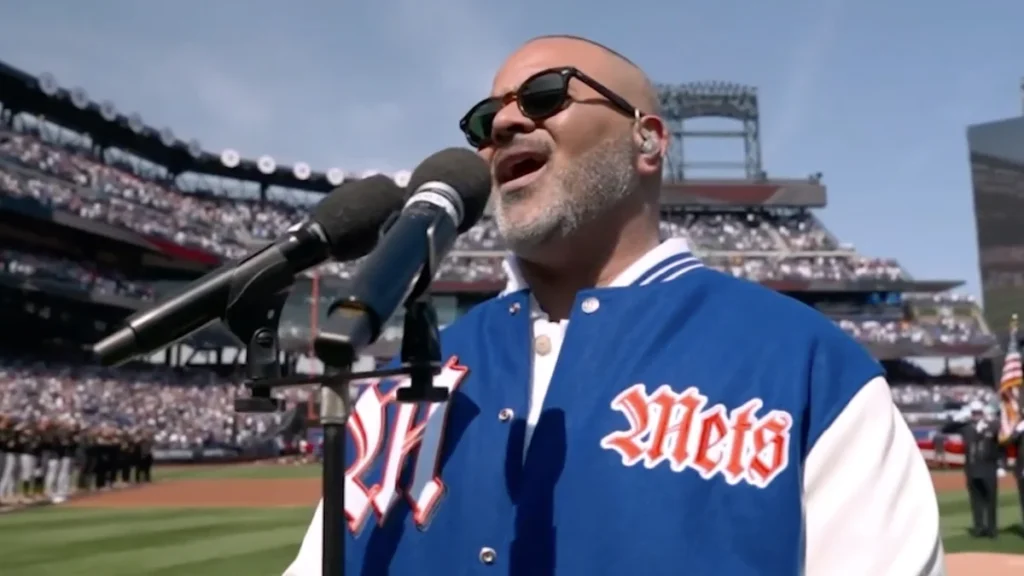

The opening day of the 2026 Major League Baseball season witnessed an unexpected moment of human vulnerability as Christopher Jackson, the acclaimed actor and singer celebrated for his portrayal of George Washington in the Broadway phenomenon Hamilton, momentarily faltered during his rendition of "The Star-Spangled Banner." The incident, which occurred at Citi Field in Queens before the highly anticipated matchup between the New York Mets and the Pittsburgh Pirates, quickly garnered attention across social media and national broadcasts, though it ultimately proved to be a minor footnote in a day filled with the pomp and excitement characteristic of MLB’s annual kickoff.
A Celebrated Performer’s Unexpected Stumble
The atmosphere at Citi Field on March 26, 2026, was electric, a palpable buzz filling the 42,000-capacity stadium as fans gathered to mark the unofficial start of spring and the return of America’s pastime. As part of the traditional pre-game ceremonies, Christopher Jackson, whose voice and stage presence have captivated millions, stepped to the microphone to perform the national anthem. Known for his powerful vocals and meticulous performances, expectations were high for a stirring rendition.
However, during the third verse of Francis Scott Key’s iconic anthem, Jackson experienced a momentary lapse. As he approached the lines "O’er the ramparts we watched, were so gallantly streaming," he inadvertently repeated a phrase from an earlier part of the song, singing "What so proudly we hailed" before a brief, discernible pause. With remarkable composure, he quickly re-centered himself, drawing a breath and resuming with "Were so gallantly streaming," smoothly navigating the remainder of the complex melody and lyrics. The performance, broadcast nationally by Peacock, captured the brief stumble and the swift recovery that followed.
Despite the momentary confusion, the crowd’s reaction was overwhelmingly supportive. A wave of murmuring quickly transformed into encouraging cheers, signaling the audience’s empathy and appreciation for the performer’s effort. By the time Jackson reached the anthem’s powerful crescendo, "O’er the land of the free and the home of the brave," the stands erupted in jubilant shouts and applause, seemingly having already moved past the brief lyrical misstep. The collective energy shifted back to the impending game, a testament to the forgiving spirit of sports fans and the unifying power of the pre-game ritual.
The Luminary Behind the Microphone: Christopher Jackson’s Acclaimed Career
Christopher Jackson’s presence at Citi Field was a reflection of his stature as one of Broadway’s most respected and decorated performers. His career, spanning decades, has been marked by a consistent string of critical and popular successes, establishing him as a versatile talent across stage, screen, and music.
He is perhaps most famously known for originating the role of George Washington in Lin-Manuel Miranda’s groundbreaking musical Hamilton. His portrayal of the stoic, conflicted, and ultimately triumphant first President of the United States earned him widespread acclaim, including a nomination for the Tony Award for Best Featured Actor in a Musical. The role demanded not only exceptional vocal prowess but also a deep understanding of historical character, qualities Jackson delivered with profound impact. As part of the Hamilton original cast, he also shared in the glory of the 2016 Grammy Award for Best Musical Theatre Album, an accolade that underscored the show’s cultural dominance. The irony of the actor who so powerfully embodied the nation’s founding father momentarily forgetting the words to the national anthem was not lost on observers, adding a layer of unexpected narrative to the incident.
Jackson’s contributions to Broadway extend far beyond Hamilton. He originated the role of Benny in Miranda’s earlier success, In the Heights, a performance that further cemented his reputation as a formidable talent. His stage credits also include roles in The Lion King, Memphis, and After Midnight, showcasing his adaptability across various musical genres and theatrical styles. More recently, in 2025, he garnered attention for his role in Hell’s Kitchen, a Broadway jukebox musical inspired by the life and music of Grammy-winning artist Alicia Keys, further demonstrating his enduring appeal and artistic range.
Beyond the stage, Jackson has made significant inroads into television and film. He is a familiar voice to millions of children, having contributed numerous songs to the beloved children’s program Sesame Street, for which he earned an Emmy Award for Outstanding Original Song for "What I Am" in 2011. His television appearances include roles in Bull, Oz, and Fringe, among others, solidifying his presence across multiple entertainment platforms. His consistent excellence and professionalism have built a career founded on precision and dedication, making the national anthem flub a particularly rare and humanizing moment for an artist of his caliber.
The Weight of Tradition: The National Anthem at Sporting Events
The performance of "The Star-Spangled Banner" before major sporting events is a deeply ingrained tradition in American culture, imbued with patriotic significance and a sense of collective identity. The custom dates back to the early 20th century, notably gaining widespread adoption after World War I. While played sporadically before, it was the 1918 World Series, particularly Game 1 in Chicago, where the song was played during the seventh-inning stretch, that cemented its place in sports pageantry. By World War II, it became standard practice to play the anthem before every game, a tradition that has persisted ever since, evolving into a solemn and unifying ritual preceding athletic competition.
The anthem itself, with lyrics penned by Francis Scott Key during the War of 1812 after witnessing the bombardment of Fort McHenry, became the official national anthem of the United States in 1931. Its complex melody and poetic language, while deeply meaningful, can be challenging for even the most seasoned vocalists, especially under the intense pressure of a live performance in front of tens of thousands of people and a national television audience.
Performers tasked with singing the anthem carry a unique burden. They are not merely entertainers; they are momentarily custodians of a national symbol, expected to deliver a flawless and respectful rendition. This inherent pressure has led to a long history of both iconic and infamously botched performances. From Christina Aguilera’s lyrical mix-up at Super Bowl XLV in 2011 to Fergie’s jazzy, widely criticized rendition at the 2018 NBA All-Star Game, and even Roseanne Barr’s deliberately controversial take in 1990, the annals of sports history are dotted with examples of singers struggling with the anthem. These incidents, while often sparking public debate and scrutiny, also serve to underscore the difficulty of the task and the very human element involved in live performance. Christopher Jackson’s momentary lapse, while a minor error, joins this continuum, highlighting that even the most accomplished professionals are not immune to the pressures of the moment.
Opening Day Grandeur: Setting the Scene at Citi Field
Major League Baseball Opening Day is more than just the start of a new season; it’s an unofficial national holiday, a cultural touchstone that signifies renewed hope, fresh starts, and the unfolding drama of America’s national pastime. The 2026 season opener at Citi Field, home of the New York Mets, was no exception. The energy was palpable, a mix of anticipation for the Mets’ prospects and the pure joy of baseball’s return.
Citi Field, with its distinctive architecture and vibrant atmosphere, is a modern cathedral of baseball, designed to evoke the classic ballparks of yesteryear while offering contemporary amenities. Its capacity of approximately 42,000 provides an intimate yet grand setting for such an important event. On Opening Day, the stadium transforms into a focal point of national attention, with elaborate pre-game ceremonies preceding the first pitch. These typically include team introductions, ceremonial first pitches often thrown by celebrities or local heroes, flyovers by military aircraft, and, centrally, the performance of "The Star-Spangled Banner."
The matchup between the New York Mets and the Pittsburgh Pirates carried its own specific weight. For the Mets, a team often under intense scrutiny in the media capital of the world, Opening Day is a chance to set a positive tone for the season. Fans arrive with high hopes, analyzing every roster move and managerial decision made in the off-season. The Pirates, a storied franchise with a passionate fanbase, also looked to start their campaign on a strong note. The anthem, therefore, served not only as a patriotic tribute but also as the ceremonial signal for the impending battle on the diamond, uniting both sets of fans, however briefly, in a shared moment before the rivalry commenced. The magnitude of the event amplified the visibility of Jackson’s performance, making his minor flub a moment of national observation.
Navigating the Aftermath: Reactions and Resilience
In the immediate aftermath of Christopher Jackson’s national anthem performance, the response from the live audience at Citi Field was notably compassionate. Rather than jeers or widespread disapproval, the stadium offered a chorus of supportive cheers and sustained applause, particularly as Jackson regained his footing and concluded the anthem with his characteristic vocal strength. This immediate, positive reinforcement from tens of thousands of attendees underscored a collective understanding and empathy for the human element of live performance.
On social media platforms, initial reactions ranged from surprise and lighthearted commentary to an outpouring of support for the esteemed performer. Many users quickly shared snippets of the performance, but a significant portion of the discourse focused on defending Jackson’s talent and recognizing the difficulty of the task. Phrases like "It happens to the best of them" and "Still sounds amazing" were common, showcasing a public largely willing to overlook a minor error from a beloved artist. There was no widespread condemnation or calls for recrimination, a stark contrast to some past anthem controversies where perceived disrespect or blatant incompetence drew significant ire.
From official channels, there was a predictable lack of formal commentary regarding the incident. Neither Major League Baseball nor the New York Mets organization issued any statements addressing Jackson’s performance, which is standard protocol for such minor, non-controversial events. The focus of the day quickly shifted to the game itself, the traditional Opening Day festivities, and the start of the season. This unspoken acceptance reinforces the idea that the moment was indeed a "blip" rather than a significant incident requiring official acknowledgment or intervention.
Christopher Jackson, a consummate professional, likely experienced personal embarrassment, a natural reaction for any artist striving for perfection. However, his ability to recover seamlessly and finish the anthem strongly speaks volumes about his stage experience and mental fortitude. It is characteristic of seasoned performers to absorb such moments, learn from them, and move forward without dwelling excessively, understanding that the show must always go on. The incident, therefore, served as a humanizing glimpse into the high-pressure world of live performance, even for an artist of Jackson’s exceptional caliber.
Beyond the Blip: Analyzing the Long-Term Impact
The incident involving Christopher Jackson’s national anthem performance is poised to be precisely what the initial reports suggested: a minor bump in an otherwise illustrious and highly respected career. In the broader context of his extensive body of work on Broadway, television, and in music, a brief lyrical lapse during a live performance is unlikely to leave any lasting stain on his legacy. His numerous awards, including a Grammy for Hamilton and an Emmy for Sesame Street, along with his consistent critical acclaim, firmly establish him as a performer of exceptional talent and integrity.
The episode serves as a powerful reminder of the inherent challenges of live performance. Unlike recorded works, live events offer no retakes or edits, demanding absolute focus and real-time problem-solving from the artist. Even the most prepared and experienced individuals can fall prey to nerves, a momentary mental block, or the sheer pressure of performing under intense public scrutiny. Jackson’s recovery demonstrated not only his professionalism but also the resilience required to thrive in such environments.
Crucially, the nature of Jackson’s flub was one of honest human error, devoid of any perceived disrespect or political statement. This distinguishes it sharply from other controversial anthem performances that have sparked widespread debate or outrage due to perceived artistic liberties, political protest, or blatant disregard for the song’s gravitas. In Jackson’s case, the overwhelming public sentiment leaned towards empathy and understanding, reflecting a general appreciation for his genuine effort and swift recovery.
In the fast-paced news cycle and the ever-churning content landscape of the internet, even moments that briefly go viral often fade from collective memory quickly. While a video clip of the incident might circulate for a short period, it is highly improbable that this event will become a defining moment of Jackson’s career. Instead, it will likely be relegated to a footnote, a minor anecdote occasionally recalled but never overshadowing his significant contributions to the arts.
Ultimately, the 2026 MLB Opening Day at Citi Field continued its celebratory course after the anthem. The New York Mets and Pittsburgh Pirates commenced their season, and fans enjoyed the return of baseball. Christopher Jackson, having delivered a performance that was ultimately strong despite a brief, human error, reinforced his status as a remarkable talent whose occasional vulnerability only served to endear him further to an appreciative audience. His career continues to flourish, a testament to his enduring skill and the public’s willingness to forgive minor imperfections from artists who consistently deliver excellence.