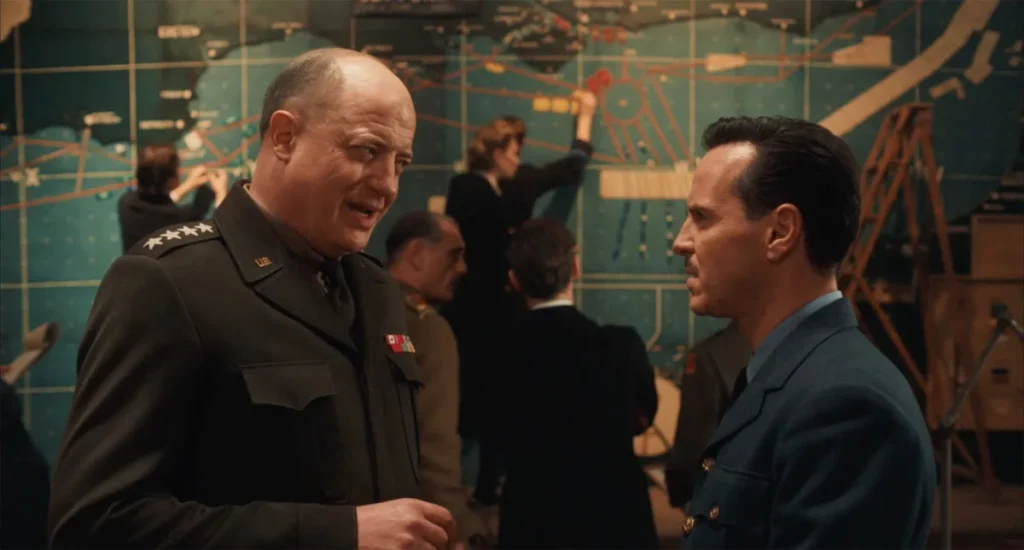

Studiocanal has unveiled a compelling new international trailer for the World War II drama Pressure, a film that plunges into the high-stakes decisions surrounding the D-Day landings. Scheduled for release in US theaters on May 29, 2026, and later in the UK on September 9, 2026, the movie focuses on the pivotal role of meteorology in the success of one of history’s most significant military operations. The trailer, released via YouTube, amplifies the tension inherent in the film’s premise: the fate of the free world rested, in part, on the accuracy of a weather forecast.
The Precipice of Invasion: A Chronicle of Critical Decisions
Pressure dramatizes the harrowing 72 hours leading up to June 6, 1944, the originally planned date for the Allied invasion of Normandy, codenamed Operation Overlord. The film centers on the immense pressure faced by Royal Air Force meteorologist Captain James Stagg, portrayed by Andrew Scott. Stagg’s responsibility was to provide General Dwight D. Eisenhower, played by Brendan Fraser, and the Allied high command with a precise weather assessment that would determine whether to launch the invasion or postpone it. The success of the amphibious assault, the largest in history, was intrinsically linked to favorable weather conditions, with storm surges, high winds, and poor visibility posing catastrophic risks to the invading forces.

The film’s narrative is deeply rooted in historical fact, highlighting the immense uncertainty that characterized the final days before D-Day. Allied planners had a narrow window of opportunity, dictated by tidal patterns and lunar illumination, which further intensified the criticality of Stagg’s meteorological predictions. A miscalculation could have led to a devastating defeat, potentially altering the course of World War II and its outcome.
A Stellar Ensemble Navigates the Storm of War
Beyond the central performances of Scott and Fraser, Pressure boasts a formidable cast that brings to life the key figures involved in the D-Day decision-making process. Kerry Condon appears as Captain Kay Summersby, a trusted aide to Eisenhower. Damian Lewis takes on the role of Field Marshal Bernard Montgomery, a senior British commander. Chris Messina is cast as Irving P. Krick, an American meteorologist whose differing forecast presented a significant point of contention. The ensemble is further bolstered by Henry Ashton as John Eisenhower, Con O’Neill, Daniel Quinn-Toye, Toby Williams, and Max Croes, rounding out a cast that promises to deliver nuanced portrayals of individuals under extraordinary duress.
The film is directed by Anthony Maras, an Australian filmmaker known for his work on the intense thriller Hotel Mumbai. Maras brings a proven ability to craft suspenseful narratives rooted in real-world events. The screenplay, penned by David Haig and Maras, is an adaptation of David Haig’s 2014 stage play of the same name. The production is helmed by experienced producers Tim Bevan and Eric Fellner, whose extensive filmographies suggest a commitment to quality filmmaking.

The Meteorological Gamble: Historical Context and Implications
The decision to proceed with D-Day was a monumental gamble, and weather forecasting in 1944, while advanced for its time, was far from the precise science it is today. Captain James Stagg and his team relied on a combination of observational data, atmospheric models, and expert judgment. The prevailing meteorological conditions in the English Channel were notoriously unpredictable, and a significant storm system was developing off the coast of Iceland. Stagg’s primary challenge was to ascertain if this storm would pass quickly enough to allow for a brief period of favorable weather for the invasion fleet and the airborne landings.
The existence of conflicting forecasts, particularly from Irving P. Krick who famously predicted clearer skies, underscores the immense pressure and the scientific uncertainty faced by the Allied command. Krick’s more optimistic outlook was influenced by different interpretations of the available data and perhaps a greater willingness to accept risk. Ultimately, it was Stagg’s more cautious assessment, predicting a temporary lull in the weather, that swayed General Eisenhower. The decision to launch on June 6th was based on this narrow forecast of a brief window of opportunity, a testament to the critical role of meteorological intelligence in military planning.
The successful execution of D-Day, despite challenging weather, is a pivotal moment in World War II. The landings established a crucial second front in Western Europe, a vital step towards the eventual defeat of Nazi Germany. The film Pressure seeks to illuminate this often-overlooked aspect of the operation, demonstrating how a scientific prediction, made under the most extreme circumstances, directly influenced the trajectory of global conflict.

A New Perspective on a Historic Turning Point
The release of this new international trailer for Pressure comes after the debut of the first official trailer last month. Early reactions suggest that this latest preview offers a more potent and engaging glimpse into the film’s dramatic core. The emphasis on the race against time and the personal stakes for the characters involved, particularly Captain Stagg and General Eisenhower, is amplified. The trailer effectively conveys the claustrophobic tension of the war room and the immense weight of the decision that rests on the shoulders of a few key individuals.
The film’s focus on the human element behind the strategic decisions provides a fresh perspective on a well-documented historical event. By delving into the personal anxieties, the scientific debates, and the moral quandaries faced by those involved, Pressure aims to offer an intimate and compelling portrayal of a turning point in history. The film is poised to engage audiences with its gripping narrative, historical accuracy, and strong ensemble cast.
Broader Impact and Anticipation for Release
The timing of Pressure‘s release, with its focus on a pivotal moment in World War II, is significant. In an era where historical dramas continue to resonate with audiences, the film offers a unique angle by highlighting the often-underestimated influence of science and forecasting in warfare. The success of D-Day had profound geopolitical implications, leading to the liberation of Western Europe and ultimately contributing to the Allied victory. Understanding the intricate planning and the critical decisions, including those based on meteorological intelligence, provides a deeper appreciation for the scale and complexity of the war effort.

The film’s ensemble cast, featuring established actors like Brendan Fraser and Andrew Scott, is likely to draw considerable attention. Fraser’s recent resurgence in popular cinema, coupled with Scott’s acclaimed performances, suggests a strong box office appeal. The film’s production values, evident even in the trailer, further enhance its promise as a significant cinematic event.
As Pressure prepares for its theatrical debut, anticipation is building for a film that promises to be both an educational and a thrilling cinematic experience. The trailer has successfully generated interest by posing the central question: "If we delay, we will lose this war." The film’s exploration of the answer, hinging on the unpredictable nature of weather and the courage of those who made the ultimate decision, is set to captivate audiences worldwide. The narrative serves as a potent reminder that even in the grandest of conflicts, the smallest details, such as the direction of the wind, can hold the balance of fate.