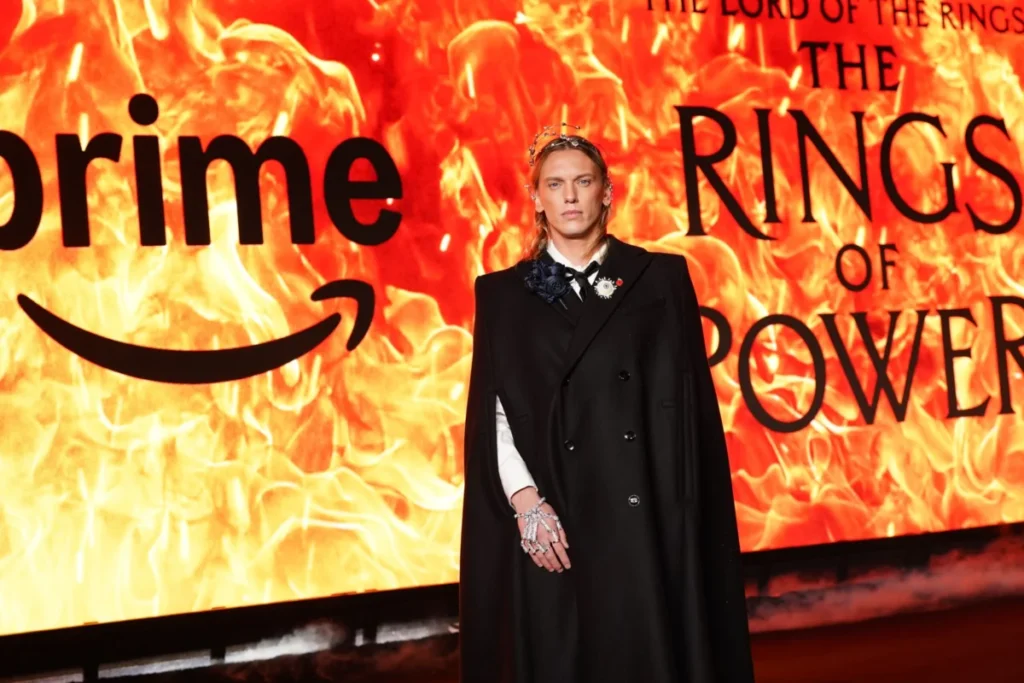

The landscape of modern fantasy television is defined by its commitment to moral ambiguity and complex character archetypes, a genre in which British actor Jamie Campbell Bower has firmly established himself. Known for his chilling portrayals of antagonists—most notably the formidable Vecna in Netflix’s Stranger Things and the dark wizard Gellert Grindelwald in the Fantastic Beasts film series—Bower has pivoted toward a more introspective and ethereal role for his latest endeavor. Joining the expansive cast of Amazon Prime Video’s The Lord of the Rings: The Rings of Power, the 37-year-old actor now takes on the mantle of the Elven lord Celeborn, the long-lost husband of the formidable Galadriel, portrayed by Morfydd Clark.
This transition from the depths of darkness to the light of Middle-earth’s noble lineage has, by Bower’s own admission, presented an unexpected set of professional hurdles. In a recent interview, he articulated that the absence of malicious intent in his new character does not equate to a lack of dramatic weight; rather, it introduces a subtle, persistent complexity that challenges the actor’s established methodology.
The Complexity of the Light: A Shift in Characterization
In the canon of J.R.R. Tolkien, Celeborn is a figure of grace, wisdom, and profound emotional endurance. For an actor who has spent significant portions of his career dissecting the motivations of villains, the pivot to a character who actively chooses a "lighter path" requires a different psychological toolkit. Bower suggests that while his previous roles—driven by trauma, revenge, or a desire for dominion—offered clear, albeit dark, objectives, the nobility of an Elven lord requires a constant, active maintenance of virtue despite the inevitability of suffering.
"It’s not that Celeborn doesn’t suffer—because he does," Bower noted during a recent promotional event in London. "It’s just that he chooses a different path to the character that I played before. The character I played before suffered and chose a path of suffering for others, whereas Celeborn suffers and tries to continually choose a sort of lighter path. I think it certainly felt at times more challenging to take on that opportunity for him to choose the lighter path, because you go, ‘How? Why is he not just sitting in the ownness of it all the time?’"

This analysis highlights a fundamental difference in acting craft: the externalization of malice versus the internal preservation of hope. For Bower, the challenge lies in the restraint required to maintain the character’s integrity without succumbing to the cynicism that has defined his more notorious performances.
A Legacy Spanning Decades: Contextualizing The Rings of Power
The Rings of Power occupies a unique position in the pantheon of high-budget television. Set thousands of years before the events of J.R.R. Tolkien’s seminal 1954 novel, The Lord of the Rings, the series acts as a grand architectural project, constructing the history of Middle-earth’s Second Age.
The production timeline for the show has been historic in its scale. Since its inception, the series has operated under a massive logistical framework. Reports indicate that the development and initial production phases spanned nearly eight years, reflecting the sheer ambition of adapting Tolkien’s appendices and supplementary lore. For the actors involved, this longevity brings an inherent weight of expectation. The fandom surrounding Tolkien’s work is notoriously detail-oriented, and the pressure to uphold the source material’s philosophical gravity is immense.
"It’s very daunting at times," Bower confessed. "I think that pressure is very internal on my end. I don’t think there’s a project that I’ve done where I haven’t felt that level of pressure. Of course, you add into that how loved this is… you want to do the best that you can do, and honor it and the work."
Production Data and Industry Impact
The Rings of Power is widely regarded as one of the most expensive television productions in history. Amazon’s initial investment in the rights to the franchise, coupled with the staggering production budgets for each season, has set a high benchmark for the genre. With the third season slated for release on November 11, the industry is closely monitoring the show’s ability to sustain its audience engagement.

Supporting data regarding the show’s performance indicates that while it faced significant scrutiny upon its debut, the narrative expansion into the Second Age has successfully broadened the franchise’s appeal to a new generation of viewers. The integration of characters like Celeborn—who appear only sporadically in the original trilogy’s narrative—allows for a deeper exploration of Elven society, their internal politics, and their long-standing conflicts with the rising threat of Sauron.
Aesthetic and Cultural Presence
During the recent London event, the cast’s public appearance served as a testament to the show’s visual identity. Bower’s appearance was particularly striking, as he sported an ornate gold headpiece that complemented his long, platinum hair, echoing the regal and timeless aesthetic associated with the Elven race. This attention to detail—from the costumes to the intricate set designs—is a hallmark of the series’ commitment to world-building.
He was accompanied by co-stars Morfydd Clark, whose presence as Galadriel continues to be a cornerstone of the narrative, and Charlie Vickers. The chemistry between the cast members, as evidenced by their collaborative promotion of the series, suggests a cohesive production environment that has managed to navigate the immense pressure of living up to the Tolkien legacy.
Analytical Implications: The Future of Fantasy
The shift in Bower’s performance style serves as a microcosm for the evolution of the fantasy genre itself. Historically, fantasy villains were often portrayed with one-dimensional malice. Modern audiences, however, have shown a preference for characters that occupy the "grey areas" of morality. By moving from a character who spreads suffering to one who actively resists it, Bower is exploring the nuances of heroism.
The implication for the industry is clear: actors who can portray internal conflict with the same intensity as external threat are becoming the most valuable assets in high-stakes fantasy television. As the series moves into its third season, the narrative arc of Celeborn is expected to provide a necessary counterbalance to the darker themes emerging from the shadows of Mordor.

For the production team, maintaining this balance is crucial. The show must continue to satisfy the rigorous standards of Tolkien scholars while simultaneously functioning as a compelling, modern drama for a mainstream audience. The casting of an actor with Bower’s specific history—one who understands the mechanics of fear and is now applying that knowledge to the mechanics of grace—is a strategic choice that adds layers of depth to the upcoming episodes.
Looking Toward the Premiere
As the November 11 premiere of the third series approaches, anticipation remains high. The narrative is poised to delve deeper into the origins of the rings themselves and the intricate webs of deception that will eventually lead to the events familiar to filmgoers. With the introduction of more complex character dynamics, The Rings of Power is positioning itself as a foundational piece of television that seeks to do more than just entertain; it aims to examine the philosophical endurance of those who stand against the tide of history.
Jamie Campbell Bower’s evolution as a performer, mirrored in his current role, suggests that the series will continue to prioritize character depth over simple spectacle. By choosing to embrace the "lighter path," Bower is not just playing a hero; he is exploring the difficult, often painful, choice to remain good in a world that is increasingly defined by its darkness. This nuanced approach will likely remain a defining feature of the series as it progresses toward the inevitable conclusion of its sprawling narrative.