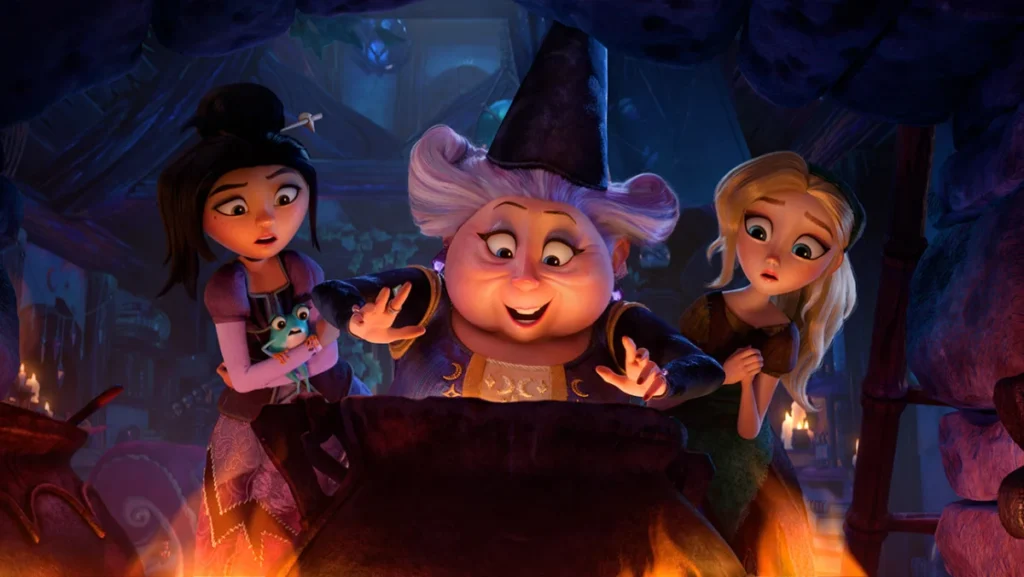

Netflix continues its aggressive expansion into family-friendly animated features with the release of Steps, a candy-colored musical fantasy that attempts to turn the classic Cinderella narrative upside down by framing the traditionally maligned stepsisters as misunderstood protagonists. Directed by Alyce Tzue and John Ripa, and produced by industry veteran Amy Poehler, the 101-minute PG-rated feature arrived on the streaming platform ahead of the Thanksgiving holiday, a strategic release window designed to capture family audiences looking for shared viewing options. Despite boasting a glittering ensemble voice cast that includes Amanda Seyfried, Ali Wong, Stephanie Hsu, Peter Dinklage, Bette Midler, and Daniel Radcliffe, the film struggles under the weight of a convoluted plot, overstuffed writing credits, and an aggressively modern yet weary aesthetic that fails to capture genuine cinematic magic.
The genesis of Steps dates back to an original concept conceived by comedy folk duo Riki Lindhome and Kate Micucci, professionally known as Garfunkel and Oates. Their initial premise—exploring the untold perspectives of Cinderella’s stepsisters—was eventually handed over to an extensive writers’ room. The screenplay is formally credited to five distinct writers: Ava Tramer, James Madejski, Jen Chuck, Dana Schwartz, and Felicia Ho, with a story credit distributed among six individuals. This outsize assembly line of creative input ultimately imparts a distinct committee-crafted quality to the final product, stripping away spontaneity, emotional resonance, and narrative cohesion. Consequently, the narrative frequently feels disjointed, oscillating between fast-paced, high-concept musical numbers and sluggish, exposition-heavy dialogue sequences that demand considerable patience from viewers.
Narrative Overview and Character Dynamics
The central conceit of Steps shifts focus away from the titular glass-slipper wearer, positioning her instead as a secondary figure in the lives of her stepfamily. Ali Wong lends her voice to Lilith, a punky, rebellious teenager determined to correct what she terms the historical “character assassination” of her lineage. Alongside her is Margot, voiced by Stephanie Hsu, a profoundly innocent and affectionate younger sibling whose defining characteristic is an unwavering love for all living things, particularly amphibians.
The inciting incident occurs when the sisters’ mother, a dressmaker named Li Mei (voiced by Gwendoline Yeo), falls in love and marries Edmund (Matt Lowe). The newly blended family relocates to the whimsical, macaroon-hued kingdom of Alouette. Edmund’s cheerful daughter, Cinderella (Amanda Seyfried), warmly welcomes her new stepsisters. However, the family’s traditional 18th-century French rococo environment clashes immediately with Lilith and Margot’s dark hair and traditional Asian-inspired garments, instantly marking them as social outsiders within the pastel-drenched kingdom.
Tensions escalate rapidly when the family attends a high-society tea party hosted by Priscilla, a vain, status-obsessed antagonist voiced by Nikki Glaser. Priscilla’s parents have placed her under the watchful eye of a sinister butler named Roderick, portrayed by Peter Dinklage, whose physical performance reportedly mimics a high-intensity, rigid-armed sprinting style. When Lilith attempts to captivate the party guests with an exotic folktale, Priscilla views the display as a direct challenge to her social dominance. In retaliation, she tricks Lilith and Margot into entering a gated storm drain, locking them inside. Caught between loyalty to her newly acquired stepsisters and the powerful social gravity of her elite peers, Cinderella ultimately chooses self-preservation and peer alignment, planting the seeds of an inevitable betrayal.
Unlike traditional iterations where Cinderella endures a life of domestic servitude, this version portrays her as an obsessive neat freak who cleans her home voluntarily, aided by a chorus of forest animals. As preparations for the Royal Ball commence, Lilith and Margot find themselves deliberately excluded from the guest list, subjected to public mockery by Priscilla. The plot thickens when Lilith observes Cinderella receiving magical assistance from her Fairy Godmother, played by Bette Midler, who has dedicated her entire existence to securing Cinderella’s marriage to the kingdom’s handsome Prince, voiced by Daniel Radcliffe.
Chronology of the Climax and Resolution
Desperate to alter their circumstances, Lilith and Margot devise a counter-strategy. They manage to intercept the Fairy Godmother’s magical wand, utilizing it to conjure a goth-glamour aesthetic complete with a skull-shaped carriage reminiscent of Tim Burton’s cinematic style. The sisters crash the Royal Ball, injecting chaotic energy into the festivities. However, disaster strikes when the treacherous Priscilla manages to seize the wand from them.
Utilizing the stolen magic, Priscilla convinces the Prince that she is his true love, effectively fracturing the established fairy tale chronology. She dispatches the rigid and intense Roderick to pursue Cinderella, Lilith, and Margot. During the chaotic escape, Margot is accidentally transformed into a talking frog. This sets off a secondary quest through the enchanted wilderness, where the characters must navigate various trials. Along their journey, they encounter a gentle-hearted troll named Gef, voiced by Young Mazino, who has been cast out by his cruel brother Craktor—a character physically and temperamentally inspired by WWE star Damian Priest.
The overarching narrative resolutions are predictable: Cinderella must race against the midnight clock to prove her authenticity to the Prince, the stepsisters must reconcile their differences to discover the true power of familial bonds, Margot must find a way to revert to her human form, and Lilith must navigate her own path toward emotional fulfillment. Yet, directors Alyce Tzue and John Ripa spend an inordinate amount of runtime navigating this forest odyssey, causing the film’s pacing to drag significantly during its middle acts.
Production Design, Music, and Industry Context
Visually, Steps attempts to capitalize on contemporary animation trends by merging Korean animation styling with traditional Disney character aesthetics. The character designs feature exaggerated round faces and expansive saucer-like eyes, echoing stylistic choices seen in recent streaming hits such as Netflix’s KPop Demon Hunters. This cross-cultural pastiche is further emphasized by a high-energy pop credit track performed by Jennie of the globally renowned K-pop group Blackpink.
Despite these intentional stylistic nods, industry analysts and critics have noted that the cross-cultural integration often feels tentative and superficial, functioning more as a calculated market trend-chasing exercise than an organic artistic choice. The pervasive pastel color palette—dominated by excessive pink hues—has drawn mixed reactions from viewers, with some praising its vibrant whimsy and others finding it visually fatiguing over the course of a feature-length runtime.
Musically, the film benefits from original compositions penned by Justin Tranter. Amanda Seyfried delivers standout vocal performances, utilizing her crystalline range to elevate the soundtrack, while Bette Midler brings her decades-long comedic expertise to her role as the pragmatic Fairy Godmother. Nevertheless, critics point out that even these seasoned performers are frequently constrained by uninspired dialogue and a lack of character depth, making it difficult for the audience to form genuine emotional attachments to the digital avatars on screen.
Broader Implications for Netflix Animation Strategy
The release of Steps underscores Netflix’s ongoing strategy to capture family viewing blocks during major domestic holidays. By deploying star-studded voice casts and recognizable modern subversions of classic public domain fairy tales, the streaming giant aims to secure high initial viewership numbers among families with children ranging from toddlers to tweens.
However, the critical reception of Steps highlights an ongoing challenge within the streaming-first animation model: the risk of creative dilution caused by committee-driven writing processes. When multiple writers and story originators contribute to a single project, the resulting narrative frequently struggles to maintain a unified voice or distinct artistic vision. While younger demographics—particularly young girls—may find sufficient diversion in the film’s bright colors, musical numbers, and modernized moral about sisterhood, the project ultimately serves as a cautionary tale regarding the limitations of formulaic intellectual property reinvention in the modern animation landscape.