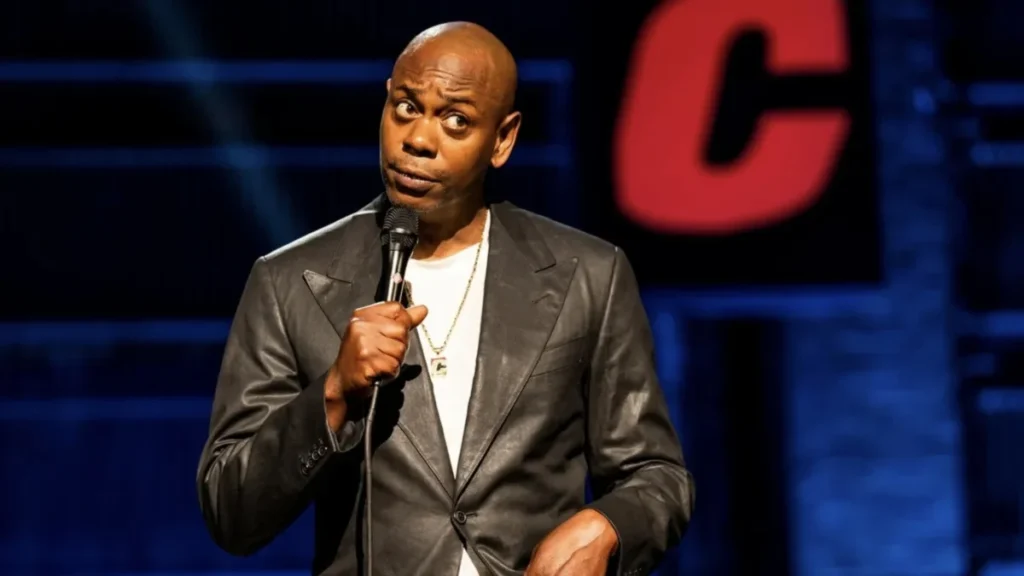

The comedy world and the broader political landscape are currently navigating the fallout from a high-profile performance by Dave Chappelle at Madison Square Garden this past weekend. During his set as part of the New York Comedy Festival, the legendary comedian made provocative remarks regarding the 2025 assassination of conservative political commentator Charlie Kirk. The comments, which have ignited a firestorm on social media and drawn sharp rebukes from prominent figures, have once again placed Chappelle at the epicenter of a national debate concerning the boundaries of speech, public mourning, and the role of the comedian in a polarized society.
The Madison Square Garden Incident
The controversy began when a low-quality video recording of Chappelle’s performance began circulating on social media platforms. The clip, which appears to be a secondary recording of a screen rather than a direct feed from the stage, captures Chappelle discussing the risks associated with public speaking in the modern era. In the footage, Chappelle is heard stating, "I feel fucked up saying this. It’s scary being a public speaker . . . Ever since that guy Charlie Kirk got murdered, and I shouldn’t say this publicly, but, I feel better."
The audience’s response, captured in the audio, was a mixture of hesitant laughter and audible tension. Chappelle seemingly acknowledged the gravity of his own words, adding, "I know I shouldn’t say that. But, it’s just a feeling."
Because Chappelle’s live shows maintain a strict "phone-free" policy—utilizing secure pouches to prevent the use of personal recording devices—the emergence of this clip has led to intense speculation regarding its provenance. The nature of the footage, which does not appear to be an official capture of the stage, suggests that a patron may have bypassed security protocols, potentially leading to further scrutiny of the comedian’s tour management and venue policies.
Corroboration and Public Outcry
Following the initial leak of the video, Rob Henderson, a writer and senior fellow at the Manhattan Institute, corroborated the reports. Henderson, who attended the performance, posted to social media that he personally witnessed Chappelle double down on the sentiment. According to Henderson, the comedian remarked, "I’m so happy Charlie Kirk was killed. I can’t help it, it’s involuntary."
The interaction between the video and Henderson’s public account quickly gained traction, accumulating nearly 7 million views within 48 hours. Among the many voices weighing in was Elon Musk, who, despite his well-documented public advocacy for the principle of absolute free speech on his platform, X, responded to a thread criticizing the comedian with the post: "Shame, shame, shame on Chappelle." This reaction has been highlighted by political analysts as a significant indicator of the current cultural climate, where even those who champion unrestricted expression are finding themselves alienated by the specific nature of Chappelle’s recent rhetoric.
Contextualizing the 2025 Assassination
To understand the weight of Chappelle’s comments, one must look back at the events of 2025. Charlie Kirk, a prominent conservative activist and founder of Turning Point USA, was assassinated while attending an event at a university in Utah. The murder sent shockwaves through the American political establishment and brought the rising tide of political violence into sharp focus.
In the wake of his death, public discourse was heavily divided, with some mourning Kirk as a defender of conservative values and others criticizing his rhetoric as inflammatory. The assassination occurred during a period of heightened domestic instability, leading to widespread debates about the safety of public speakers, journalists, and activists who operate in high-visibility environments.
Chappelle’s History with the Subject
This is not the first time Dave Chappelle has integrated the death of Charlie Kirk into his professional material. In his 2025 Netflix special, The Unstoppable, Chappelle dedicated a portion of his set to the aftermath of the killing. During that performance, he expressed a personal sense of vulnerability, noting that he feared his own provocative brand of comedy—specifically his commentary on the transgender community—might make him a target for similar violence.
In The Unstoppable, Chappelle also sought to address the public comparisons that were being drawn between Kirk’s death and the assassination of Dr. Martin Luther King Jr. Chappelle rejected these comparisons outright, stating, "They both got murdered in a terrible fashion. They both got shot in the neck, but that’s about where those similarities ended."
He further deconstructed the nature of the "internet personality," arguing that figures like Kirk were fundamentally different from historical civil rights leaders. Chappelle posited that the current digital ecosystem incentivizes antagonism: "Charlie Kirk’s an internet personality—by design. Fundamentally, he can’t function like Dr. King. Internet [personalities] are negative because they have to be. No one will engage them unless they say shit that makes them upset."
Broader Implications for Free Speech and Comedy
The current controversy touches upon several complex issues regarding the role of the artist. Philosophically, comedy has long served as a pressure valve for societal tensions, often allowing for the exploration of dark, uncomfortable, or even taboo subjects. However, the line between social commentary and the perceived endorsement of violence is a narrow one.
Analysts suggest that Chappelle’s comments represent a shift in the traditional "contract" between comedian and audience. When a performer uses their platform to express a sense of relief or satisfaction regarding the death of a real-world political figure, they invite a different level of scrutiny than they would when critiquing abstract policy.
Furthermore, the involvement of figures like Elon Musk in the public condemnation of the remarks illustrates how the "free speech" movement is increasingly fracturing. The debate is no longer solely about whether a comedian has the right to say something, but about whether the public has the right to demand social accountability when those words are perceived as celebrating the loss of human life.
The Professional and Security Fallout
For Madison Square Garden and the producers of the New York Comedy Festival, the incident presents a logistical challenge. If the "phone-free" policy was successfully breached, it may lead to stricter enforcement protocols, including more rigorous security screenings or the implementation of signal-jamming technology, which itself presents a host of ethical and legal concerns.
Additionally, industry insiders suggest that such controversies often lead to a chilling effect on booking agents and event sponsors. While Chappelle has historically remained "unstoppable" in terms of his career trajectory, the combination of widespread public backlash and the disapproval of influential tech and media moguls could lead to a reassessment of his commercial viability in certain mainstream markets.
Future Outlook
As of this writing, representatives for Dave Chappelle have not issued an official statement regarding the Madison Square Garden performance or the subsequent social media reaction. The comedian is known for his stoic approach to controversy, often preferring to address criticism through his work rather than through formal press releases.
The incident serves as a stark reminder of the volatility of the current American cultural landscape. As the country continues to grapple with the memory of the 2025 political violence and the ongoing, often vitriolic, discourse surrounding public figures, the role of the artist in navigating this terrain remains fraught with peril. Whether Chappelle’s latest comments will be viewed by history as a bold piece of social provocation or an egregious overstep remains to be seen, but the immediate reaction indicates that the conversation regarding his performance is far from over.
The incident has undeniably deepened the existing divide between those who view comedy as a sacrosanct space for any expression and those who believe there are moral red lines that even the most acclaimed performers should not cross. As the video continues to circulate and the debate continues to unfold on global platforms, the case of Dave Chappelle and Charlie Kirk stands as a defining moment in the intersection of celebrity, political violence, and the evolving nature of public speech.