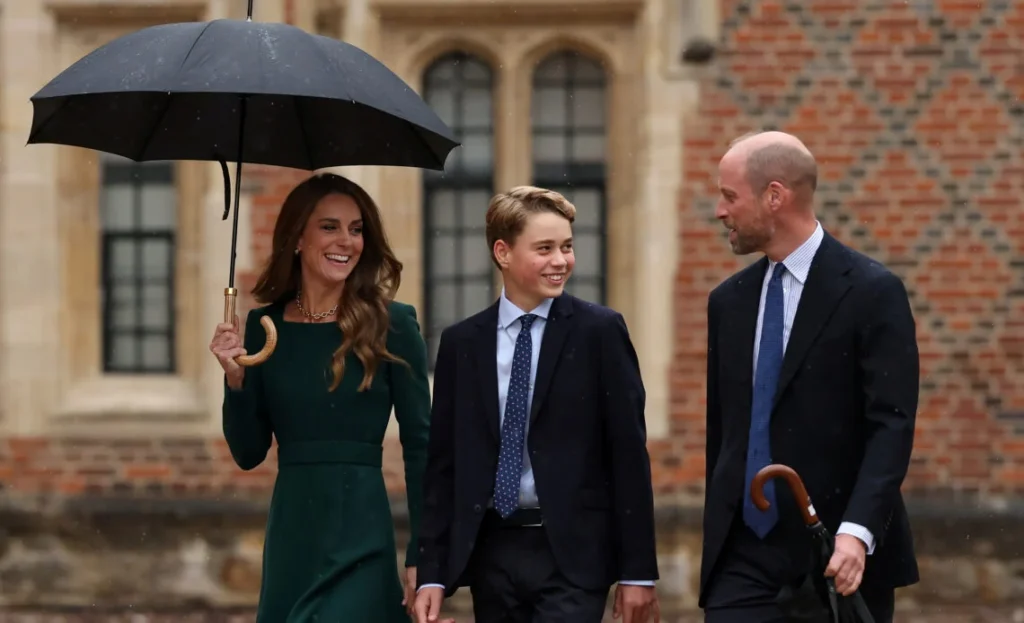

The modernizing ethos of the British Monarchy faced another visible evolution this week as the Prince of Wales and his eldest son, thirteen-year-old Prince George, were captured by fellow passengers boarding a routine commercial flight to Spain. The father and son duo bypassed the customary protocol of private aviation—and the historic restrictions governing the line of succession—to travel together on a British Airways service bound for Barcelona. Their destination was the iconic Spotify Camp Nou, where they intended to support their favored English Premier League club, Aston Villa, in a high-stakes UEFA Champions League fixture against FC Barcelona.
Footage of the future monarchs standing among everyday travelers during the final moments of the flight quickly circulated across social media platforms, sparking widespread public discussion regarding the shifting boundaries of royal protocol. While members of the senior royal family frequently utilize commercial carriers for both official and private engagements, the simultaneous presence of the first and second in line to the British throne on a single aircraft directly challenges a decades-old convention designed to safeguard the institutional stability of the Crown.
The unwritten rule, which discourages direct heirs from traveling together, has long served as a preventative measure against catastrophe. Yet, as the institution navigates a transition toward contemporary sensibilities and environmental consciousness, the strict adherence to these mid-20th-century safety practices appears to be softening under the stewardship of the current generation of senior royals.
The Evolution of Royal Succession Travel Protocols
For generations, the logistics governing the travel of the British royal family have been defined by caution and contingency planning. At the core of these arrangements is the protection of the line of succession. Prince William currently stands as the direct heir to the British throne, followed immediately by his eldest son, Prince George, who reached his thirteenth birthday in July 2026. Behind them in the order of succession are Prince George’s younger siblings, Princess Charlotte and Prince Louis, followed by Prince Harry.
Historically, the rationale behind restricting direct heirs from sharing a mode of transport—particularly aircraft—was rooted in the imperative to prevent a simultaneous tragedy that could destabilize the crown or trigger a sudden, unprepared regency. Aviation accidents, while statistically rare, carried catastrophic potential for an institution whose continuity is paramount to the constitutional framework of the United Kingdom and the Commonwealth realms.
However, these guidelines have never been codified into statutory law. Instead, they have functioned as internal working guidelines, adapted, interpreted, and occasionally bypassed according to the preferences of the reigning monarch and the practical demands of modern family life.
Former royal pilot Graham Laurie, who spent decades at the helm of the Royal Squadron, provided public insight into how these rules were enforced during the late twentieth century. According to Laurie, strict separation protocols were applied to Prince William as soon as he reached his twelfth birthday. Prior to that milestone, William had frequently flown alongside his parents, the then-Prince and Princess of Wales, and his younger brother, Prince Harry, under explicit dispensations granted directly by Queen Elizabeth II. Once William attained the age of twelve, however, he was required to board a separate aircraft from his father to ensure that a single accident could not imperil two successive generations of heirs.
With Prince George celebrating his thirteenth birthday in the summer of 2026, he has officially passed the historical threshold at which his father was required to travel independently. The recent flight to Barcelona suggests that Prince William and Catherine, the Princess of Wales, have chosen a more integrated, contemporary approach to family travel, aligning more closely with the lived experiences of ordinary citizens than with the rigid compartmentalization of past eras.
A Public Sighting Aboard British Airways
The journey itself became a matter of public record not through an official dispatch from Kensington Palace, but through the observations of fellow passengers. Video footage shared across digital platforms showed Prince William and Prince George preparing to disembark from the aircraft, blending seamlessly with the routine exodus of travelers arriving in Catalonia.
Keen-eyed observers quickly noted that the royals were not sequestered within a private first-class cabin, but were instead seated in the standard sections of the aircraft. Social media commentary highlighted the humility of the arrangement, with users remarking on the absence of visible barriers between the future kings and the traveling public. Such sightings reinforce a deliberate branding strategy cultivated by William and Catherine over the past decade, wherein accessibility and relatability are prioritized over aristocratic detachment.
This is not the first time senior members of the royal household have opted for commercial aviation. Prince William famously utilized a commercial service for a transatlantic journey from New York to Washington, D.C., in 2014, ahead of official engagements at the White House. Similarly, the Princess of Wales has occasionally been spotted utilizing British Airways for personal travel. Nevertheless, the combination of a commercial booking, an economy-tier environment, and the simultaneous presence of two direct heirs transformed a routine flight into a significant cultural moment.
Kensington Palace has consistently maintained a policy of declining to comment on the private travel arrangements of the Prince and Princess of Wales and their children, treating such journeys as private family matters. Consequently, it remains unconfirmed whether formal consultations or permissions were sought prior to the booking, though the public nature of the trip implies a calculated acceptance of visibility.
Football, Rain, and Royal Fandom in Catalonia
Beyond the geopolitical and institutional implications of their travel arrangements, the primary objective of the father-son excursion was sporting leisure. The timing of the trip coincided with the United Kingdom’s school half-term break, offering a brief window for personal travel before the resumption of academic and public duties.
Aston Villa, the historic West Midlands football club passionately supported by Prince William, had secured a fixture against Spanish giants FC Barcelona at the renowned Spotify Camp Nou. The match carried considerable sporting weight within the Champions League tournament, drawing thousands of traveling supporters to the Catalan capital. Despite inclement weather conditions that brought heavy rain to the stadium, the Prince of Wales and Prince George were observed in the stands, visibly engaged in the match and offering vocal support for their team.
The presence of British royalty did not go unnoticed by the host club. FC Barcelona officials publicly acknowledged the attendance of the royal visitors prior to kickoff, extending standard diplomatic and institutional courtesies to the future king and his heir. For Prince George, who has increasingly accompanied his father to high-profile sporting fixtures—including domestic cup finals and international rugby matches—the evening offered a glimpse into the public engagements that will eventually define his adult life, balanced against the shared camaraderie of a father and son enjoying a mutual passion for sport.
Broader Impact and Institutional Implications
The decision by the Prince and Princess of Wales to permit father and son to travel together on a commercial flight carries broader implications for the trajectory of the modern British monarchy. As the institution confronts the pressures of the twenty-first century, it faces a continuous balancing act: maintaining the mystique and historical continuity necessary for its survival, while demonstrating fiscal responsibility, environmental awareness, and cultural relevance.
Private aviation has increasingly become a lightning rod for public criticism, particularly regarding its carbon footprint and the perception of exorbitant expenditure of public or private funds. By choosing commercial carriers, senior royals not only mitigate environmental critiques but also align themselves with the economic realities experienced by the tax-paying public. Furthermore, the relaxation of the historical travel separation rule signals a shift toward a more pragmatic, family-centered lifestyle for the royal children.
Constitutional analysts suggest that while the risk profile of the monarchy is technically altered by such decisions, the contemporary statistical safety of commercial aviation renders the historical restrictions largely obsolete. Modern commercial aircraft boast safety records that make catastrophic incidents exceedingly rare, allowing the royal household to modernize its operational guidelines without incurring unacceptable risk.
Ultimately, the sight of Prince William and Prince George navigating a commercial cabin on their way to a football match in Spain underscores a quiet revolution within the House of Windsor. It is an evolution defined less by royal decree and more by the practical demands of raising future leaders in an interconnected, transparent, and rapidly changing world.