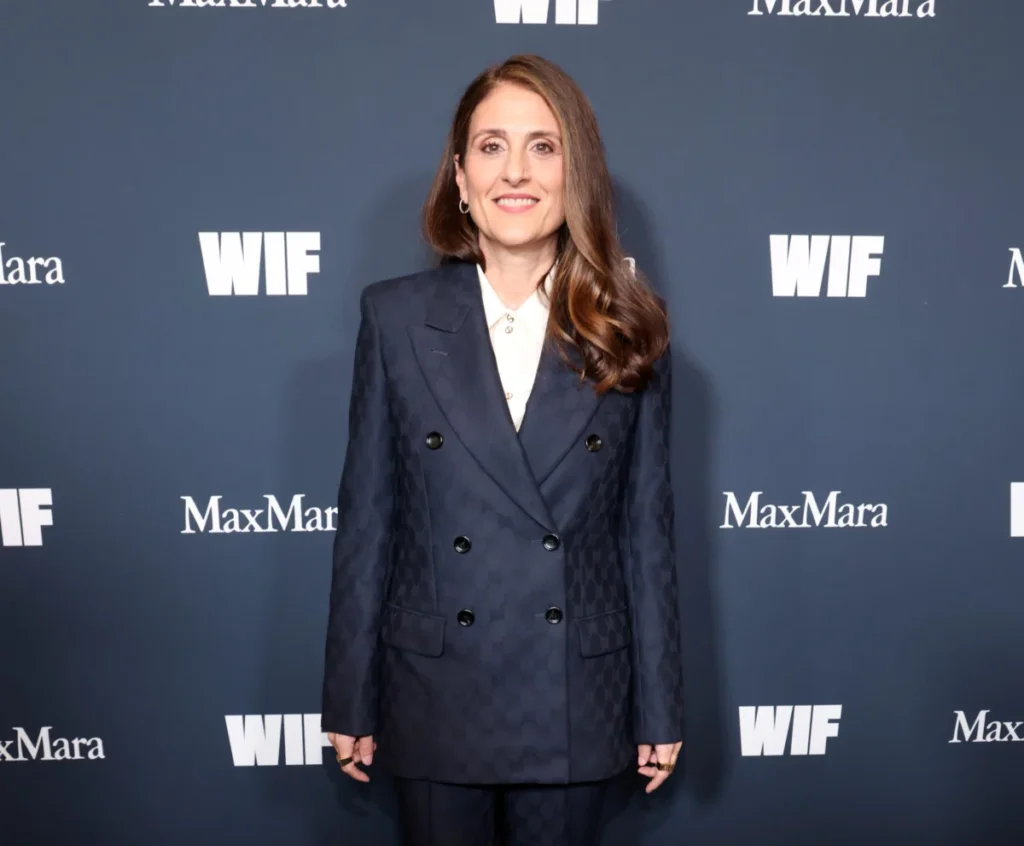

The glittering ballroom of the Beverly Hilton played host to one of the most blistering and unfiltered industry reckonings in recent memory on Thursday evening, as veteran studio executive Pamela Abdy took the stage at the Women in Film (WIF) Annual Honors. Making her first public appearance since her high-profile departure from Warner Bros.—a casualty of the massive $111 billion mega-merger between Paramount and Skydance that reshaped the media landscape last month—Abdy did not mince words. Accepting the inaugural Vanguard Award, presented to her by legendary filmmaker Nancy Meyers, Abdy used her platform to decry systemic misogyny, corporate double standards, and the pervasive culture of sexism that continues to plague the upper echelons of the entertainment industry.
The speech marked a definitive turning point for an executive who has spent over three decades navigating the treacherous waters of Hollywood studio politics. For a woman whose career has been defined by prestige filmmaking, championing complex narratives, and collaborating with some of the most revered auteurs in cinematic history, the evening served as both a celebration of her enduring legacy and an indictment of an industry that she argues is actively regressing when it comes to gender equity in leadership.
A Legacy of Prestige Under the Corporate Microscope
To understand the weight of Abdy’s remarks, one must examine the tumultuous climate of Hollywood over the past year. Her exit from Warner Bros., alongside longtime producing partner Mike De Luca, followed months of industry speculation and corporate upheaval. The Paramount-Skydance merger created a new media behemoth, resulting in sweeping structural reorganizations, asset evaluations, and executive attrition across legacy studios.
Yet, Abdy’s departure was not merely a footnote in a corporate prospectus; it coincided with a disturbing broader trend across the entertainment sector. Within a remarkably short window, several of the industry’s most powerful female executives were pushed out of their respective power seats. Alongside Abdy’s exit from Warner Bros., Cindy Holland was removed from her post as Paramount’s streaming chief, and Bela Bajaria was ousted as Netflix’s chief content officer. This sudden culling of top-tier female leadership sent shockwaves through Hollywood, raising urgent questions regarding the actual durability of diversity initiatives within boardrooms when financial pressures mount and legacy studios consolidate.
Stepping to the podium at the WIF Honors, Abdy reflected on the tightrope walk required of modern executives. She noted that while her career has been dedicated to sparking meaningful cultural conversations through film, these artistic endeavors are increasingly evaluated "under the microscope of a media ecosystem that has largely abandoned analysis and fact for the trap of clickbait."
From Professional Stoicism to Unadulterated Rage
The emotional core of Abdy’s fifteen-minute address centered on the psychological toll exacted upon women who dare to occupy positions of ultimate corporate authority. For decades, female executives have been culturally and institutionally conditioned to display stoicism, grace under pressure, and an unwavering smile in the face of institutional hostility. Abdy explicitly rejected this expectation, channeling a sentiment that resonated deeply with the room full of actors, producers, directors, and industry power-brokers.
"My gratitude for these women has only grown over the years, but lately other feelings, and one in particular, have risen to the surface with undeniable ferocity—and that feeling is pure, unadulterated rage," Abdy told the rapt audience. She detailed a comprehensive spectrum of frustration: "Rage for these women, rage for me, and even more rage for the entire generation of women who deserve to have their potential recognized and elevated. Rage at how women are under attack everywhere. Rage at how our health and our well-being always seem to come second to how we show up in a room."
Addressing the double standards baked into corporate culture, Abdy highlighted the systemic hypocrisy faced by female leaders. When men exhibit assertiveness, vision, and uncompromising dedication to their craft, they are frequently praised as visionary captains of industry. When women exhibit those exact same traits, the vernacular shifts dramatically.
"I’ve been called difficult, emotional, combative," Abdy revealed. "I’ve been told to put on my big-boy pants, to smile more. I’ve been told movies starring women and movies directed by women don’t make as much money, that the audience is limited. That everyone gets nervous when our sisters lead a movie because traditional tracking suggests men won’t show up." Furthermore, she pointedly called out male directors for failing to offer their female counterparts the same institutional and vocal solidarity that they routinely extend to one another.
Challenging the Illusion of Post-Pioneer Parity
A central thesis of Abdy’s critique was the dangerous illusion of progress that permeates Hollywood’s executive suites. For years, corporate conglomerates have pointed to the appointment of a handful of high-profile female studio heads and network chiefs as definitive proof that the glass ceiling has been shattered permanently. Abdy argued that this narrative is fundamentally misleading and masks a starkly different reality on the ground.
"It is getting harder, not easier, to be a woman in the business," she warned. "We tell ourselves because a few of us made it into these chairperson seats, we broke through, that we paved the way for the next generation. But I don’t think it’s true."
As empirical evidence of this structural inequality, she noted the ubiquitous media tradition of publishing lists celebrating "The Most Powerful Women in Hollywood," pointing out the glaring absence of an equivalent list for men. "They don’t have a version for the men because they are the list."
This observation cuts to the heart of structural tokenism in corporate America. When demographic representation is treated as an exception rather than the baseline norm, individual successes can easily be leveraged to mask systemic inertia. The sudden and simultaneous displacement of Abdy, Bajaria, and Holland underscores her argument: that female leadership in legacy media remains precarious, highly vulnerable to macroeconomic shifts, and disproportionately susceptible to executive restructuring.
Reflecting on the Future of Storytelling and Executive Survival
Despite the fierce critique of her industry, Abdy’s address was not without moments of pragmatic hope. She noted that recent political developments—specifically the appointment of numerous women to prominent political positions—offered a glimmer of encouragement regarding broader societal trends. Moreover, she took time to express profound appreciation for her professional allies, including Mike De Luca, thanking him and others for standing by her through "the highs, the lows, the great successes, and yes, the very public failures."
Speaking with reporters earlier in the evening prior to taking the stage, Abdy addressed her immediate professional future with a sense of liberated uncertainty. When asked what her next move would be in the wake of the Warner Bros. exit, she admitted with characteristic candor, "I have no idea what we are going to do next. Honestly, it is kind of a nice thing to not know."
Regarding the alarming wave of departures among her female peers in the executive ranks, she maintained a philosophical yet resolute perspective. "Obviously, it is upsetting to see," she told reporters. "But all of these women are incredible women and have incredible careers. These one moments don’t define you. What defines you is the work you did and the work you left behind and the work you hope to do in the future."
Redefining "Difficult" on Her Own Terms
Abdy concluded her landmark address by reclaiming a word that has historically been weaponized to marginalize capable women in the workplace. After 31 years of climbing the ranks of the entertainment industry, she declared that she has finally abandoned the exhausting pursuit of universal corporate approval.
"It has taken me 31 years in this business to speak in my own voice and to stop caring whether someone calls me difficult," Abdy reflected. "Because now when I hear that, I say, ‘No, you’re wrong.’ If the definition of difficult is someone who is passionate about getting movies made, then I will just have to suffer the fools who don’t know the difference and keep fighting to do what I love."
She closed with a reaffirmation of her commitment to the cinematic medium and the community of artists she has spent her life supporting: "I am so grateful and so blessed for this life I have and this career so far—I’m not done. And to be a part of this incredible community."
Celebrating Industry Advocacy and Achievement
While Pamela Abdy’s searing speech dominated the cultural conversation surrounding the event, the Women in Film Honors evening also served to celebrate a diverse array of luminaries who have driven artistic excellence and social advocacy forward throughout the year.
Adria Arjona was honored with the prestigious WIF Max Mara Face of the Future Award, recognizing her rapidly ascending career and cultural impact. Gemma Chan and director Beth de Araújo were jointly awarded the Crystal Award for Advocacy in Film, celebrating their collaborative and socially resonant work on the film Josephine. Additionally, Hannah Waddingham received the Crystal Award for Advocacy in TV for her critically acclaimed and culturally resonant performance in Apple TV+’s Ted Lasso.
The emotional pinnacle of the evening’s awards presentation arrived when legendary actress and activist Jane Fonda presented the Jane Fonda Humanitarian Award to iconic multihyphenate Salma Hayek Pinault, celebrating Hayek Pinault’s tireless dedication to advocacy, philanthropy, and representation within and beyond the entertainment ecosystem.
Broader Implications for the Media Landscape
As the dust settles on the Paramount-Skydance merger and legacy studios continue to navigate a rapidly evolving digital marketplace, Pamela Abdy’s public critique serves as a watershed moment for Hollywood. The convergence of corporate consolidation, mass layoffs among top-tier female leadership, and the public voicing of institutional rage by one of the industry’s most successful executives points toward a looming reckoning.
The implication is clear: the era in which female leaders are expected to quietly navigate institutional barriers without critique is drawing to a close. As Abdy and her peers chart their next chapters, the institutional systems that failed to retain them face mounting pressure to prove that their commitment to diversity, equity, and sustainable leadership is more than just corporate public relations. Whether Hollywood’s power structures will heed this warning or continue down the path of cyclical exclusion remains the defining question for the next generation of storytellers and executives.