
The landscape of independent digital journalism has suffered a profound and historic loss with the announcement that Salon, the pioneering left-leaning web publication renowned for its sharp political commentary and cultural criticism, is permanently shutting its doors after a remarkable 31-year run. The closure marks the end of an era for a platform that fundamentally demonstrated what online journalism could achieve long before mainstream print institutions fully migrated to the digital space.
In an unsigned farewell statement published on Thursday, the outlet’s leadership pointed directly to the shifting economic realities of the digital publishing ecosystem, stating unequivocally that their long-standing business model is no longer financially viable. The announcement reflected both the pride of the publication’s legacy and the sobering difficulties of operating in a modern media environment dominated by algorithmic shifts and changing reader habits.
The shuttering of Salon is not an isolated incident; rather, it serves as a glaring symptom of a broader, systemic crisis within digital media. Across the industry, even the most established and historically significant digital-first publications are contending with precipitous declines in organic web traffic. The mechanics of audience acquisition have been repeatedly upended over the past decade. Traditional pathways reliant on search engines and social media referrals have steadily eroded, while the recent integration of artificial intelligence-driven search overviews—which allow users to consume summarized answers directly on search engine result pages without clicking through to source websites—has accelerated the decline in referral traffic. In this modern, hyper-competitive landscape, decades of brand longevity, journalistic prestige, and deep cultural influence no longer offer a guarantee of economic survival.
A Storied History: From 1995 Origins
to Digital Prominence
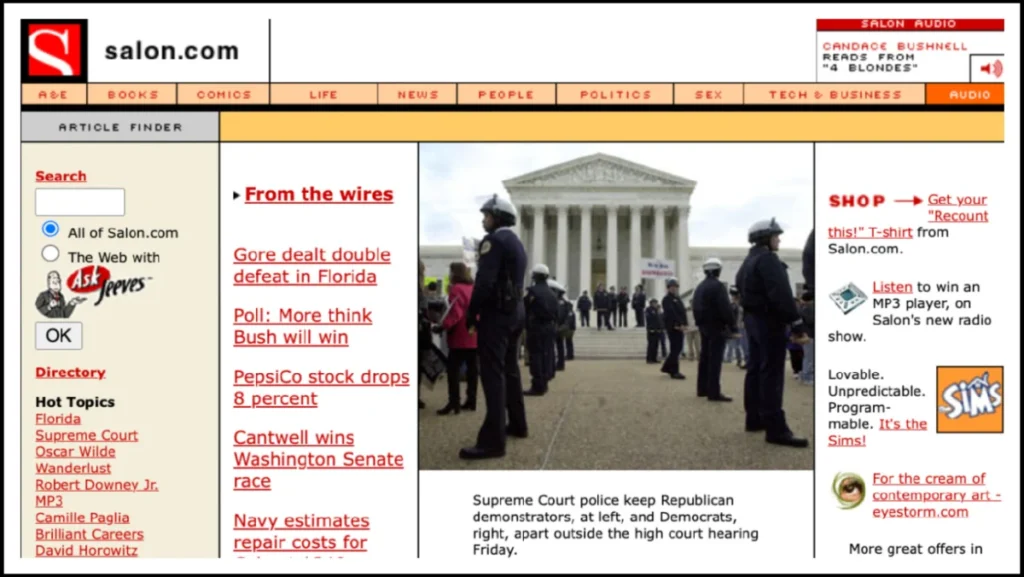
Launched in November 1995 by David Talbot, then-editor of the San Francisco Examiner, Salon was conceived as a bold, early experiment in digital-first publishing. At a time when the World Wide Web was still largely an unexplored frontier and legacy media companies viewed the internet with skepticism or as a mere dumping ground for print copy, Salon emerged as a vibrant, digitally native alternative. It operated entirely without a print companion, establishing an early blueprint for what a purely online publication could look and sound like.
Four years after its inception, the company went public during the height of the dot-com boom, successfully navigating the turbulent early waters of internet commerce and cultivating a dedicated, highly engaged readership. Over the course of three decades, Salon carved out a distinct niche by aggressively merging hard-hitting political reporting with incisive cultural criticism, sharp media analysis, and provocative personal essays. It examined structures of power, challenged conventional political wisdom, surfaced vital stories that were frequently ignored by mainstream gatekeepers, and deliberately made room for diverse perspectives.
The publication also served as an indispensable incubator for some of the most prominent journalistic talents working in the industry today. A veritable who’s who of modern media secured their foundational footholds at Salon. Alumni of the publication include prominent CNN anchor Jake Tapper, NBC News national political correspondent Steve Kornacki, The Intercept founder Glenn Greenwald, and Joan Walsh, the national affairs correspondent for The Nation who previously served as Salon’s editor-in-chief for five years.
Beyond its monumental impact on political journalism, Salon even managed to secure a unique place in popular culture. In 2009, the publication played a starring role in Nora Ephron’s feature film Julie & Julia, starring Amy Adams and Meryl Streep. In the film, Adams’ character, Julie Powell, uses a Salon blog to document her ambitious, year-long quest to cook every single recipe in Julia Child’s iconic cookbook—a plotline that mirrored the actual cultural prominence of personal blogging and digital commentary during that era.
The Algorithm Era and Changing Ownership
Despite its cultural footprint and dedicated readership, Salon was not immune to the seismic tectonic shifts in internet traffic patterns that crippled the digital media sector throughout the 2010s and 2020s.
Like countless other independent publishers, the site suffered a catastrophic blow to its traffic in 2016 when Meta (then Facebook) altered its core social media news feed algorithm. The platform pivoted sharply away from prioritizing news publishers and public content, opting instead to elevate posts from friends and family members. For a generation of digital publications that had grown dependent on social referral traffic to drive ad impressions and subscriptions, the algorithmic shift precipitated a steep, irreversible decline in reach.
As financial pressures mounted, Salon changed hands multiple times. In 2023, the website was acquired from previous owners Drew Schoentrup and Chris Richmond by Find.co, a privately held digital media company. Find.co has historically positioned itself as a marketing operation revolving heavily around cryptocurrency brands, boasting a portfolio that includes sites such as CCN, Webopedia, and CryptoManiaks.
The integration into a crypto-adjacent marketing portfolio raised eyebrows among longtime readers and industry observers, many of whom wondered about the long-term editorial direction of the historic left-leaning outlet. However, the ultimate undoing proved to be the broader structural economic collapse facing independent digital publishers rather than any single corporate maneuver.
Reactions, Institutional Legacy, and the Fate of the Archive
In the wake of Thursday’s closure announcement, journalists, alumni, and readers took to various social media platforms to express their grief, share memories, and pay tribute to the monumental impact Salon had on their careers and intellectual lives.
Addressing questions regarding the fate of the publication’s immense historical archive—which chronicles three decades of pivotal political battles, cultural shifts, and literary essays—Salon Chief Content Officer Erin Keane addressed concerned readers on the social media platform Bluesky. Keane offered a measure of reassurance, confirming that the site’s vast digital library will "stay live for now," preserving decades of institutional history for researchers, students, and historians to access.
The official farewell statement released by the editorial team emphasized that the true measure of Salon’s success lay not merely in its longevity, but in the community it built and the conversations it provoked.
"Salon was never just a website," the final statement read. "It was an idea about what journalism could be, born at a moment when the internet was still a largely unexplored frontier… The business realities of independent digital journalism have changed profoundly over the years. After careful consideration, we have reached the difficult decision that our publishing model is no longer sustainable."
Broader Implications for the Future of Independent Media
The demise of Salon serves as a sobering milestone in the ongoing contraction of the digital media landscape. Over the past several years, the industry has witnessed a steady wave of layoffs, acquisitions, pivots to video, and outright closures affecting legendary digital outlets. Outlets that once defined the golden age of web-based reporting are finding it increasingly impossible to generate sufficient revenue through traditional digital advertising models, which have been thoroughly monopolized by tech giants like Google and Meta.
At the same time, the rise of subscription fatigue among consumers, combined with the explosive growth of artificial intelligence-generated content and zero-click search engine summaries, has squeezed the lifeblood out of ad-supported digital journalism. When users can effortlessly obtain summaries of news events directly from AI search tools without visiting the underlying reporting websites, the fundamental traffic-to-revenue pipeline collapses.
The loss of Salon removes a vital, distinct voice from the American media ecosystem—one that routinely challenged orthodoxies and pushed the boundaries of digital commentary. As the dust settles on a remarkable 31-year run, the closure of Salon stands as both a celebration of what early internet journalism achieved and a stark warning about the precarious economic future facing independent, text-based reporting in the twenty-first century.