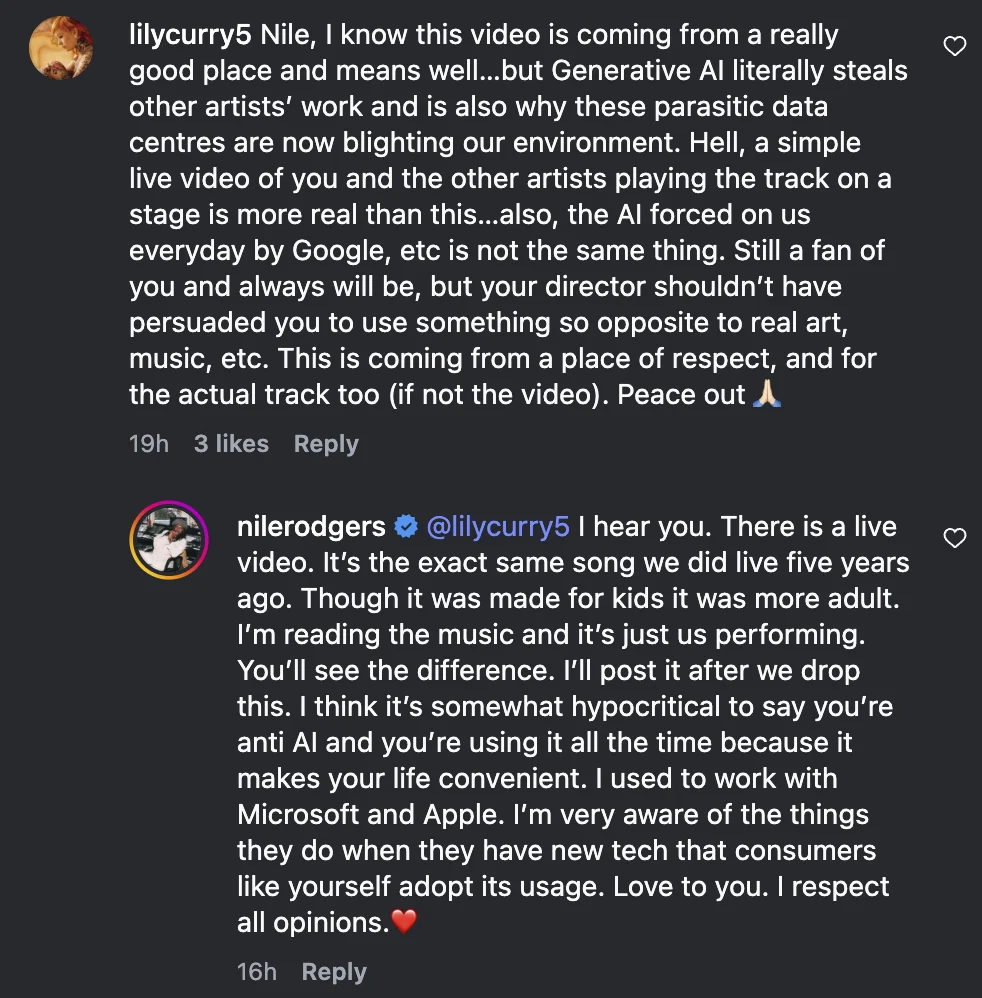

The integration of generative artificial intelligence into creative industries has sparked a volatile debate, with legendary musician and Chic bandleader Nile Rodgers finding himself at the center of a growing controversy. Rodgers, a Songwriting and Rock and Roll Hall of Fame inductee, has faced significant public backlash following his announcement that his latest music video—a visual companion for a new version of his 2020 charity track "The Christmas Song" with Rebecca Ferguson—was produced using AI technology. The discourse, which unfolded primarily on social media, highlights a deepening divide between artists embracing emerging digital tools and a fan base wary of the perceived erosion of human artistry.
The controversy began when Rodgers posted behind-the-scenes footage of himself inside a photogrammetry rig. In his caption, the musician expressed genuine enthusiasm for the project, describing it as a "next level" endeavor that utilized thorough AI capture. Rodgers noted that his creative pivot was inspired by witnessing the Eagles perform at the Las Vegas Sphere, a venue renowned for its cutting-edge immersive visual technology. However, the reception from his audience was largely hostile, with critics labeling the aesthetic "AI slop" and questioning the artistic integrity of replacing traditional filmmaking techniques with algorithmic generation.

A Chronology of the Digital Dispute
The timeline of this incident reflects the rapid escalation typical of social media-driven public relations crises. Following his initial announcement, Rodgers attempted to engage directly with his detractors. When one user dismissed the work as "magic for old people," Rodgers replied with a defense rooted in the distinction between CGI and generative AI. He questioned the legitimacy of criticizing a project that had yet to be fully revealed, urging followers to reserve judgment until the finished product was released.
As the project neared its November 20th release date, Rodgers shared stills from the music video. These images, featuring digital avatars of himself and Ferguson alongside stylized, fuzzy creatures, drew further scrutiny. The visuals contained several hallmarks common in current generative media: inconsistent text rendering, illogical depth perception, and a pervasive "uncanny valley" quality that viewers found jarring. Critics argued that the use of AI for a charitable project was particularly misaligned, suggesting that a humanitarian effort should prioritize human labor and craftsmanship.
Rodgers responded to these claims by emphasizing the labor-intensive nature of the process. He argued that the production followed a traditional workflow—involving mood boards, storyboards, and meticulous direction—and that the AI acted as a tool to execute his specific creative vision. He estimated that a traditional film production with equivalent visual complexity would have incurred costs upwards of $100,000, framing the AI implementation as a matter of fiscal efficiency rather than a shortcut.

The Argument for Technological Evolution
Nile Rodgers is no stranger to the intersection of music and technology. Throughout his storied career, he has been an early adopter of innovations that redefined the industry. In his defense, he has frequently pointed to the history of the drum machine and the sequencer. In 2023, he publicly dismissed concerns about the "fakeness" of generative AI, comparing it to the initial skepticism surrounding the introduction of sequencers, which he credited for enabling a new generation of musicians to record music who otherwise might not have had the resources to do so.
His argument rests on the principle of "input vs. output." To Rodgers, the technology is secondary to the creative intent behind it. He has repeatedly countered accusations of hypocrisy by pointing out that his critics likely utilize AI in their daily lives, citing examples such as GPS navigation, algorithmic social media feeds, and search engines. By framing AI as an omnipresent utility, he challenges the moral distinction that some users draw between "functional" AI and "creative" AI.
Analyzing the Industry Divide
The tension surrounding Rodgers’ project reflects a broader, systemic issue within the entertainment industry. While proponents argue that AI democratizes high-end production, allowing independent creators or charitable projects to achieve cinematic polish on a limited budget, opponents contend that generative models rely on the unauthorized ingestion of human creative work. This "data scraping" concern is the primary engine behind the widespread hostility toward AI-generated images and video.

From an economic perspective, the industry is currently undergoing a painful transition. The $100,000 cost-savings figure cited by Rodgers is precisely what alarms industry professionals, including VFX artists, animators, and cinematographers. If generative tools can mimic the aesthetic of high-budget productions at a fraction of the cost, the market demand for human labor in these specialized fields could see a significant decline. This economic anxiety manifests in the "hypocrisy" claims levied against artists who, despite their stature, appear to be displacing the very workforce that has supported the industry for decades.
Broader Implications for Creative Property
The "The Christmas Song" project acts as a microcosm for the legal and ethical battles currently occupying courtrooms and legislative bodies. While Rodgers maintains that he directed the AI to follow his specific vision, the output bears the aesthetic markers of its training data. This leads to questions of authorship and ownership. In the United States, the Copyright Office has generally maintained that works created entirely by AI without sufficient human input cannot be copyrighted. Rodgers’ defense—that he "painstakingly created every second"—is a strategic attempt to establish the necessary human authorship required to protect the intellectual property of his video.
Furthermore, the "whataboutism" utilized by Rodgers regarding the daily use of GPS or search engines is a common defense, yet it often fails to satisfy those concerned with the creative arts. The distinction between a utility that maps a route and a model that synthesizes "original" visual content is significant. As the technology advances, the gap between these two categories is narrowing, making it increasingly difficult for the public to discern between human-assisted tools and automated generation.

The Future of AI in Music and Film
The incident involving Nile Rodgers is unlikely to be an isolated event. As more high-profile artists experiment with generative models, the music industry will likely see a split in reception. Some audiences will continue to prioritize human-made, "authentic" art, while others may accept AI-augmented media as a standard evolution of creative expression.
The success or failure of Rodgers’ music video, set for release on November 20th, may serve as a bellwether for how the public responds to legacy artists adopting these new methods. If the audience finds the "hollow" aesthetic mentioned by critics to be a distraction, it may force a reassessment of how AI is integrated into high-profile releases. Conversely, if the project is viewed as a successful, cost-effective creative venture, it could embolden other artists to pursue similar workflows.
Ultimately, the debate is not merely about whether AI is "good" or "bad," but about the value society places on the human process in artistic creation. Rodgers’ belief that he is being unfairly targeted for utilizing a tool that will eventually be as common as a sequencer places him on the vanguard of a technological shift. However, until the industry addresses the underlying concerns regarding the training of these models and the displacement of creative workers, the backlash against such projects is likely to remain intense.

As the industry moves forward, the conversation will shift from the binary of "AI vs. Human" to a more nuanced discussion about transparency. Rodgers’ willingness to be open about his process, while currently a lightning rod for criticism, may eventually become a standard expectation. Whether his defense of "hypocrisy" will hold up in the court of public opinion remains to be seen, but the event serves as a clear reminder that the transition into an AI-augmented creative era will be as contentious as it is inevitable.