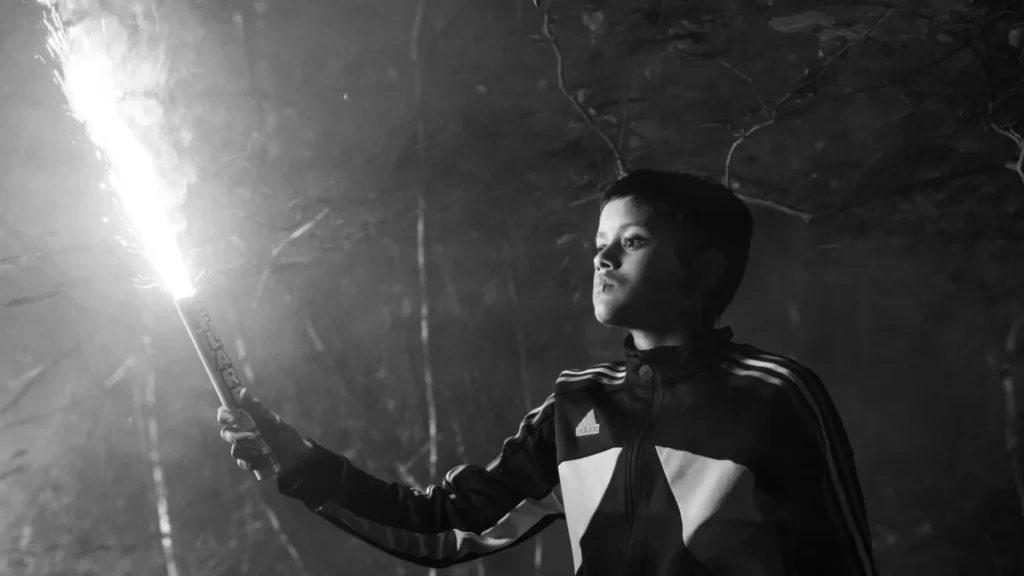

The contemporary cinematic landscape is frequently defined by stories that mirror the shifting sociopolitical tensions of the modern world. Few debut features have captured this phenomenon quite as acutely as Ish, the critically acclaimed drama written and directed by multi-disciplinary artist-turned-filmmaker Imran Perretta. Over the past year, the film has charted an extraordinary course through the international festival circuit, resonating deeply with audiences, cinephiles, and political activists alike. Set against the gritty, often misunderstood backdrop of Luton, near London, the film explores the harrowing consequences of racial profiling and an aggressive police stop-and-search that alters the trajectory of two teenage best friends, played by Farhan Hasnat, Yahya Kitana, and Sudha Bhuchar.
Perretta’s transition from the contemporary art world to narrative filmmaking has been marked by milestones that few debut directors achieve. Most recently, his artistic trajectory was validated on Wednesday when he was officially named as a member of the prestigious 2026 U.K. BAFTA Breakthrough cohort, a talent-nurturing initiative supported by streaming giant Netflix. This honor adds to a growing list of accolades, chief among them the Audience Award at the 2025 Venice Critics’ Week. Yet, despite the accolades and commercial milestones, the filmmaker remains remarkably grounded, navigating a whirlwind year that has continually redefined what the life cycle of an independent feature film can look like.
A Journey Beyond the Festival Circuit
For a creator whose foundational background lies in visual arts and gallery spaces, the traditional distribution and exhibition model of cinema presented a novel, albeit astonishing, set of experiences. In an interview with industry media, Perretta reflected on the prolonged life cycle of a feature film compared to temporary art installations.
"I come from the art world, so for me, the life cycle of a film is really a new experience," Perretta explained. "You really walk alongside the film for a long time. We did our festival run, and we’re still doing festivals here and there. But what I couldn’t really have imagined was what happened when the film came out in cinemas. I expected that to be the bookend of the whole experience, but in a weird way, it’s been a new start for the film."
The financial and critical reception of Ish has similarly defied initial projections. Independent films focusing on marginalized British communities frequently face uphill battles regarding mainstream commercial viability. However, Perretta notes that the film’s domestic and international box office returns, paired with overwhelmingly positive critical notices, surpassed even his most optimistic forecasts.
"It’s been so exciting because it exceeded all of our expectations in terms of the reception and what it did at the box office and all this sort of stuff," he said. "So, I’m still pinching myself that so much can happen in a year. It’s crazy! I’m a very happy boy."
Global Resonance and Activist Screenings
While traditional theatrical distribution has proven fruitful, the most unexpected trajectory for Ish has been its adoption by grassroots activist networks and community organizations globally. The film’s thematic core—centering on state surveillance, racial profiling, and systemic harassment—has turned it into a vital cultural touchstone for discussions surrounding modern policing.
Activists and politically adjacent film organizations have taken the initiative to screen Ish across multiple continents, including the United States, Germany, Russia, and France. In Paris, for instance, local programmers and community organizers rushed to secure screening rights amid intense civil unrest and ongoing national debates regarding police brutality and the legal overreach of law enforcement powers. For these programmers, Ish serves not merely as entertainment, but as a mirror reflecting the universal struggles of vulnerable youth attempting to forge a viable future within increasingly hostile urban environments.
Perretta admitted that while he anticipated strong engagement from politically active demographics, the sheer breadth of the film’s appeal caught him entirely off guard.
"What I didn’t expect was that it would speak to a much broader audience," Perretta noted. "It has been amazing. There’s been this amazing spread of different types of audiences, from activist audiences or certainly politically engaged audiences to cinephiles, but then also ‘normal filmgoers.’ I’m super surprised in a good way and also really proud of that."
The Universal Crisis of Authoritarian Policing
The widespread, cross-border resonance of Ish points to a darker, more systemic reality across Western democracies. According to Perretta, the themes embedded within his micro-budget British drama have inadvertently captured a global sociopolitical shift toward authoritarian governance and aggressive state control.
"So many Western countries have taken this authoritarian turn where the police have been given powers that really extend beyond traditional powers, or certainly they wield those powers in a way that feels really unjust or asymmetric, whether that’s in America, France, Italy, the U.K., wherever," Perretta observed. "And in that context, the film sparks a conversation because, it’s sad to say, that is a universal experience now. And also, this idea of surveillance is a universal experience."
This global applicability, paradoxically, stems from the extreme specificity of the film’s setting. Shot entirely in Luton—a city frequently sensationalized in British tabloid media for crime rather than cultural contributions—the film grounds its universal narrative in authentic, localized geography. Perretta remains a staunch advocate for his filming location, encouraging fellow filmmakers to look beyond traditional London production hubs and explore the rich visual and cultural tapestries of towns like Luton, provided those narratives are handled with fairness and truth.
Expanding Horizons: From BAFTA Breakthrough to Tate Britain
With the momentum of Ish still propelling his career forward, Perretta is showing no signs of slowing down. His inclusion in the 2026 U.K. BAFTA Breakthrough cohort places him alongside other emerging creative talents poised to shape the future of British film, television, and games. Supported by Netflix, the BAFTA Breakthrough program provides international networking, mentoring, and professional development opportunities, positioning Perretta for larger-scale cinematic endeavors in the near future.
Simultaneously, the artist is returning to his roots in the contemporary art sector. Perretta is currently preparing a major exhibition at the Tate Britain titled the destructors. According to official gallery documentation, the exhibition will navigate the complex emotional, social, and psychological landscapes of coming of age for Asian Muslim men in Britain in the post-9/11 era—a theme that complements the socio-political inquiries explored in his cinematic work.
Furthermore, Perretta has returned to the writing desk, developing a new feature screenplay that continues his interrogation of power dynamics, institutional friction, and class structures within British society.
"One that I’m writing at the moment has a lot to do with property and land and this very British idea of ownership—what it means to own something and what it means to leverage that ownership," Perretta revealed. "You can chart a lot of the highs and lows—well, let’s be real, it’s lows for anyone other than the ruling class. So for me, it’s another political work about all of the friction—social, emotional, and political—that comes from this idea of ownership."
As Imran Perretta transitions seamlessly between the hallowed halls of contemporary art galleries, international film festivals, and the upper echelons of British screen talent recognition, Ish remains a testament to the power of hyper-local storytelling to ignite global dialogue. Through unflinching honesty and sharp artistic vision, Perretta has firmly established himself as one of the most vital new voices in contemporary cinema.