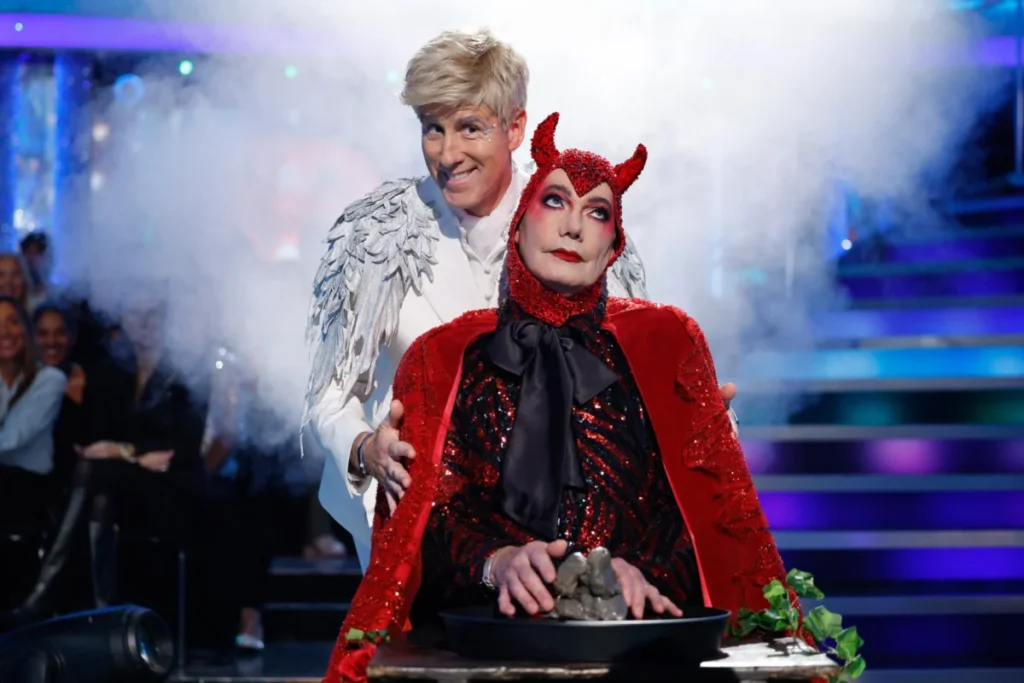

The iconic BBC ballroom has once again transformed into a house of horrors, as the Strictly Come Dancing Halloween special delivered a night of high-stakes drama, intricate choreography, and elaborate production values. As the competition reaches its sixth week, the pressure on the remaining celebrities has reached a fever pitch, culminating in a leaderboard that saw significant shifts in the standings and a sobering reminder of the impending elimination process.
Lacey Turner, the 38-year-old actress, emerged as the standout performer of the evening. Channeling a sophisticated gothic aesthetic, Turner and her professional partner, Vito Coppola, executed a high-energy Charleston set to the infectious beat of Crazy Stupid Love by Cheryl and Tinie Tempah. The routine, characterized by its sharp transitions and synchronized footwork, resonated deeply with the judging panel. Motsi Mabuse was particularly effusive in her praise, declaring the performance the "best dance of the night." With a total score of 36, the pair secured the top position, marking a significant milestone in their journey toward the glitterball trophy.
A Night of Theatrical Brilliance and Seasonal Spectacle
The Halloween theme provided a canvas for the show’s creative team to push the boundaries of costume and set design. The judges themselves embraced the festivities: Anton Du Beke appeared in an angelic ensemble, while Craig Revel Horwood leaned into his reputation with a devilish costume. Shirley Ballas commanded the studio in a chilling ice queen aesthetic, and Motsi Mabuse captivated the audience with a vibrant green butterfly-inspired look. Presenters Josh Widdicombe and Emma Willis set the tone early, with Widdicombe remarking on the fitting nature of the judges’ costumes, while Willis noted the slightly intimidating atmosphere created by the elaborate production.
Following close behind the leaders were social media personality John Nellis and his partner, Katya Jones. Their tango, performed to Slayyyter’s Dance, earned a commendable 35 points. Mabuse praised the technical execution of the routine, noting the precision required for such a fast-paced track. This performance effectively solidified Nellis as a serious contender as the competition enters its second half.
Mid-Table Contenders and Rising Stars
The competition remains tight in the middle of the pack, where several couples delivered personal bests. Dani Dyer, the former Love Island winner, achieved a career-high score for the season with her Viennese waltz. Partnered with Nikita Kuzmin, Dyer performed to the classic My Favourite Things by Rodgers and Hammerstein. Clad in haunting Victorian-era attire, the pair showcased a level of grace and technical maturity that impressed the judges. Both Anton Du Beke and Craig Revel Horwood highlighted the progress Dyer has made, with Revel Horwood offering a rare moment of near-total approval, stating he had little to add to the critique beyond labeling it "brilliant."
Sharing that 32-point total were Will Best and Dianne Buswell. Their Couple’s Choice routine to the rhythmic Nu Flow by Big Brovaz brought a modern, urban flair to the ballroom, diversifying the night’s aesthetic and proving that contemporary styles can hold their own against traditional ballroom standards.
Elsewhere, Delta Goodrem and Kai Widdrington captivated the audience with their portrayal of the iconic Morticia and Gomez Addams. Their Viennese waltz to the timeless Unchained Melody earned 33 points. The routine was lauded for its dramatic flair and emotional resonance, with Revel Horwood describing the performance as "absolutely gorgeous" and Du Beke calling the result "sensational." Matching that score were Cach Mercer and Maddie Ingoldsby, whose Argentine tango to Pas De Deux by Michael Abels demonstrated a mastery of tension and technical control, further tightening the gap between the middle and upper tiers of the leaderboard.
The Struggles at the Bottom
As the leaderboard reveals, the margin for error is shrinking. At the lower end of the spectrum, Graeme Hall and Lauren Oakley found themselves in a difficult position after their samba to Harry Nilsson’s Coconut. Scoring 25, the routine was flagged by Revel Horwood for needing significant "finessing," leaving the duo at the joint bottom of the leaderboard. They share this precarious position with Olympic medallist Tabby Stoecker and her partner, Mark Karmalita. Their quickstep to Little Mix’s Black Magic failed to land with the judges, with Shirley Ballas noting that the performance was not up to their usual standards.

Lawrence Robb and Jowita Przystal also faced a challenging night, scoring 26 for their tango to the Ghostbusters theme. While the theme was seasonally appropriate, the technical requirements of the tango proved difficult to balance with the performance elements, leaving the couple needing a strong showing in the upcoming week to avoid the danger zone.
The Implications of the Historic Triple Dance-Off
The conclusion of Saturday’s episode was marked by a shift in tone, as presenters confirmed the nature of the upcoming results show. For the first time in the current series, the production will feature a "triple dance-off." Unlike standard weeks, where the judges choose between two couples to save, the Sunday broadcast will require three couples to re-perform their routines. The judging panel will then be tasked with voting to eliminate one pair directly, fundamentally changing the strategic landscape of the competition.
This change represents a departure from the traditional elimination format and underscores the production’s intent to accelerate the thinning of the field as the finale approaches. With three couples at risk, the pressure on those in the lower half of the leaderboard—specifically those who scored 25 or 26—is immense. The ability to perform under extreme psychological pressure will now be as important as technical dance skill.
Context and Analysis: The Strictly Evolution
Strictly Come Dancing remains a cornerstone of British weekend television, and its ability to maintain high viewership figures during its sixth week is a testament to its production model. The Halloween episode, in particular, acts as a litmus test for the contestants’ ability to balance "character work" with the rigorous demands of professional ballroom technique.
Statistically, contestants who reach this stage of the competition typically experience a plateau in their learning curve. The jump from learning basic steps to executing complex, character-driven choreography requires a level of stamina and spatial awareness that often separates the amateur participants from the potential finalists. The high scores awarded to Turner and Nellis indicate that the judges are now looking for complete performances—where costume, music choice, and technique coalesce into a cohesive, television-ready package.
The inclusion of a triple dance-off is a strategic maneuver by the BBC to ensure that the final weeks of the competition remain unpredictable. By increasing the number of couples in the bottom-tier challenge, the show forces contestants to demonstrate their consistency. A single mistake, which might have been forgiven in early weeks, now carries the risk of immediate exit.
Looking Ahead
As the contestants prepare for the results show, the focus shifts to the psychological resilience required to return to the dance floor after a critique from the judges. The combination of the triple dance-off and the high stakes of the Halloween leaderboard sets the stage for what is expected to be one of the most intense results shows of the season.
With Lacey Turner leading the pack and several high-performing couples within striking distance of the top spot, the competition is effectively a race for consistency. Fans and critics alike are now looking to see if the couples at the bottom—Hall, Stoecker, and Robb—can channel the intensity of the Halloween theme into a performance that can save them from the unprecedented triple elimination threat.
The episode serves as a reminder that in the world of professional dance, technical mastery is only half the battle; the ability to captivate an audience and command the floor under the glare of the studio lights remains the ultimate requirement for survival. Strictly Come Dancing continues to be a masterclass in high-production entertainment, and as the season progresses, the margin between the triumph of a 36-point routine and the risk of elimination continues to narrow.