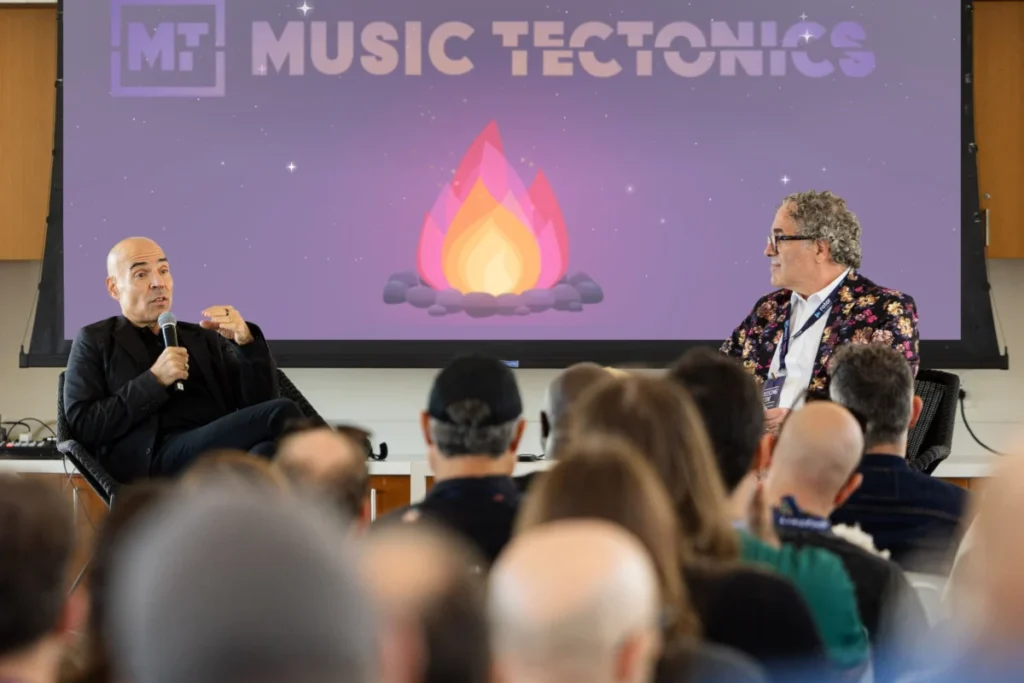

The modern music business is built on a foundation of intellectual property, asset classes, and financial engineering, yet the individuals who steer the creative output—artists and artist managers—often struggle to secure sustainable, long-term equity in the fruits of their labor. Addressing this fundamental industry imbalance, music industry veteran Merck Mercuriadis took the stage on Wednesday, October 28, at the Music Tectonics conference in Santa Monica, California, to unveil expansive details regarding his latest venture: Hipgnosis Artist Partnerships. Mercuriadis, widely recognized for pioneering the concept of music catalogs as a distinct asset class through his orchestration of the original Hipgnosis fund entities, used his keynote address to outline a radical corporate roll-up strategy aimed at reshaping how talent management companies operate globally.
During a conversation moderated by Music Tectonics director Dmitri Vietze, Mercuriadis announced that Hipgnosis Artist Partnerships is actively consolidating eight major management firms. This aggressive consolidation aims to form a monolithic talent management enterprise capable of shifting the financial paradigm away from traditional record labels and publishers and placing it firmly back into the hands of creators and their representatives. While the specific identities of the eight target acquisition companies remain confidential under ongoing non-disclosure agreements, Mercuriadis confirmed that the first of these major transactions is scheduled for official public announcement in the first quarter of 2027.
The Genesis of the Vision: Redefining the Artist-Manager Relationship
Mercuriadis brings decades of high-level industry experience to this new venture, having previously guided the careers of global superstars such as Beyoncé, Guns N’ Roses, and Elton John. Drawing from his extensive background in both talent representation and corporate asset acquisition, Mercuriadis designed Hipgnosis Artist Partnerships to fundamentally realign financial incentives across the artist lifecycle.
Under the innovative operational model detailed at the conference, artists and their managers will co-own all commercial assets created throughout the duration of their professional partnership. Structurally, the artist will retain the majority shareholder position, while the management company holds a minority ownership stake. A critical structural innovation of this model is its approach to career mobility: while artists maintain the absolute freedom to terminate their working relationship with the management company at any time, the intellectual property and assets generated during the partnership remain permanently within the co-owned corporate structure. This ensures that the collective value built over time continues to benefit both parties regardless of ongoing personal or professional alignments.
Financial Architecture: Guaranteed Cash Flow and Profit-Sharing
The economic framework of Hipgnosis Artist Partnerships introduces a departure from traditional recoupment structures that have historically plagued recording artists and songwriters. Under legacy major label and management agreements, creators often endure lengthy periods without royalty distributions while recouping recording, video, and marketing expenditures.
Mercuriadis explained that Hipgnosis Artist Partnerships will implement an immediate, continuous cash-flow mechanism. From day one of signing, as the company deploys capital to support the artist’s creative endeavors, direct revenue streams will flow continuously to the creator.

"Day one when we’re writing checks for the artists, the majority of the money’s coming to the company, but money’s always flowing through to the artist, at least 20 or 30%, regardless of recoupment," Mercuriadis stated during his keynote. "They recoup very, very quickly because they’re now recouping from all income streams. And then when they recoup and the company hits its return-on-investment targets, it’ll swing so they’re getting 80% of the money and the company’s getting 20% of the money."
This tiered financial model accelerates the recoupment phase by aggregating income across all diverse revenue streams—including touring, merchandise, sync licensing, and publishing—rather than isolating recording costs against master royalties alone. Once the initial investment thresholds and return targets are achieved by the corporate entity, the financial split dramatically favors the creator, inversion-style, routing 80 percent of incoming revenues directly to the artist.
Leveraging Major Label Infrastructure Without Ceding Control
Despite positioning Hipgnosis Artist Partnerships as a direct competitive challenger to traditional label hegemony, Mercuriadis pragmatic approach acknowledges the necessary operational scale provided by the major music conglomerates. Rather than attempting to build an entirely independent global distribution and administrative network from scratch, the company intends to lease existing operational infrastructures.
"We will lease the infrastructure of Universal, Warner and Sony, but Hipgnosis Artist Partnerships will be the ones to decide how the money is spent," Mercuriadis emphasized.
By outsourcing back-end administrative functions such as global distribution, physical manufacturing, and international royalty collection to the major record labels—Universal Music Group, Warner Music Group, and Sony Music Entertainment—Hipgnosis Artist Partnerships maintains lean overhead while exerting absolute control over creative direction, marketing budgets, and strategic investments. This hybrid approach mirrors the operational efficiency of modern independent record labels that utilize major-label distribution arms while retaining autonomous corporate governance.
Historical Context: The Rise, Sale, and Evolution of the Hipgnosis Brand
To fully appreciate the scope and ambition of Hipgnosis Artist Partnerships, one must examine the turbulent evolution of Mercuriadis’s previous corporate endeavors. Beginning in 2017, Mercuriadis founded and built a trio of companies under the Hipgnosis banner, aggressively acquiring iconic song catalogs from legendary creators. Over several years, the fund amassed a multibillion-dollar portfolio comprising timeless works by artists such as Shakira, the Red Hot Chili Peppers, Fleetwood Mac, and Diana Ross.
The strategy proved transformative, convincing institutional investors, pension funds, and private equity firms that music copyrights possessed the low-correlation, high-yield characteristics of traditional infrastructure assets like real estate or toll roads. However, rapid expansion, rising interest rates, and valuation scrutiny led to a complex financial period for the publicly traded Hipgnosis Songs Fund.

Following a contentious corporate bidding war and intense shareholder debate regarding asset valuations, Mercuriadis sold his stake to private equity giant Blackstone in 2024. Subsequently, the consolidated catalog assets—renamed Recognition Music—were acquired by Sony Music Publishing in May 2025, marking the conclusion of Mercuriadis’s first major chapter in catalog aggregation.
Reflecting on past criticisms during his Music Tectonics keynote, Mercuriadis addressed industry skeptics who previously argued that he had aggressively overpaid for legacy music rights. Pointing to the ultimate financial outcome of the Blackstone transaction—which realized a significant premium over initial acquisition costs—Mercuriadis dismissed the critique.
"When you then sell your catalog for $1.2 billion more than what you paid for it, that argument tends to go out the window," Mercuriadis remarked. "To anyone who thought that I overpaid, god bless you. Keep doing what you’re doing."
Broader Industry Implications and Future Outlook
The launch of Hipgnosis Artist Partnerships arrives at a critical juncture for the global music economy. As streaming growth rates stabilize in mature territories and competition for consumer attention intensifies, creators and managers are increasingly seeking sophisticated financial partners who understand both the digital landscape and long-term asset valuation.
By merging eight established management firms into a single, well-capitalized entity, Mercuriadis is attempting to institutionalize artist management at a scale never before seen in the industry. Traditional talent agencies and management firms have historically operated as service-based partnerships dependent on commission percentages. In contrast, Hipgnosis Artist Partnerships introduces a private equity-backed, balance-sheet-driven model where managers and artists act as true co-investors and co-owners of intellectual property.
Industry analysts are closely monitoring the rollout of the venture, noting that if Mercuriadis successfully executes the integration of the eight target management firms by early 2027, it could trigger a broader wave of consolidation across the talent representation sector. As managers increasingly seek institutional capital to compete globally and secure their own financial futures, the model pioneered by Hipgnosis Artist Partnerships may well establish a new baseline standard for how elite creative talent is managed, financed, and rewarded in the twenty-first-century music industry.