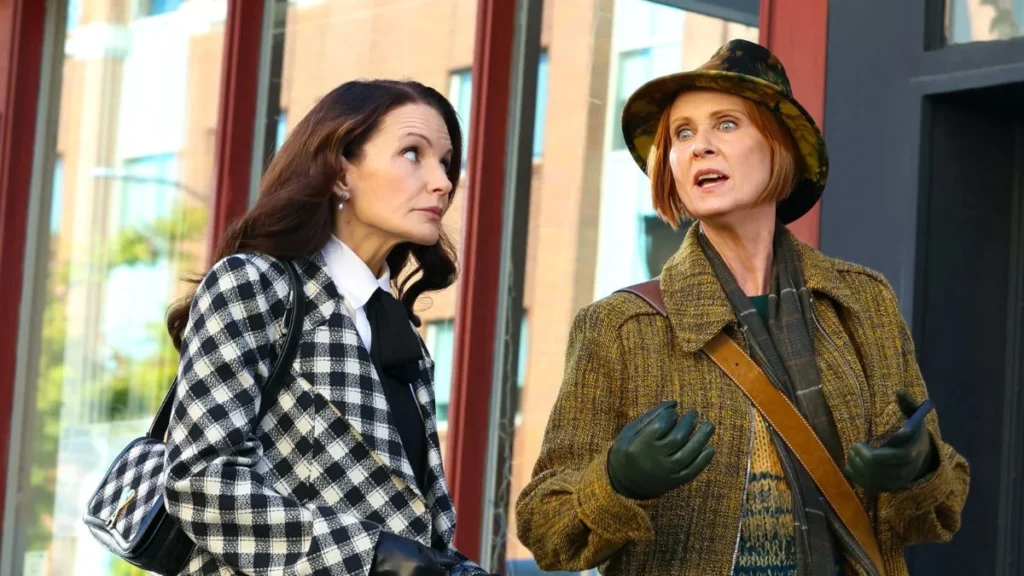

The cultural phenomenon that was Sex and the City defined a generation of television landscape, shaping conversations surrounding female friendship, career ambition, romantic trials, and urban independence. Yet, behind the seamless on-screen chemistry of Carrie Bradshaw, Charlotte York, Miranda Hobbes, and Samantha Jones lay a complex web of early professional dynamics. Decades after the groundbreaking HBO series first premiered, revelations continue to emerge regarding the behind-the-scenes reality of the iconic core quartet. Recently, Kristin Davis shed light on a lesser-known aspect of the show’s formative days, disclosing that she deliberately maintained a degree of distance from co-star Cynthia Nixon during the initial phases of production.
The admission offers a fascinating glimpse into the psychological landscape of actors entering a high-stakes, career-defining television project. While audiences worldwide came to view Charlotte York and Miranda Hobbes as inseparable confidantes who navigated the turbulent waters of Manhattan dating together, the actresses bringing them to life experienced a distinctly more cautious professional beginning.
The Revelation on the Are You A Charlotte? Podcast
The details surrounding this early dynamic came to light during an episode of the Are You A Charlotte? podcast. Kristin Davis appeared alongside guest and fellow veteran actress Jane Leeves to dissect the rich history of the franchise, current pop-culture perceptions of its characters, and the intricate realities of long-form television production.
During the conversation, the discussion shifted toward the ensemble nature of Sex and the City and the initial meetings between the principal cast members. Davis candidly confessed that she did not immediately forge a close bond with Cynthia Nixon, attributing the hesitation to a sense of professional intimidation.
"I didn’t talk to her a ton in the beginning. It took me a while," Davis recalled, explaining that Nixon’s formidable theater background and intensely serious demeanor regarding the dramatic arts created an aura that felt initially unapproachable.
Unlike her relationships with other members of the ensemble, which developed rapidly through warm overtures, Davis’s connection with Nixon required patience and time to evolve. The acknowledgment highlights the diverse backgrounds and temperaments that converged on the set in the late 1990s, ultimately blending to create one of television’s most enduring ensembles, despite the tentative first steps.
Contrasting Welcomes: Navigating the Ensemble Dynamics
To fully understand Davis’s initial hesitation, industry analysts and entertainment historians often look at the contrasting backgrounds of the principal cast members prior to their casting in the Darren Star-created series. When HBO greenlit Sex and the City, the production brought together four actresses with vastly different career trajectories, training regimens, and personal styles.
Cynthia Nixon entered the project already possessing a deeply established reputation in the theatrical world. Having made her professional stage debut at a young age, Nixon built a critically acclaimed resume through demanding theatrical productions such as Tom Stoppard’s The Real Thing and David Rabe’s Hurlyburly. Her dedication to the craft of acting was rooted in the rigorous disciplines of the New York stage, a background that imbued her with a serious, laser-focused approach to character work.
Jane Leeves, appearing as a podcast guest, offered valuable insight into why Nixon’s presence might elicit such a reaction from a peer. "I think it’s a weight she carries as an actor," Leeves observed during the podcast. "She is committed and very serious about her craft. And you pick up on that, which is magnificent."
Davis, who eventually grew to deeply admire and befriend Nixon, admitted that this intense artistic energy was palpable on set. However, she also noted a shift in Nixon’s demeanor over the decades, suggesting that time and shared history have mellowed those sharp edges. "I think she’s less like this now than she used to be in a way," Davis reflected.
This cautious introduction stood in stark contrast to Davis’s experiences with Sarah Jessica Parker and Kim Cattrall. Davis recalled that Parker immediately adopted a welcoming, inclusive posture toward her incoming co-star. "Sarah Jessica was really like, ‘Come here, come in my trailer!’" Davis said, describing an environment of instant camaraderie. Similarly, Davis fondly remembered meeting Cattrall in Vancouver prior to the commencement of principal photography, setting a tone of warmth and accessibility that contrasted with the more formal distance she initially maintained from Nixon.
A Comprehensive Chronology of the Sex and the City Franchise
To contextualize these behind-the-scenes revelations, it is helpful to examine the timeline of the Sex and the City universe, tracing its origins from literary adaptation to global television institution and its subsequent modern revivals.
- 1996–1997 (Pre-Production and Casting): HBO acquires the rights to Candace Bushnell’s newspaper column and subsequent anthology book. Creator Darren Star casts Sarah Jessica Parker as Carrie Bradshaw, followed by Kristin Davis as Charlotte York, Cynthia Nixon as Miranda Hobbes, and Kim Cattrall as Samantha Jones. The actresses convene in New York City for table reads and wardrobe tests, where differing professional backgrounds first intersect.
- June 6, 1998 (Series Premiere): Sex and the City debuts on HBO, pushing boundaries with its frank discussions of modern female sexuality, dating conventions, and professional independence. The show establishes the core dynamic between Charlotte and Miranda, despite the off-screen professional boundaries initially maintained by the actresses.
- 2004 (Series Conclusion): After six critically acclaimed seasons and multiple Emmy Awards, the series concludes its original run with the two-part finale "An American Girl in Paris." By this point, the cast has forged a deep, enduring bond through years of grueling production schedules across New York City.
- May 2008 (First Feature Film): The principal cast reunites for the theatrical release of Sex and the City: The Movie. The film proves to be a massive commercial success, grossing over $415 million worldwide against a modest budget, proving the lasting cultural relevance of the characters.
- May 2010 (Second Feature Film): Sex and the City 2 hits theaters, expanding the narrative scope to Abu Dhabi. While receiving mixed critical reviews, the film further solidifies the economic power of the franchise.
- December 2021 (And Just Like That… Premiere): HBO Max launches the sequel series And Just Like That…, bringing back Parker, Davis, and Nixon to reprise their iconic roles, charting the evolution of their characters into their fifties, notably without the participation of Kim Cattrall.
Industry Implications and the Evolution of Ensemble Chemistry
The revelation that primary cast members experienced moments of professional intimidation or distance during the early days of a legendary production provides a vital lesson in the realities of television production. In the modern era of media consumption, audiences frequently project the seamless intimacy of fictional characters onto the real-life relationships of the actors portraying them. However, industry insiders emphasize that professional chemistry is rarely instantaneous; rather, it is a constructed artifact built over thousands of hours of shared labor, mutual respect, and collaborative compromise.
For serialized television, particularly in prestige cable formats of the late 1990s and early 2000s, actors were often thrust into high-pressure environments with tight shooting schedules, demanding physical locations on the streets of New York City, and intense media scrutiny. In this context, divergent working styles—such as the theatrical rigor brought by Nixon versus the more intuitive, collaborative approach described by Davis—can initially create friction or professional boundaries.
Furthermore, these behind-the-scenes dynamics offer context for the longevity of the franchise. The transition from cautious professional distance to genuine, lifelong friendship underscores the emotional maturation not only of the characters within the writers’ room but of the women portraying them. Over six seasons and multiple feature films, the shared experience of weathering global fame forged a resilient bond that allowed the core cast to return decades later for And Just Like That….
Broader Context and Legacy in Television History
As Sex and the City continues to find new generations of viewers through streaming platforms and contemporary social media discourse, revelations regarding its production history retain immense cultural value. Younger audiences, who frequently analyze the show’s narrative arcs, fashion choices, and character motivations through a modern lens, demonstrate an unflagging appetite for the human stories behind the cameras.
Kristin Davis’s honest recollection does not diminish the achievements of the series; rather, it humanizes an artistic triumph. By acknowledging her initial intimidation by Cynthia Nixon’s theatrical dedication, Davis illuminates the multifaceted nature of artistic collaboration. It serves as a reminder that complex, believable on-screen dynamics can arise just as powerfully from mutual professional respect and boundary-setting as they do from instant, effortless affection. As the franchise continues to expand its legacy, these glimpses into the foundational years of its stars remain an essential component of television history.