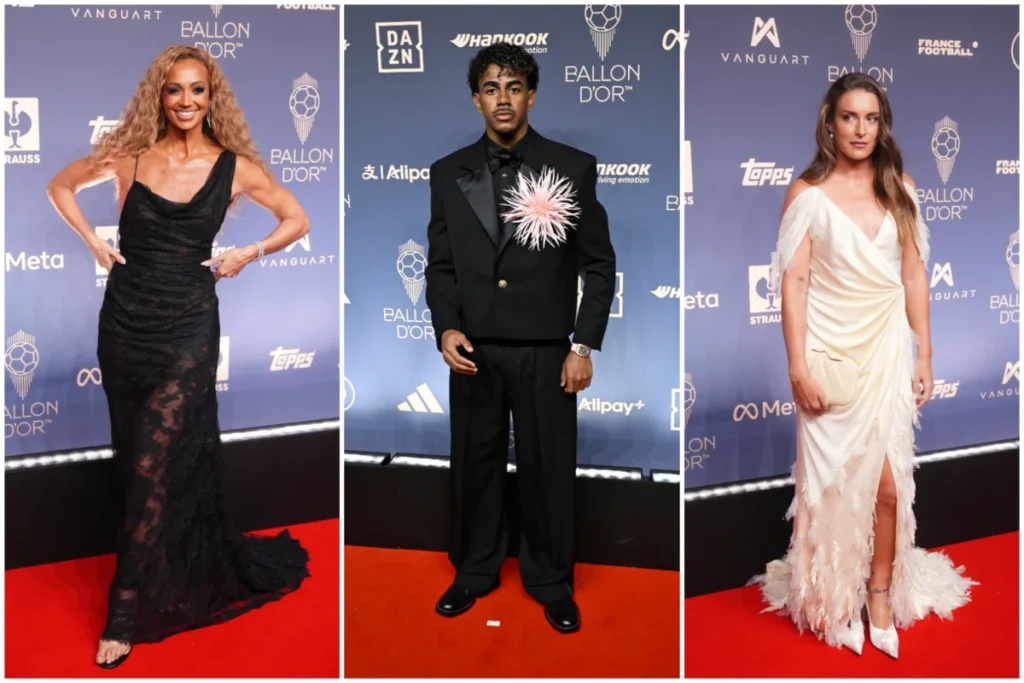

The 70th annual Ballon d’Or ceremony transformed London’s iconic Palladium Theatre into the global epicenter of football and fashion this evening, as the sport’s most decorated figures gathered to celebrate the pinnacle of individual achievement. While the event is formally dedicated to honoring technical mastery on the pitch, the pre-ceremony red carpet has evolved into a significant cultural spectacle, serving as a high-stakes runway where the industry’s top athletes, managers, and influencers debut carefully curated aesthetic statements. This year, the intersection of high-end tailoring, avant-garde couture, and classic black-tie elegance underscored the growing synergy between professional football and the luxury fashion sector.

A Legacy of Excellence and Evolution
The Ballon d’Or, established by France Football in 1956, remains the most prestigious individual accolade in world football. For seven decades, it has served as the definitive barometer of a player’s performance over the course of a calendar year. However, the 2026 edition, hosted in the heart of London, highlighted a shift in the event’s identity. It was not merely a celebration of athletic prowess—marked by a record-breaking season for many of the attendees—but also a reflection of the athletes’ increasing role as brand ambassadors and global style icons. The presence of luxury partners, including Louis Vuitton, which designed the bespoke, monogrammed trunks for the golden trophies, emphasized the commercial weight the event now carries.

The Coronation of a New Icon
The spotlight fell brightest on Harry Kane, the Bayern Munich striker who secured the Men’s Striker of the Year award. His arrival alongside his wife, Katie Goodland, served as a definitive moment of the evening. Kane, who moved to the Bundesliga in 2023 and has since anchored his reputation as one of the most prolific finishers in the sport, capped off a 2025-26 season defined by a staggering 73-goal haul. His choice of a classic, sharp-shouldered black-tie tuxedo, adorned with a traditional poppy badge, provided a stark, traditional contrast to the more experimental attire seen elsewhere on the carpet. Goodland’s choice of an off-the-shoulder gown, accessorized with a signature Birkin bag, signaled the quiet luxury that has become a staple of football’s elite social circles.

For Kane, this recognition is the culmination of a multi-year trajectory that saw him transition from a Premier League talisman to a dominant force in European football. His success at the 2026 awards serves as an indicator of the changing tides in international football, where longevity and sustained output at the highest level are now rewarded with greater consistency.
Women’s Football Takes Center Stage

The women’s game was represented with equal gravitas, led by London City Lionesses star Alexia Putellas, who claimed the Women’s Ballon d’Or. Putellas, whose arrival in a cream-colored gown embellished with intricate feather detailing made an immediate impression, brought a touch of theatrical fashion to the proceedings. Her transition from Barcelona to the Women’s Super League in 2025 was a landmark moment for the sport, and her victory tonight serves as a testament to her enduring influence.
Alongside her, Arsenal and England forward Alessia Russo opted for a high-neck satin dress, a silhouette that mirrored the sleek, minimalist trends dominating current red-carpet fashion. Russo’s presence was a reminder of the rising status of the Lionesses, who have maintained a high profile following their UEFA Women’s Euro 2025 championship title. The breadth of fashion displayed by the women’s contingent—ranging from the architectural, structural designs worn by Putellas to the sophisticated, fluid satin chosen by Russo—highlighted the diversity of personal expression currently thriving within the women’s game.

Generational Shifts and Family Dynamics
The evening was also a showcase of the sport’s shifting demographics. Lionel Messi, an eight-time winner of the Ballon d’Or, provided a heartwarming display of continuity by arriving with his wife, Antonela Roccuzzo, and their three sons. The family’s decision to wear coordinated, starry-patterned suits was a nod to their status as football royalty, grounding the high-pressure environment of the ceremony in a rare moment of domestic unity. Despite the recent disappointment of the World Cup final, where his Argentina side was defeated by Spain, Messi’s continued relevance to the ceremony confirms his status as a permanent fixture in the history of the sport.

Conversely, the emergence of the next generation was personified by Barcelona’s Lamine Yamal. The recipient of the Young Talent of the Year award, Yamal arrived with his partner, Inés García, in a coordinated all-black ensemble. His choice of a light-pink, flower-shaped lapel pin offered a whimsical, youthful contrast to the more rigid formality of his peers. His candid admission on stage—that he believed his teammate, Pau Cubarsí, was more deserving of the award—provided a refreshing moment of authenticity in a night often choreographed by PR teams and brand strategies.
The Managerial and Support Contingent

The event was not limited to those competing on the pitch. Arsenal manager Mikel Arteta, joined by his wife, Lorena Bernal, represented the tactical side of the game. His presence underscored the increasingly blurred lines between the roles of player, manager, and media personality. Similarly, the attendance of sports broadcaster Kate Scott, alongside her husband, former boxer Malik Scott, highlighted the integral role that the media plays in the football ecosystem. Her sheer black, floral-accented gown was a bold departure from the standard gala attire, reflecting the confidence that modern sports broadcasters now exude in the public eye.
Style Statements and Fashion Choices

The red carpet served as a canvas for a variety of sartorial expressions. Ousmane Dembélé made a notable impact by arriving in a head-to-toe brown monochromatic suit, paired with sunglasses—a look that leaned heavily into the "quiet cool" aesthetic favored by young, high-earning athletes. Real Madrid’s Marc Cucurella, meanwhile, opted for a traditional, sharp black suit with a satin tie, leaning into a timeless, dapper aesthetic. Kylian Mbappé further diversified the night’s fashion by choosing a textured suede tuxedo, a material choice that provided depth and visual interest under the intense lighting of the Palladium.
The involvement of luxury entities was further solidified by the presence of actress Sophie Turner. As a house ambassador for Louis Vuitton, her all-black buttoned suit acted as a bridge between the worlds of high fashion and professional sports. Given that Louis Vuitton acts as the official trophy trunk partner for the ceremony, the brand’s presence was both symbolic and structural, reinforcing the prestige of the award through its association with Parisian luxury heritage.

Data and Implications: The Changing Landscape
The 2026 Ballon d’Or ceremony arrives at a time of significant transition for the sport. Data from the 2025-26 season indicates that attendance and digital engagement for top-tier matches have reached all-time highs, particularly within the women’s game. The financial investment into women’s clubs, evidenced by high-profile transfers like that of Putellas and the presence of Chelsea’s international stars on the red carpet, suggests that the sport is entering a new era of commercial viability.

The event’s location in London—a global fashion hub—was a strategic choice that amplified the visibility of these athletes beyond the stadium. By moving the spotlight from the pitch to the red carpet, the organizers have successfully elevated the Ballon d’Or from a niche sporting event to a mainstream cultural happening. This shift has clear implications for the future of football marketing: the "footballer as celebrity" model is no longer a peripheral aspect of the career but a core component of the brand-building process.
Broader Impact on the Sport

As the 70th Ballon d’Or ceremony concludes, the primary takeaway is the professionalization of the athlete’s public image. The coordination, the designer partnerships, and the stylistic risks taken on the red carpet are indicative of a workforce that is increasingly aware of its global reach. While the awards themselves provide the necessary prestige, it is the spectacle surrounding them that ensures the sport remains at the forefront of the cultural conversation.
The evening also served to humanize the global superstars. Seeing the likes of Yamal, Russo, and Kane not just as athletes, but as individuals with distinct personal tastes and family lives, contributes to the ongoing narrative of the "human side of the game." For the fans watching across the globe, the ceremony provided a bridge between the intense, high-stakes competition of the pitch and the accessible, aspirational world of red-carpet glamour.

Looking ahead, the success of this year’s event in London sets a high bar for future ceremonies. The integration of high fashion, the celebration of both men’s and women’s achievements on equal footing, and the inclusion of cross-industry influencers suggest that the Ballon d’Or will continue to expand its influence far beyond the footballing calendar. As the dust settles at the Palladium Theatre, the focus will undoubtedly return to the field, but the memories of this evening—a blend of athletic achievement and sartorial flair—will remain a definitive marker of the 2026 season. The industry has proven once again that football is not just about the scoreline; it is about the story, the style, and the enduring power of its icons.