
When writer-director Richard Kelly’s feature film debut, Donnie Darko, premiered in the dramatic competition at the Sundance Film Festival in January 2001, it arrived with little conventional fanfare yet immediately polarized audiences. Set against the backdrop of 1988 suburban America, the psychological sci-fi drama explored teenage alienation, mental health struggles, and temporal mechanics through the lens of a troubled high school student. Distributed by Newmarket Films, the picture eventually secured a theatrical release on October 26, 2001. Though its initial commercial performance was modest—grossing just over $8 million globally against a reported production budget of $4.5 million—the film would go on to transcend its humble box-office origins, evolving over subsequent decades into one of modern cinema’s most enduring cult classics.
Chronology of a Cult Phenomenon: From Development to Distribution
The genesis of Donnie Darko traces back to the late 1990s, when Richard Kelly, a graduate of the University of Southern California’s cinematic arts program, penned the screenplay. Influenced by his own upbringing in Virginia and a steady diet of science fiction, suburban satire, and 1980s pop culture, Kelly sought to craft a narrative that blended the mundane realities of adolescent angst with high-concept theoretical physics, including time travel and parallel universes.
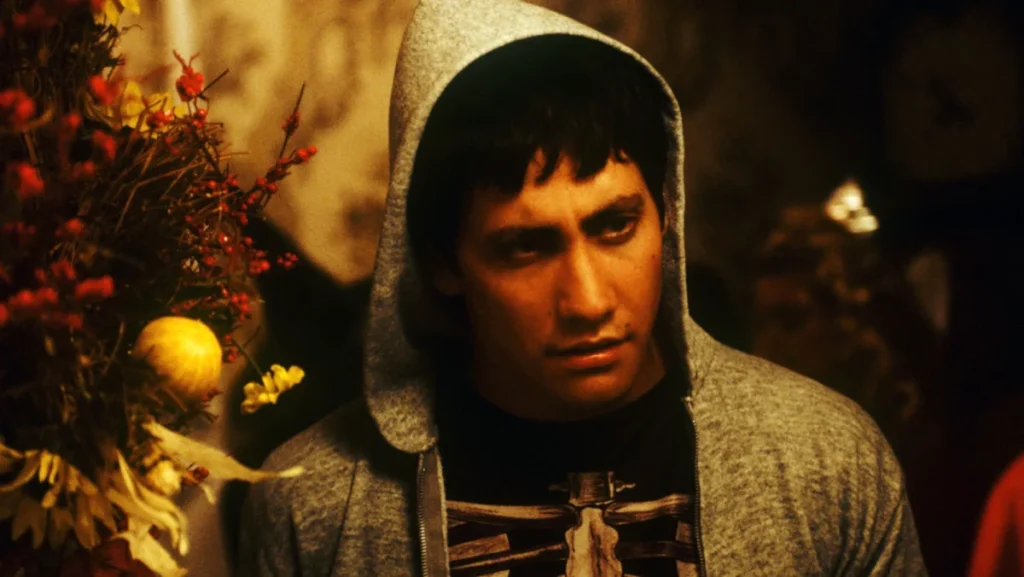
Securing financing proved to be a formidable hurdle. For a time, the project was nearly converted into a direct-to-video release before Drew Barrymore’s production company, Flower Films, stepped in. Barrymore not only committed to executive producing the project but also agreed to take on a supporting acting role as a sympathetic English teacher, Karen Pomeroy. With backing secured and a cast assembled—featuring a then-rising Jake Gyllenhaal in the title role alongside his sister, Maggie Gyllenhaal, Jena Malone, Patrick Swayze, Mary McDonnell, and Holmes Osborne—principal photography commenced in the summer of 2000.
Following its debut at the Sundance Film Festival in January 2001, the film faced an uphill battle in securing a major theatrical distributor. The tone, which straddled the line between dark teen comedy, psychological thriller, and metaphysical puzzle, made conventional marketing difficult. Compounding these distribution challenges was the tragic backdrop of the September 11 terrorist attacks in late 2001. Because the narrative prominently features a jet engine crashing into a suburban home—a plot point crucial to the science-fiction mechanism of the story—marketers grew hesitant to promote a film involving aviation disasters so soon after a national tragedy. When Newmarket Films finally brought the movie to theaters on October 26, 2001, its theatrical footprint was severely limited, resulting in the soft initial box-office returns that characterized its domestic run.
Critical Reception and Audience Polarization
Upon its original publication on January 23, 2001, The Hollywood Reporter’s review captured the volatile nature of the Sundance audience’s response, noting a stark "generational abyss" between younger viewers who embraced the picture’s anti-establishment bite and older critics who found its narrative ambitions overly convoluted.
Reviewers at the time frequently classified the feature within the lineage of dark, suburban satires, drawing thematic comparisons to films like Heathers and American Beauty. The narrative centered on Donnie Darko, a brilliant yet deeply troubled teenager medicated for paranoid schizophrenia, who begins experiencing terrifying auditory and visual hallucinations. Guided by Frank—a six-foot-tall figure in a grotesque rabbit suit who informs Donnie that the world will end in 28 days, 6 hours, 42 minutes, and 12 seconds—the protagonist embarks on a series of subversive actions that disrupt the hypocritical status quo of his upscale Virginia community.
While critics praised the atmospheric cinematography by Alexander Hammond and the strong performances of the ensemble cast—particularly Jake Gyllenhaal’s fragile, morose portrayal of Donnie and Patrick Swayze’s slick turn as a disgraced motivational speaker—many expressed reservations regarding the screenplay’s structural coherence. Observers noted that the intricate layers of paranormal activity and theoretical physics occasionally overwhelmed the emotional core of the narrative, leading to a sprawling, hyperactive finale that divided critical consensus. Nevertheless, the performances of seasoned professionals like Mary McDonnell and Holmes Osborne as Donnie’s overburdened parents, alongside young talents like Jena Malone, grounded the eccentric premise in genuine emotional stakes.
Supporting Data and Financial Trajectory
Though Donnie Darko is widely celebrated today as a landmark of 2000s independent cinema, its early financial indicators offered little hint of its eventual cultural footprint. Produced on an estimated budget of $4.5 million, the film’s initial domestic theatrical run yielded a mere fraction of that investment, pulling in roughly $515,000 domestically before concluding its theatrical run with a worldwide total just eclipsing the $8 million mark.
However, theatrical receipts proved to be an inaccurate metric for the movie’s financial and cultural viability. The true turning point for Donnie Darko arrived with its home video release on DVD in 2002. Fueled by word-of-mouth recommendations, internet message board communities, and the inclusion of the filmmaker’s preferred "Director’s Cut" in 2004—which restored several minutes of footage and explicitly clarified the mechanics of the "Tangent Universe"—the film found its intended audience. Sales of physical media and subsequent licensing deals transformed the property into a lucrative asset for its rights holders, eventually achieving profitability that far outpaced its initial theatrical earnings.
Analysis of Implications and Legacy
The enduring legacy of Donnie Darko extends well beyond its box-office recovery; it serves as a quintessential case study in the power of home video culture and internet-era film fandom to rescue a misunderstood work from obscurity. In the early days of online cinephilia, the film’s complex, open-ended mythology invited endless debate, video essays, and fan theories regarding predestination, free will, and quantum mechanics. This active engagement helped cement the project not merely as a passive viewing experience, but as an interactive puzzle that rewarded repeat viewings.
Furthermore, the film played a pivotal role in shaping the careers of its key creative personnel. For Jake Gyllenhaal, the performance provided a breakout vehicle that established his credentials as a versatile, intensely committed actor capable of carrying complex psychological material. It transitioned him from a promising young actor into a respected leading man, setting the stage for subsequent acclaimed performances in films like Brokeback Mountain, Zodiac, and Nightcrawler. For Richard Kelly, the project represented both a high-water mark and a bold opening statement, showcasing a distinctive visual and thematic voice that prioritized ambitious, risk-taking storytelling over formulaic crowd-pleasing.
Ultimately, Donnie Darko endures because it captured a specific, universal sensation of adolescent isolation while wrapping it in a uniquely audacious genre-blending package. By refusing to talk down to its teenage demographic and instead treating their existential dread with cinematic grandeur, the film secured a permanent place in the canon of American independent cinema, proving that even a modest Sundance entry can defy conventional expectations and leave a permanent imprint on popular culture.