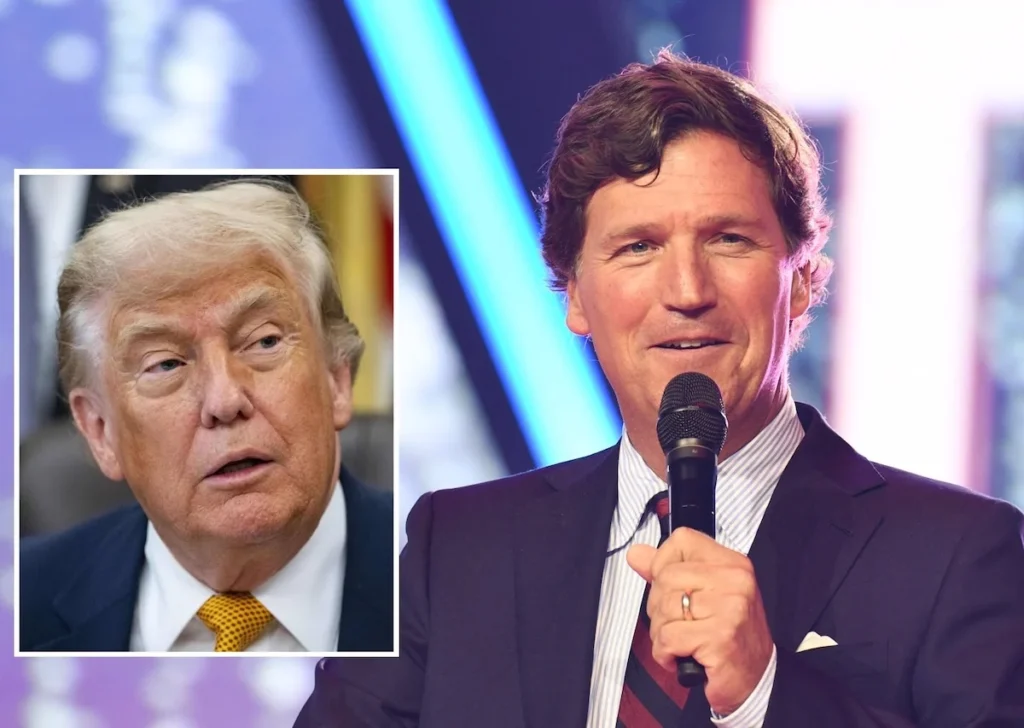

In a development that has sent ripples through the conservative political landscape, Tucker Carlson, long regarded as one of the most influential and recognizable voices in right-wing media, has publicly announced his refusal to support the Republican Party in the upcoming midterm elections. The stunning declaration, made during a recent appearance on the "Can’t Be Censored" podcast, marks a significant and dramatic break from the political establishment he spent decades defending and championing. Carlson’s pronouncements not only reflect a deepening personal frustration but also signal a potential fracturing within a crucial segment of the conservative electorate.
A Seismic Shift in Conservative Commentary
Carlson’s statement, delivered with an air of exasperation, was unequivocal: "There’s no chance I would support the Republican Party [ahead of the midterms]." To preempt any speculation of a pivot to the left, he swiftly added, "Not gonna support the Democratic Party." This dual rejection underscores a profound disillusionment with the two-party system, particularly the Republican Party, which he has accused of betraying its base. The gravity of these remarks cannot be overstated, coming from a figure whose prime-time show on Fox News consistently topped ratings, often drawing millions of viewers and shaping the daily discourse for countless conservative Americans. His move into independent media platforms post-Fox News has only broadened his reach, allowing him an unvarnished platform to articulate his evolving views.
The declaration represents more than just a personal stance; it’s a potential bellwether for a segment of the conservative movement that feels increasingly alienated by the traditional GOP. For years, Carlson served as a bulwark against liberal media and a staunch advocate for Republican causes and politicians. His shift signals a growing chasm between the populist, anti-establishment wing he now embodies and the more conventional, donor-driven Republican establishment.
The Road to Disillusionment: A Chronology of Carlson’s Evolving Stance
Tucker Carlson’s journey to this point of overt political disavowal is a complex one, marked by a gradual but discernible ideological evolution.
-
Early Career and Fox News Tenure (Pre-2023): Carlson rose to prominence through various media outlets, including CNN and MSNBC, before finding his definitive platform at Fox News. His show, "Tucker Carlson Tonight," launched in 2016, quickly became a cornerstone of the network’s prime-time lineup. During this period, he was a vocal defender of Republican policies, figures like Donald Trump, and conservative principles, often engaging in fierce debates against progressive viewpoints. He cultivated an image as a champion of the working class, a critic of globalism, and a proponent of an "America First" foreign policy, positions that largely aligned with the populist shift within the Republican Party during the Trump era. His nightly monologues often set the agenda for conservative discussions, solidifying his role as a kingmaker within the movement.
-
Departure from Fox News (April 2023): Carlson’s abrupt departure from Fox News in April 2023, following the network’s settlement with Dominion Voting Systems, marked a critical turning point. While the exact reasons for his exit remain subject to speculation, it freed him from the editorial constraints of a major corporate network. He swiftly transitioned to independent platforms, initially launching a video series on X (formerly Twitter) and later establishing the Tucker Carlson Network (TCN). This move allowed him unprecedented autonomy, enabling him to speak more freely and critically about various institutions, including those he previously defended. His independent ventures quickly garnered a massive audience, demonstrating the portability of his influence beyond traditional media structures. For instance, his videos on X routinely accumulate tens of millions of views, far surpassing typical cable news viewership.
-
The Trump Era and the Iran Conflict (Early 2024): A "major turning point," as Carlson described it, was President Donald Trump’s decision to engage in military action against Iran earlier this year. While Carlson had been a consistent supporter of Trump through the 2024 election cycle, this specific foreign policy decision appears to have catalyzed his disillusionment. Following the initiation of the conflict, Carlson publicly expressed regret over his past support for Trump, stating he felt he had "unintentionally misled people." This was a significant admission for a commentator who had built his brand on unwavering conservative advocacy. His critique of the Iran conflict aligned with his long-standing skepticism of foreign military interventions, a stance often at odds with more hawkish elements within the Republican Party. This event underscored a growing divide between Carlson’s populist, non-interventionist foreign policy views and the actions of the party leadership.
-
Growing Frustration and Podcast Declaration (Recent): In the months leading up to his "Can’t Be Censored" podcast appearance, Carlson’s criticism of the Republican establishment intensified. His commentary increasingly targeted what he perceived as the party’s failure to represent the interests of ordinary Americans, instead prioritizing corporate donors and foreign entanglements. This culminated in his recent definitive statement, which effectively formalizes his public break from the party apparatus.
Unpacking the "Treasonous" Accusation
Perhaps the most incendiary aspect of Carlson’s recent statements was his accusation against Republican leaders. He minced no words, asserting: "They are making decisions on the basis of other criteria, what’s best for this company, what’s best for Israel, what’s best for our donors. That’s not just, like, they are off in the wrong direction, like, that is unacceptable, that’s treasonous, it’s immoral, it can’t continue."
This choice of language — "treasonous" and "immoral" — is exceptionally severe for a political commentator discussing leaders of his former party. It reflects not merely disagreement but a fundamental breakdown of trust and a moral condemnation. By linking Republican decisions to corporate interests, foreign nations (specifically Israel), and donors, Carlson taps into a populist narrative that resonates deeply with a segment of the electorate suspicious of entrenched power structures and globalist agendas. This sentiment is often fueled by a perception that political elites are out of touch and prioritize special interests over the well-being of the average citizen. Such rhetoric, while controversial, serves to further galvanize his base, who often feel similarly betrayed by the political establishment. It frames the debate not as a difference in policy, but as a crisis of integrity and loyalty to the nation.
Carlson’s Influence and Audience Impact: A Ripple Effect?
Carlson’s influence is undeniable. At its peak, "Tucker Carlson Tonight" averaged over 3 million viewers nightly, making it the most-watched cable news program in the United States. His transition to independent platforms has demonstrated that his audience is loyal to him, not necessarily to the network or party. His videos on X frequently garner tens of millions of impressions, far exceeding the reach of traditional cable news. The Tucker Carlson Network, while subscription-based, also commands a significant and dedicated following.
His claim, "I’ve been a consistent defender for 35 years of the Republican Party, I mean very consistent defender, but there’s no defending this. So no, I’m out. And if I’m out, then I think a lot of other people are out," is not an idle boast. Polling data consistently indicates a growing sense of disillusionment among American voters, including conservatives, with both major political parties. A 2023 Gallup poll, for instance, found that a record 49% of Americans identify as political independents, with growing dissatisfaction among those who previously aligned with either the Republican or Democratic parties. This trend suggests that Carlson’s sentiments may indeed resonate with a substantial portion of his audience who feel their voices are not being heard by the traditional Republican establishment. Many voters, particularly those drawn to the populist appeals of figures like Trump and Carlson, often feel that the GOP has drifted too far from its stated principles, becoming beholden to corporate lobbies and globalist agendas. Carlson’s public break could provide permission or validation for these voters to similarly disengage from the party, potentially impacting turnout and loyalty in critical elections.
Reactions and Implications for the GOP
Carlson’s declaration poses a significant challenge for the Republican Party, particularly as it navigates the complexities of upcoming midterm elections and attempts to unify its diverse factions.
-
Republican Strategists: Publicly, GOP strategists might downplay Carlson’s influence or dismiss his statements as personal opinion. However, privately, such a pronouncement from a figure with his reach is undoubtedly a cause for concern. The Republican Party relies heavily on the engagement and loyalty of its base, and any erosion of that support, especially from a widely trusted voice, could be detrimental. The challenge for the GOP is to retain populist voters who share Carlson’s anti-establishment views while also appealing to traditional conservatives and donors. This internal tension is a defining feature of the post-Trump Republican Party, and Carlson’s statement exacerbates it. It forces the party to confront questions about its identity, its core principles, and its leadership.
-
Conservative Media Landscape: Carlson’s break could further fragment the conservative media landscape. While some outlets and personalities might criticize him for abandoning the party, others, particularly those with a more populist or libertarian bent, might echo his sentiments. This could lead to new alignments, with certain media figures gravitating towards Carlson’s independent stance, potentially creating a new axis of conservative thought distinct from the mainstream GOP.
-
Midterm Election Landscape: The immediate impact on the midterms is difficult to quantify but could be significant. If a portion of Carlson’s audience follows his lead and withholds support from Republican candidates, it could depress GOP voter turnout in key races. Alternatively, it might push some voters towards third-party candidates or simply lead to increased political apathy. This uncertainty complicates Republican campaign strategies, forcing them to consider how to address the growing disillusionment expressed by prominent figures like Carlson. It also raises questions about fundraising, as donors might become more selective in their contributions, favoring candidates who align with specific ideological factions.
The Uncharted Territory of Political Independence
As for what comes next, even Carlson himself admits uncertainty: "I don’t know what I’m going to do." This ambiguity leaves open several possibilities for his future role in American politics.
- Remaining a Media Figure: He could continue to leverage his independent platforms to critique both major parties, acting as a powerful voice outside the traditional political structure. This role would allow him to maintain influence without the direct responsibility of party affiliation or campaigning.
- Endorsing Non-Establishment Candidates: Carlson might choose to endorse specific candidates, perhaps those running as independents or within third parties, who align with his populist, anti-interventionist, and anti-establishment views. Such endorsements could provide significant boosts to underdog campaigns.
- Exploring Third-Party Movements: While he hasn’t explicitly stated this, his complete rejection of both major parties could position him as a potential figurehead or influential voice for a burgeoning third-party movement, should one gain traction. The current political climate, marked by high levels of dissatisfaction with the two-party system, could be fertile ground for such an endeavor.
Carlson’s declaration is not merely a personal political statement; it is a symptom of a broader societal trend – the increasing disaffection with the traditional two-party system in the United States. Many voters across the ideological spectrum feel unrepresented by established political institutions, leading to a rise in independent affiliations and a search for alternative voices.
Broader Significance
Tucker Carlson’s public break from the Republican Party serves as a critical bellwether for the future of the conservative movement. It highlights the deep ideological fissures within the right, particularly between the traditional conservative establishment, the populist MAGA wing, and an emerging anti-establishment, nationalist faction. His actions underscore the evolving role of media personalities in shaping political discourse, demonstrating their capacity to influence public opinion and potentially reorient political allegiances outside conventional party structures.
The challenge for the Republican Party, and indeed for American politics as a whole, will be to adapt to these shifting loyalties and the growing demands for authenticity and accountability from political leaders. Carlson’s move forces a crucial question: if one of the most influential conservative commentators of the modern era is officially walking away from the Republican Party, what does that mean for the broader movement heading into the midterms, and for the long-term health of the two-party system itself? The answers to these questions will undoubtedly shape the trajectory of American politics in the years to come.