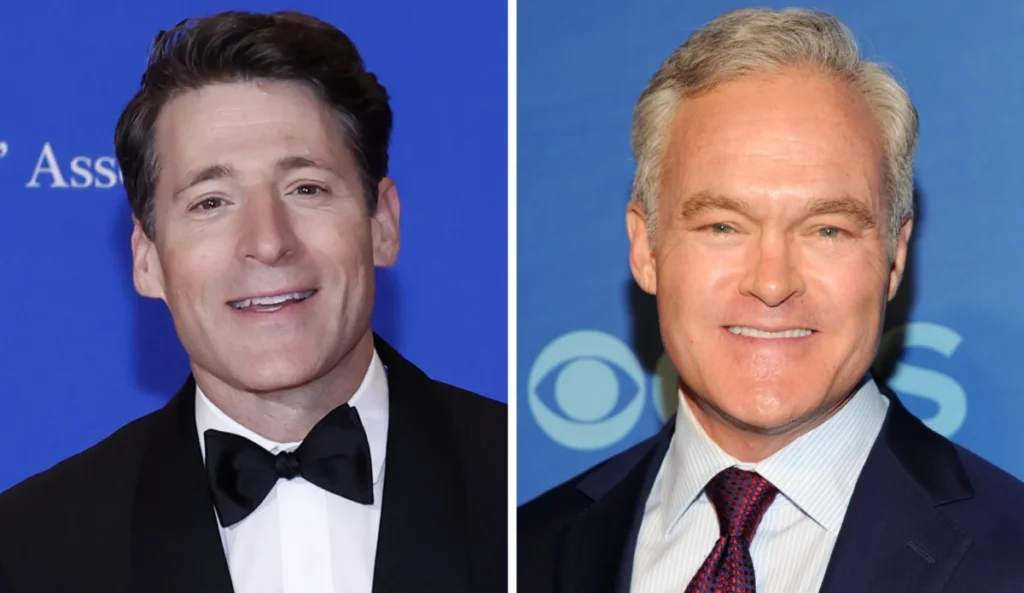

On Wednesday’s broadcast of the CBS Evening News, anchor Tony Dokoupil delivered a poignant tribute to veteran journalist Scott Pelley, marking a significant moment of transition within CBS News. Pelley’s departure from his long-standing role at 60 Minutes was confirmed on Tuesday, June 2, sending ripples through the broadcast journalism community. Dokoupil, who now helms the CBS Evening News, acknowledged Pelley’s profound influence on the network, particularly during Dokoupil’s own early days at CBS.
"When I started at CBS, Scott Pelley was in this very chair, and still doing a dozen stories a year for 60 Minutes," Dokoupil stated on air. "And amid all of that, still meeting every new correspondent to share his view of the mission here." He further articulated Pelley’s deeply held belief in the foundational importance of a free press, quoting James Madison’s assertion that it is "the right that guaranteed all the others." Dokoupil emphasized Pelley’s unwavering commitment to journalistic excellence, noting that reaching CBS News meant being "among the best in the world," a standard Pelley consistently strove to uphold.
The on-air segment featured a carefully curated montage celebrating Pelley’s illustrious career, a testament to decades of impactful reporting. The retrospective included powerful imagery from the aftermath of the September 11th attacks, where Pelley remained at Ground Zero for days, providing critical coverage of the heroic efforts of first responders. His fearless reporting from the front lines of conflicts in Iraq and Afghanistan was also highlighted, showcasing his dedication to bringing truth to light from some of the world’s most perilous environments. The montage underscored his extensive accolades, including over 50 Emmy Awards, and his history of conducting high-profile interviews with U.S. presidents, from George W. Bush to Joe Biden. It painted a portrait of a journalist who prioritized truth above all else, embodying a journalistic ethos that many described as belonging to a bygone era of dedication and integrity.
Dokoupil elaborated on Pelley’s unique approach to journalism, describing him as "a man from another era, and that’s not a knock." He recalled Pelley’s deliberate decision not to watch the competition, explaining it stemmed from a profound self-awareness of his own identity as a journalist committed to truth at any cost. Pelley’s dedication extended to remembering colleagues lost in the field, serving as a constant reminder of the inherent dangers of their chosen profession. A particularly noteworthy aspect of Pelley’s tenure, as highlighted by Dokoupil, was his innovative approach to the CBS Evening News branding. Instead of featuring his name prominently, Pelley opted for the inclusive title, "The CBS Evening News with all of us," a gesture that Dokoupil concluded with a heartfelt "Well, Scott, from all of us, thank you."
A Shifting Landscape at CBS News
The current leadership at CBS News, under Editor-in-Chief Bari Weiss, has initiated a significant programming and editorial overhaul. Dokoupil’s appointment to anchor the CBS Evening News is a key component of this strategy. Weiss, who took the helm of CBS News, has been instrumental in shaping the network’s direction, aiming to revitalize its programming and journalistic approach. However, this period of change has not been without internal friction, and has reportedly led to the departures of several veteran journalists, including prominent figures from 60 Minutes such as Sharyn Alfonsi and Cecilia Vega, in addition to Pelley.
The Genesis of Pelley’s Departure
Pelley’s exit is reportedly linked to a contentious exchange during a staff meeting with the new executive producer of 60 Minutes, Nick Bilton. According to reports in The New York Times, Bilton stated that CBS News Editor-in-Chief Bari Weiss "loves 60 Minutes." Pelley’s alleged response was sharp and direct: "She’s murdering 60 Minutes. She does not love this place; she was brought in to kill it and is doing exactly that." Further reports indicate Pelley criticized Bilton’s qualifications for the role, asserting that Bilton would "never be welcomed there," and also voiced concerns about Weiss’s broader influence on the CBS Evening News.
Following this confrontation, Pelley reportedly received a termination letter from Bilton. Pelley’s response, as detailed in subsequent reports, was a strong accusation of editorial interference. He stated, "For my part, new management has instructed me to inject falsehoods and bias into a politically sensitive story." While Pelley did not specify the particular story in question, a CBS spokesperson issued a statement refuting any claims of political interference. The spokesman asserted, "There is no political interference at CBS News, not from ownership, not from Bari Weiss. The only ‘interference’ is the normal back and forth between editor and correspondent that happens at every newsroom."
Pelley’s Public Statement and Accusations
In a public statement released after his firing, Scott Pelley articulated his deep concerns regarding the direction of CBS News under its new leadership. He accused the new management of attempting to curry favor with then-President Donald Trump, and declared that 60 Minutes had "lost its DNA." Pelley attributed this significant shift to the "incompetence and unprofessionalism in the new management" which, in his view, had "wreaked havoc" on the program. He concluded his statement with a poignant reflection on the state of the network: "I am deeply moved by the thousands of wishes we have received to ‘keep up the good fight.’ Most of the men and women of CBS News are still in that fight. But now the collapse of values at the top has become untenable. The leadership of 60 Minutes is no longer recognizable. The principles I hold dear are gone, and so I must leave as well.”
Broader Implications for Broadcast Journalism
The events at CBS News, particularly the departure of a figure as seasoned and respected as Scott Pelley, signal a broader trend of significant shifts within major broadcast news organizations. The increasing influence of new media executives, often with backgrounds in digital platforms or different journalistic philosophies, can lead to clashes with established journalistic traditions. The emphasis on perceived audience engagement, competitive pressures, and evolving media consumption habits are all factors contributing to these transformations.
The departure of veterans like Pelley raises questions about the preservation of institutional knowledge and the core values that have historically defined prestigious news programs. For audiences accustomed to a certain standard of in-depth reporting and journalistic integrity, these changes can be disorienting. The assertion of journalistic independence against potential political or corporate pressures remains a critical concern for the credibility of news organizations. The "normal back and forth between editor and correspondent" mentioned by the CBS spokesman is a standard part of newsroom operations, but the nature and intent behind such exchanges can be perceived differently by seasoned journalists who have long operated under different editorial guidelines.
The future of 60 Minutes, a program that has been a cornerstone of CBS News for decades, is now under intense scrutiny. Its ability to maintain its reputation for hard-hitting investigative journalism while navigating these internal changes will be a key indicator of the network’s overall trajectory. The "fight" that Pelley alluded to likely refers to the ongoing struggle to uphold journalistic ethics and rigor in an increasingly complex and competitive media landscape. The coming months will undoubtedly reveal the long-term impact of these leadership changes on CBS News and its flagship programs.