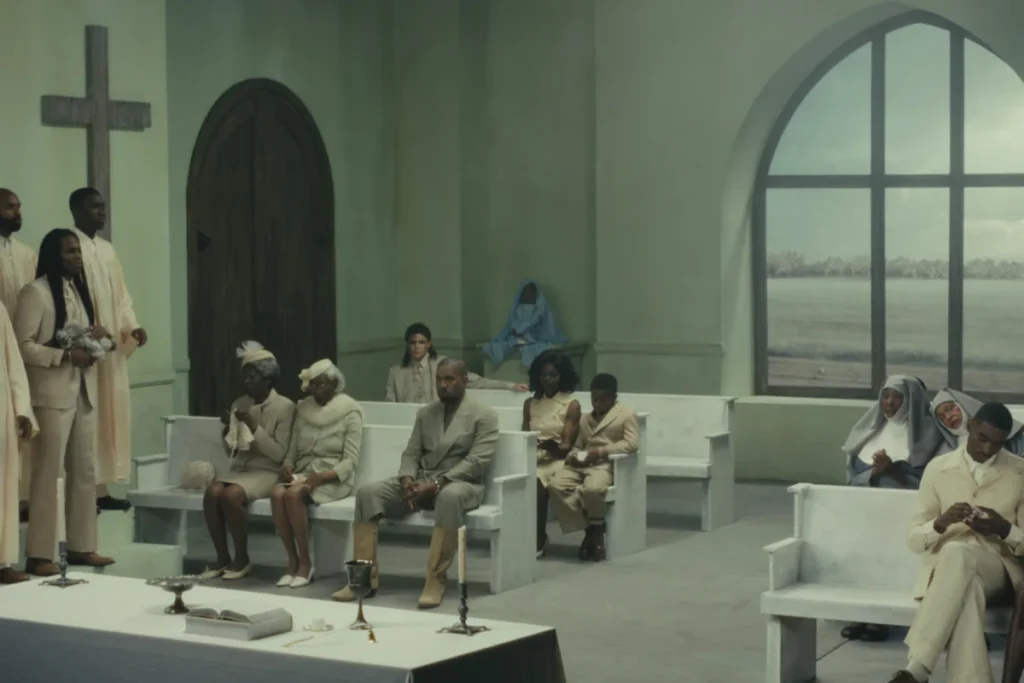

The track is from Ye’s just-released Bully album, streaming now.
The highly anticipated release of Ye’s (Kanye West’s) latest musical offering, Bully, has arrived, and with it, the striking music video for the album’s lead single, “Father.” The video, a visually arresting single-camera production directed by Bianca Censori, offers a surreal and thought-provoking narrative that has ignited discussion among fans and critics alike. Accompanying Ye on the track is fellow artist Travis Scott, whose distinct verse adds another layer to the song’s complex soundscape. Both the album and the accompanying visual are now available across all major streaming platforms, marking a significant moment in the artist’s recent output.
A Cinematic Vision in a Sacred Space
The music video for “Father” is set within the confines of a church, an environment that is at once minimalist in its design and densely populated with peculiar and compelling events. This setting serves as a stark contrast to the often chaotic and elaborate visual narratives Ye has previously presented. The single-camera technique amplifies the sense of immersion, drawing the viewer directly into the unfolding tableau. From the outset, the video establishes a tone of enigmatic commentary, eschewing overt explanations in favor of symbolic imagery and an atmosphere ripe for interpretation.

The visual narrative unfolds with a series of vignettes that challenge conventional perceptions of reality and religious observance. A card trick performed by an individual inexplicably culminates in flames, met with an almost indifferent reaction from a grandmother engaged in knitting in an adjacent pew. This juxtaposition of the miraculous and the mundane underscores a central theme of the video: the potential for extraordinary events to be overlooked in the face of routine or personal preoccupation. The scene takes a dramatic turn with the arrival of a police squad, notably preceded by a knight in plate armor who enters on horseback, a striking image that blends medieval regalia with modern law enforcement. Their objective: to arrest a nun who appears to be asleep.
Adding to the surreal atmosphere, a lookalike of the late Michael Jackson is seated alone in the back row, seemingly unperturbed by the unfolding spectacle. The video’s surrealism escalates with the apparent touchdown of a UFO. In a moment that blurs the lines between celebrity, performance, and the otherworldly, both Ye and Travis Scott are depicted pulling down masks, revealing that they themselves embody both the celebrated figures and the extraterrestrial visitors. This meta-commentary suggests a deconstruction of fame and the performative aspects of celebrity, hinting that perhaps the extraordinary is already present within the familiar, or that the artists themselves are orchestrating these perceived realities. The overarching sentiment conveyed is that these bizarre occurrences, whether supernatural or staged, are largely ignored by the churchgoers, who remain absorbed in their own worlds.
Lyrical Themes of Transformation and Identity
The lyrical content of “Father” provides a crucial counterpoint to the visual narrative, offering insights into Ye’s current state of mind and artistic evolution. The chorus, “Bye-bye to my old self/ Wake up to the new me/ I used to be on Worldstar/ Now I’m making Newsweek/ I used to hang on the 9/ Now I bought two streets/ Cottage Grove to King Drive/ Yeah, this life is a movie,” directly addresses themes of personal transformation, ambition, and a shift in public perception. The references to “Worldstar” and “Newsweek” suggest a move from grassroots online notoriety to a more established, mainstream media presence. The mention of “buying two streets” and specific locations like “Cottage Grove to King Drive” likely alludes to personal growth, material success, and a reassertion of roots, all framed within the overarching metaphor of life as a cinematic experience. This introspection suggests a period of significant self-reflection and a conscious effort to redefine his public persona and legacy.
"Bully" Album: A Comprehensive Artistic Statement

The release of Bully on March 28th, a 42-minute collection comprising 18 tracks, represents Ye’s first full album project following a period marked by public controversy and personal challenges. The album features a diverse range of collaborators, including Don Toliver on “Circles,” Peso Pluma on “Last Breath,” CeeLo Green on the title track “Bully,” and Ye’s music director Andre Troutman contributing to “All the Love” and “White Lines.” The inclusion of Travis Scott on “Father” highlights the continued artistic synergy between the two artists.
The album arrives at a pivotal moment in Ye’s career, following his public apology for antisemitic remarks and erratic online behavior that generated significant media attention in recent years. In January, Ye issued a full-page apology advertisement in The Wall Street Journal, addressing his actions and seeking forgiveness. In the statement, he articulated the difficulties of managing bipolar type-1 disorder, describing “disconnected moments” that led to poor judgment and behavior he often perceived as an “out-of-body-experience.” He expressed deep regret and mortification for his actions, emphasizing his commitment to accountability, treatment, and meaningful change, while acknowledging that these explanations did not excuse his conduct. This context imbues Bully with an added layer of significance, suggesting that the album may serve as a form of artistic redemption and a testament to his ongoing journey of self-discovery and accountability.
Context and Broader Implications
The release of Bully and its accompanying visuals takes place against a backdrop of Ye’s planned return to live performance. He is scheduled to perform at SoFi Stadium in Los Angeles on April 1st and 3rd, further signaling a renewed engagement with his audience and the music industry. The timing of these events, closely following the album’s release, suggests a strategic effort to reconnect with his fanbase and re-establish his presence in the cultural landscape.
The thematic exploration within “Father” and the album Bully can be interpreted as a multifaceted response to his recent experiences. The critique of societal indifference, the questioning of religious or spiritual frameworks, and the personal narrative of transformation all point towards an artist grappling with his public image, his personal struggles, and his place in the world. The surreal and often unsettling imagery in the video, while open to various interpretations, consistently points towards a disruption of the ordinary and a search for meaning or truth beneath the surface.
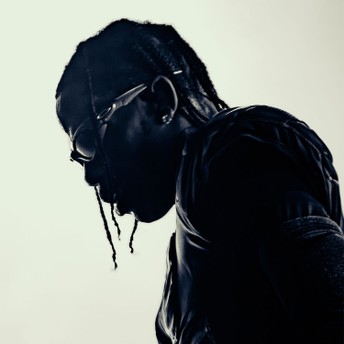
The collaboration with Travis Scott on “Father” is also noteworthy. Scott, who himself has faced scrutiny and experienced career setbacks, brings a certain gravitas to the track. Their shared artistic history and the nature of their contributions suggest a mutual understanding of the pressures and complexities of fame in the contemporary music industry.
From a broader perspective, Ye’s recent output, including Bully and the “Father” video, represents a significant chapter in his artistic trajectory. The willingness to confront personal demons, engage with controversial themes, and present a visually and lyrically complex body of work suggests a desire for artistic evolution and a commitment to pushing creative boundaries. The public’s reception of these works, particularly in light of his past controversies, will undoubtedly shape the ongoing narrative of his career and his impact on popular culture. The album’s diverse guest list also indicates an effort to bridge different musical genres and fan bases, potentially broadening his appeal and influence.
The artistic choices made in “Father,” from the single-camera direction to the symbolic imagery and the introspective lyrics, all contribute to a cohesive, albeit abstract, statement. The video acts as a visual extension of the album’s themes, inviting viewers and listeners to engage with Ye’s complex world and his ongoing exploration of identity, faith, and the human condition. As Bully continues to stream and the “Father” video garners attention, the conversations surrounding Ye’s artistic direction and personal journey are likely to intensify, solidifying his position as a polarizing yet undeniably influential figure in contemporary music. The album’s critical reception and commercial performance will offer further insights into how audiences are engaging with Ye’s latest artistic statement and his ongoing efforts towards personal and professional reconciliation.