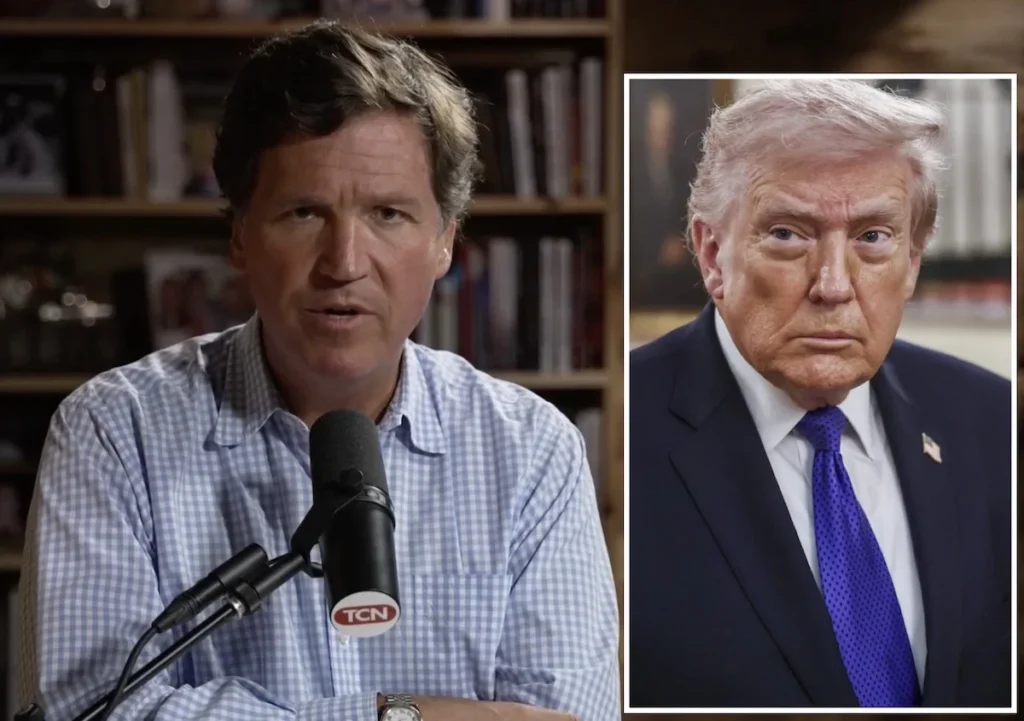

The schism became starkly apparent following an incendiary message posted by former President Trump on Truth Social on Easter Sunday, which Carlson subsequently condemned in unusually strong and somber terms on his eponymous talk show. This was not a typical political disagreement; it carried the weight of a deeply personal and ideological divergence, with Carlson’s critique focusing not merely on policy but on what he perceived as a profound moral and strategic recklessness emanating from the former president. The high stakes involved were immediately evident, as the exchange played out against a backdrop of escalating international tensions, particularly concerning the Strait of Hormuz and relations with Iran.
The Provocation: Trump’s Easter Message and the Strait of Hormuz
The catalyst for this unprecedented public confrontation was a message disseminated by Donald Trump via his social media platform, Truth Social, on a day traditionally observed for its profound religious significance by Christians worldwide. On Easter Sunday, as global tensions simmered over critical maritime choke points, Trump issued a stark and expletive-laden warning directed at Iran. His post read: “Open the F***in’ Strait, you crazy bastards, or you’ll be living in Hell – JUST WATCH! Praise be to Allah.”
This statement immediately drew attention for multiple reasons. Firstly, its aggressive and profane language stood in sharp contrast to the solemnity typically associated with Easter. Secondly, the explicit threat of military action against civilian infrastructure, coupled with the provocative invocation of "Allah," raised alarms among foreign policy analysts and religious observers alike. The Strait of Hormuz, a narrow passage between the Persian Gulf and the Gulf of Oman, is a crucial waterway for global oil shipments, and any threat to its passage has immediate international economic and geopolitical ramifications. Historically, tensions between the U.S. and Iran have frequently manifested around this strategic choke point, with past incidents ranging from naval confrontations to accusations of harassment against commercial shipping. Trump’s message, therefore, was perceived not just as rhetorical flourish but as a potentially dangerous escalation in an already volatile region.
Carlson’s Unprecedented Rebuke: A Moral and Strategic Critique
Tucker Carlson, long recognized as one of Donald Trump’s most vocal and influential media allies, responded to the Truth Social post with a degree of alarm and direct criticism that surprised many observers. Speaking on his Monday night program, Carlson eschewed his characteristic combative style, adopting instead a tone described as "somber, urgent, and deeply alarmed." His initial reaction was a direct challenge to Trump’s authority and judgment: "Who do you think you are? You’re tweeting out the f-word on Easter morning?"
Carlson then delved deeper, articulating a critique that transcended mere decorum. He framed Trump’s message as a dangerous mockery of religion, not just of Islam, but of the very concept of faith. "So, obviously you’re mocking the religion of Iran. OK. If you seek a religious war, that’s a good idea. But by the way, no decent person mocks other people’s religions. You may have a problem with the theology. Presumably, you do if it’s not your religion, and you can explain what that is. But to mock other people’s faith is to mock the idea of faith itself. And we should never mock that because at its core is the acknowledgement that we are not in charge of the universe. We did not build it. We won’t be here at the end of it. We can destroy life. We cannot create it because we are not God."
This philosophical turn was particularly striking for Carlson, whose career has often been defined by sharp, partisan rhetoric. He articulated a core theological principle, arguing that humility before a higher power is central to all major faiths and that human beings, particularly leaders, should not usurp that divine role. He further elaborated, "The message of all faith at the biggest picture level is the message in our Bible, which is you are not God. And only if you think you are, do you talk this way. But it’s not just mockery of Islam. And no president should mock Islam. That’s not your job. This is not a theocracy. We don’t go to war with other theocracies to find out which theocracy is more effective. We are not a theocracy. And God willing, we never will be because theocracies corrupt the religion." Carlson’s argument underscored a fundamental tenet of American secular governance, emphasizing the separation of church and state and cautioning against the dangers of conflating national policy with religious crusades.
Historical Context: US-Iran Relations and the Strait of Hormuz
To fully appreciate the gravity of Trump’s statement and Carlson’s response, it is crucial to understand the long and complex history of US-Iran relations, particularly concerning the Strait of Hormuz. This vital maritime artery, barely 21 miles wide at its narrowest point, is responsible for approximately one-fifth of the world’s total petroleum liquids consumption and a significant portion of global liquefied natural gas (LNG) trade. Its strategic importance makes it a frequent flashpoint for regional and international tensions.
Since the 1979 Iranian Revolution, relations between the United States and Iran have largely been characterized by antagonism, punctuated by periods of heightened confrontation. Key events include the Iran hostage crisis, the Iran-Iraq War (during which the U.S. provided some support to Iraq), and more recently, the controversy surrounding Iran’s nuclear program. The 2015 Joint Comprehensive Plan of Action (JCPOA), or Iran nuclear deal, aimed to curb Iran’s nuclear ambitions in exchange for sanctions relief, but its unilateral withdrawal by the Trump administration in 2018 reignited severe tensions.
Following the JCPOA withdrawal, the U.S. reimposed stringent sanctions, leading to economic hardship in Iran and increased Iranian provocations, including attacks on oil tankers in the Gulf and drone strikes. The killing of Iranian General Qasem Soleimani by a U.S. drone strike in January 2020 further escalated tensions to a near-war footing. Against this backdrop, Trump’s Easter message, explicitly threatening military action and referencing "Hell," was not merely rhetorical but carried the weight of past threats and military actions, amplifying concerns about potential miscalculation or accidental escalation.
The Shifting Dynamics of a Political Alliance
The public clash between Carlson and Trump did not emerge from a vacuum. While Carlson was a steadfast supporter of Trump throughout his presidency and a frequent defender of his policies, particularly against mainstream media criticism, subtle cracks in their alliance had begun to appear. Carlson had previously expressed skepticism, if not outright opposition, to certain proposed military interventions, including strikes on Iranian nuclear facilities. He had also been a vocal critic of what he termed "absolutely disgusting and evil" wars, a stance that often put him at odds with more hawkish voices within the Republican Party, including figures like Senator Ted Cruz, with whom he has also publicly disagreed.
Carlson’s populist, non-interventionist foreign policy views have long distinguished him from traditional conservative internationalists. His consistent questioning of military spending, overseas engagements, and the rationale for various conflicts often resonated with a segment of the Republican base but occasionally clashed with Trump’s own more unpredictable and transactional approach to foreign policy, which, while often isolationist in rhetoric, could also involve sudden and aggressive shows of force. This recent incident represents a significant escalation of these underlying tensions, moving from implicit disagreement to an explicit, public denunciation of the former president’s judgment and moral compass.
Broader Implications for Conservative Media and Politics
The public unraveling of the Carlson-Trump alliance carries profound implications for the conservative media landscape and the Republican Party. Tucker Carlson, through his highly rated programs and extensive reach, wields immense influence over a significant portion of the conservative electorate. His critique of Trump is therefore not easily dismissed as fringe dissent.
For Donald Trump, who relies heavily on unwavering loyalty from his base and media surrogates, Carlson’s direct challenge poses a significant threat. It could erode his support among those who respect Carlson’s judgment and who may already harbor reservations about Trump’s more extreme rhetoric or policies. In the context of potential future presidential campaigns, such a rift could complicate Trump’s efforts to consolidate conservative support, potentially empowering other candidates who might seek to position themselves as more measured or ideologically consistent with Carlson’s brand of conservatism.
The incident also highlights a broader struggle within the Republican Party over its future direction. Is the party primarily defined by Trump’s personality and populist instincts, or are there deeper ideological principles, such as non-interventionism or a certain moral framework, that should guide its path? Carlson’s comments, particularly his emphasis on humility, respect for faith, and caution against theocratic impulses, suggest an attempt to re-anchor the conservative movement to principles he perceives as fundamental, even if they diverge from Trump’s immediate actions. This could foster internal debates and potentially lead to a fragmentation of conservative media influence.
International Repercussions of Rhetoric
Beyond domestic political ramifications, the exchange underscores the significant impact of a former U.S. president’s rhetoric on the global stage. Even out of office, Donald Trump’s statements resonate internationally, particularly given his potential return to power. Threats of military action, especially those couched in inflammatory and religiously insensitive language, can be perceived by adversaries as serious provocations and by allies as destabilizing.
Carlson’s critique of mocking other people’s religions on a global stage is particularly pertinent here. In a world grappling with religious extremism and geopolitical tensions often exacerbated by perceived cultural or religious affronts, such rhetoric can be profoundly counterproductive. It risks alienating moderate voices, fueling radical narratives, and making diplomatic de-escalation far more challenging. Foreign policy experts often emphasize the importance of careful, calibrated language in international relations, especially when dealing with sensitive regions like the Middle East. Trump’s Truth Social post, therefore, was not merely a domestic political statement but an intervention with potential international consequences, further complicating an already delicate geopolitical balance.
The Call to Action and its Significance
Perhaps the most significant aspect of Carlson’s critique was his explicit call to action. He concluded his remarks by stating, "Now it’s time to say no, absolutely not, and say it directly to the president, no." This was not just a condemnation but a direct instruction to his audience and, implicitly, to other conservative figures, to actively oppose Trump on this matter.
Such a direct challenge from a figure of Carlson’s stature is rare and speaks to the depth of his concern. It suggests that he views Trump’s recent behavior as crossing a line that demands active resistance rather than passive disagreement. This call to "say no" could galvanize opposition to Trump’s more extreme impulses within the conservative movement, potentially creating a new fault line that could reshape future political contests. It challenges the long-held expectation of unquestioning loyalty that Trump often demands from his allies, suggesting that some may now prioritize perceived moral and strategic principles over political allegiance.
Reactions and Future Outlook
Donald Trump, predictably, has publicly dismissed Carlson’s criticism, reportedly stating that Carlson has "lost his way." This reaction is consistent with Trump’s history of discrediting critics, particularly those who were once allies. However, the nature of this particular split—not over a policy disagreement but over fundamental issues of judgment, decorum, and the use of power—suggests that it may be more enduring than previous squabbles.
While a loud, explosive break might have been anticipated given the personalities involved, what appears to be unfolding is a quieter, yet unmistakable, decoupling. The consequences of this rift are likely to extend far beyond the immediate headlines, influencing the discourse on conservative media, shaping the dynamics of future political campaigns, and potentially redefining the boundaries of acceptable rhetoric within the Republican Party. The public nature of this disagreement between two titans of the conservative movement ensures that its ripple effects will be closely watched, offering insights into the evolving landscape of American politics.