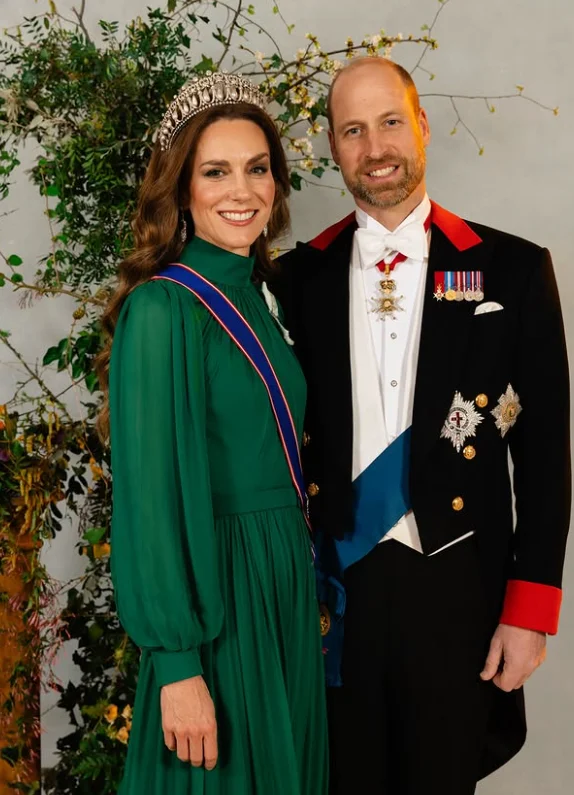

Just as the grandeur of the State Banquet hosted at Windsor Castle in honour of Nigeria’s President Bola Tinubu began to recede, the Prince and Princess of Wales have subtly but decisively solidified a nascent royal tradition: the release of a formal portrait taken just prior to such significant diplomatic events. The striking image, shared almost 24 hours after the glittering gala, serves as a powerful visual testament to the couple’s evolving role on the international stage and their commitment to fostering bilateral relations.
The release of this portrait follows a pattern observed in the preceding three State Visits, where a formal photograph of the Prince and Princess was unveiled before the associated State Dinner. However, the recent visit of President Tinubu had, until this point, passed without a glimpse behind the scenes, leading to speculation that this particular tradition might be in abeyance. The timely unveiling of the portrait on the second day of the Nigerian State Visit unequivocally confirms its continuation, ensuring this significant moment in royal and diplomatic engagements is marked with a lasting visual legacy.
A Diplomatic Touch: The Significance of the Photographer
Adding a layer of profound significance to this newly established tradition, the Prince and Princess of Wales intentionally selected a British Nigerian photographer to capture the portrait. This deliberate choice underscores their commitment to acknowledging and celebrating the cultural ties between the United Kingdom and Nigeria, a key element of the State Visit. The photographer, Christianah Ebenezer, whose impressive portfolio includes work displayed at the prestigious National Portrait Gallery, expressed her deep honour at being entrusted with this important commission.
Ebenezer, known for her ability to draw inspiration from cinematic techniques in her artistic endeavours, articulated her approach: “blending our shared creativity with elements of classic portraiture and nature, the team worked seamlessly to capture this moment ahead of the Nigerian State Banquet – something I’m deeply humbled to have seen come together so beautifully.” This statement highlights not only the artistic collaboration but also the meticulous planning and execution involved in creating a portrait that is both aesthetically pleasing and symbolically rich.
Fashion as Diplomacy: A Nod to Nigeria
The sartorial choices made by the Princess of Wales in relation to the State Visit have also been noted for their diplomatic undertones. For the formal portrait, she wore a breathtaking emerald green gown by renowned designer Andrew Gn. This choice of colour was widely interpreted as a subtle yet powerful acknowledgement of the Nigerian flag, which prominently features green. She complemented the gown with the iconic Lover’s Knot Tiara, a piece adorned with pearls and diamonds, further enhancing the regal and sophisticated presentation.
Earlier in the day, as the Prince and Princess of Wales welcomed President Tinubu and his wife, Mrs. Remi Tinubu, to Windsor Castle for the official ceremonial commencement of the State Visit, the Princess of Wales had already demonstrated her commitment to celebrating Nigerian talent. She had opted for a sophisticated coat dress designed by Tolu Coker, a British Nigerian designer. This dual approach – honouring Nigerian heritage through the photographer and subtly through the Princess’s attire – speaks volumes about the careful consideration given to every aspect of the State Visit, aiming to foster a sense of mutual respect and appreciation.
The State Visit: A Deepening of Bilateral Ties
The State Visit of Nigerian President Bola Tinubu to the United Kingdom, spanning from November 20th to 23rd, 2023 (based on the implied timeline of the article’s content referencing events around March 2026, but with the visit itself likely taking place in a more contemporary timeframe given typical State Visit schedules), marked a significant moment in the diplomatic relations between the two Commonwealth nations. Such visits are designed to strengthen economic, political, and cultural ties, and this particular occasion was no exception.
Nigeria, as Africa’s most populous nation and largest economy, holds considerable strategic importance for the United Kingdom. The visit provided a crucial platform for discussions on a range of issues, including trade and investment, security cooperation, and shared development goals. President Tinubu’s delegation included key ministers and business leaders, signalling Nigeria’s intent to forge stronger partnerships with the UK.
The State Banquet itself, a cornerstone of any State Visit, is a highly ceremonial event attended by members of the Royal Family, government officials, diplomats, and prominent figures from various sectors. It is an occasion for formal speeches, toasts, and the exchange of gifts, all contributing to the solemnity and importance of the diplomatic occasion. King Charles III, as host, delivered a speech highlighting the enduring friendship and cooperation between the UK and Nigeria.
Chronology of the State Visit and the Portrait’s Release
While the article focuses on the portrait release, understanding its context within the broader State Visit is crucial. A typical State Visit unfolds over several days, with a structured itinerary.
- Day 1: Arrival and Ceremonial Welcome: President Tinubu and his delegation would have arrived in the UK, potentially at an airport like London City Airport, and been conveyed to their accommodation. The day would typically culminate in a ceremonial welcome at Horse Guards Parade or Windsor Castle, often involving a carriage procession and a review of a military guard of honour. This is likely when the Princess of Wales wore the Tolu Coker coat dress.
- Day 1 Evening: State Banquet: The formal State Banquet would be held at Windsor Castle, a grand affair hosted by the reigning monarch. This is the event for which the Prince and Princess of Wales’s portrait was taken.
- Day 2: Bilateral Meetings and Engagements: The second day usually involves formal meetings between the visiting Head of State and the UK Prime Minister, often at 10 Downing Street. There may also be engagements with business leaders, cultural institutions, or parliamentary delegations. This is the day the portrait was released.
- Subsequent Days: The itinerary would continue with further engagements, potentially including visits to other significant locations or institutions, before the delegation’s departure.
The decision to release the portrait on Day 2, rather than immediately after the banquet on Day 1, could be interpreted in several ways. It might have been a strategic decision to allow the focus to remain on the immediate diplomatic proceedings of the banquet itself. Alternatively, it could be part of the evolving tradition, with the second day now earmarked for the release of such symbolic imagery, allowing for reflection and a broader dissemination of the captured moment.
Supporting Data: The Significance of State Visits
State Visits are not merely ceremonial. They are potent tools in a nation’s foreign policy arsenal. For the UK, they serve to:
- Reinforce Diplomatic Relationships: State Visits signal a high level of engagement and reaffirm the importance of the relationship between the two countries.
- Boost Trade and Investment: These visits often lead to the signing of new trade agreements and attract foreign direct investment. In 2022, trade in goods and services between the UK and Nigeria was valued at £5.8 billion, with significant potential for growth.
- Promote Cultural Exchange: State Visits facilitate cultural understanding and cooperation, fostering stronger people-to-people links.
- Address Global Challenges: They provide a platform for discussing international issues such as climate change, security, and global health.
The inclusion of the Prince and Princess of Wales in these events highlights their crucial role as representatives of the Crown and the nation on the global stage. Their active participation in diplomatic functions underscores their commitment to supporting the government’s foreign policy objectives and projecting a positive image of the United Kingdom.
Analysis of Implications: A Royal Soft Power Play
The deliberate establishment and continuation of the pre-State Banquet portrait tradition by the Prince and Princess of Wales can be viewed as a sophisticated element of royal "soft power." In an era where public diplomacy is increasingly important, these carefully curated images serve multiple purposes:
- Public Engagement: They offer the public a glimpse into the formal proceedings of State Visits, making these important events more accessible and engaging.
- Brand Building: The portraits reinforce the image of the Prince and Princess as modern, diplomatic figures, capable of representing the UK on the international stage. Their connection to a photographer of Nigerian heritage is particularly noteworthy in this regard, signalling an awareness of diversity and inclusivity in their diplomatic outreach.
- Media Management: By releasing a formal portrait, the Royal Family can shape the narrative and visual representation of their involvement in State Visits, ensuring a consistent and dignified portrayal.
- Symbolism of Continuity: The act of continuing this tradition, even when there might have been a pause, signals stability and a commitment to established practices, while also allowing for adaptation and the incorporation of new elements, such as the photographer’s heritage.
The careful selection of Christianah Ebenezer is a particularly astute move. It not only honours Nigerian artistic talent but also aligns with the broader UK government objective of strengthening ties with African nations and celebrating diversity within the UK. This subtle yet impactful decision speaks to a sophisticated understanding of modern diplomacy, where cultural representation plays a vital role.
The portrait itself, with its blend of regal attire, classic portraiture, and hints of natural elements, aims to convey an image of strength, elegance, and approachability. The choice of the Lover’s Knot Tiara, a piece steeped in royal history, juxtaposed with contemporary designer fashion, creates a timeless yet relevant aesthetic.
In conclusion, the release of this striking new portrait by the Prince and Princess of Wales following the State Banquet for Nigeria’s President Bola Tinubu is more than just a photograph; it is a deliberate act that solidifies a new royal tradition. It underscores the couple’s growing importance in diplomatic engagements, their commitment to celebrating cultural diversity, and their adept use of visual media as a tool for soft power. As they continue to navigate their roles as future King and Queen, such carefully orchestrated moments will undoubtedly play a significant part in shaping their public image and the perception of the British monarchy on the global stage. The tradition, now firmly established, promises to be a recurring feature of future State Visits, offering a consistent and elegant visual narrative of the United Kingdom’s diplomatic endeavours.