
The sixth edition of Frieze Los Angeles, hosted within the expansive hangars and bespoke structures of the Santa Monica Airport, signaled more than just a seasonal gathering of the global art elite; it marked a definitive institutional and commercial embrace of textiles. Once relegated to the secondary tiers of "craft" or "decorative arts," fiber-based works emerged as the undisputed protagonists of the fair. From gossamer silks suspended in architectural configurations to densely worked narrative quilts that challenge historical erasures, the medium occupied center stage, commanding six-figure price tags and captivating a new generation of collectors. This shift reflects a broader movement within the contemporary art world to dismantle the hierarchical boundaries between fine art and manual labor, repositioning the loom and the needle as tools of profound conceptual rigor.
The Evolution of the Medium: From Marginalized Craft to Market Dominance
For much of the 20th century, the Western art canon maintained a rigid distinction between the "fine arts"—painting and sculpture—and the "applied arts," which included textiles, ceramics, and glass. This divide was deeply gendered and often racialized, as weaving and quilting were frequently associated with domestic labor or indigenous traditions. Even figures who operated at the intersection of these worlds often felt the need to distance themselves from the "craft" label. Louise Bourgeois, whose parents famously operated a tapestry restoration studio outside Paris, spent decades channeling the logic of weaving into her monumental bronze spiders. Yet, Bourgeois herself once dismissed textiles as "more engaging and less demanding" than traditional sculpture, arguing that the medium rarely "liberated itself from decoration."

The presentations at Frieze Los Angeles 2024 suggest that this liberation is now complete. The current "material turn" is driven by a realization that fiber arts offer a unique structural and spatial potential that transcends the two-dimensionality of the canvas. Karina Argudo, cofounder of the Bowery-based Helm Contemporary, notes that textiles are being reengaged for their ability to occupy space in ways that are both ethereal and imposing. This sentiment was echoed across the fair’s aisles, where the distinction between a "sculpture" and a "fabric work" was increasingly blurred.
Chronology of a Resurgence: Institutional Validation
The momentum witnessed in Los Angeles is the result of a decade-long institutional push to re-evaluate fiber-based practices. This chronology of resurgence can be traced through several key milestones:
- The Rise of the Pioneers (2014–2018): Major retrospectives for artists like Sheila Hicks (at the Centre Pompidou) and Anni Albers (at Tate Modern) began to recalibrate the market’s understanding of textile history. Hicks, in particular, demonstrated that fiber could be used to create massive, site-specific installations that rivaled the scale of Minimalist sculpture.
- The Gee’s Bend Phenomenon (2020–Present): The critical and commercial ascent of the quilters of Gee’s Bend, Alabama, forced a reckoning with the history of Black American abstraction. Their work, once viewed as utilitarian, is now recognized for its sophisticated geometric compositions, leading to acquisitions by the Metropolitan Museum of Art and other top-tier institutions.
- The Post-Pandemic Tactile Shift (2021–2024): Following years of digital saturation, collectors have shown a marked preference for works that emphasize the "hand" of the artist. Textiles, with their inherent tactility and visible labor, have benefited immensely from this desire for physical presence.
At Frieze Los Angeles, this timeline culminated in significant sales. A sculptural work by Sheila Hicks was reported to have sold for $350,000, while Christina Fernandez’s stitched text panels at Galerie Frank Elbaz—which use embroidery to explore themes of labor and immigration—drew significant critical acclaim.

Profile in Narrative Power: Yvonne Wells
Among the most discussed presentations at the fair was the solo booth dedicated to Yvonne Wells, an 86-year-old self-taught artist from Tuscaloosa, Alabama. Represented by Fort Gansevoort, Wells’s quilts represent a bridge between the traditional "story quilt" and contemporary political commentary. Her work is characterized by what she calls a "shaggy-raggedy" style—a deliberate rejection of the precision found in commercial quilting in favor of raw, jagged abstraction and vivid figuration.
Wells’s biography adds layers of depth to her work. A high school teacher who lived through the era of segregation, she began quilting later in life as a means of personal expression while balancing domestic responsibilities. "I need to feel the fabric—because fabric talks to you," Wells says of her process. Her quilts tackle subjects ranging from the crucifixion to the Civil Rights movement, transforming discarded scraps into historical documents.
The market response to Wells at Frieze was immediate and robust. Before the fair’s public opening, Ari Emanuel, CEO of Endeavor (the company that owns Frieze), acquired three of Wells’s works during the VIP preview. With her pieces already held in the collections of the Smithsonian National Museum of African American History and Culture and the International Quilt Museum, Wells’s debut at Frieze confirms her status as a major figure in American contemporary art.

Architecture and Silk: The Immersive Worlds of Elise Peroi
While Wells uses textiles for narrative storytelling, French artist Elise Peroi uses them to redefine architectural space. Her installation at the Carvalho booth, titled L’ocre du vent, served as a focal point for visitors interested in the intersection of textile design and philosophy. Peroi, who was trained in traditional textile techniques in France, constructs freestanding structures from silk and linen that function as "tiny cities."
Her work at Frieze consisted of six lattice-like structures with suspended tapestries that invited viewers to move through them like a labyrinth. This spatial approach draws inspiration from literature—specifically Italo Calvino’s Invisible Cities—and the architectural philosophy of Luis Barragán. By "weaving a painting" directly into three-dimensional forms, Peroi challenges the viewer to consider the relationship between the body and the built environment.
The success of Peroi’s presentation—which became a viral sensation on social media—highlights a growing trend: the "Instagrammability" of large-scale textile installations. However, Peroi’s work offers more than just visual appeal; it represents a sophisticated bridging of landscape, choreography, and craft, signaling a move toward "soft architecture" in the gallery space.

The Bazaar as Gallery: Marley Freeman’s Domestic Integration
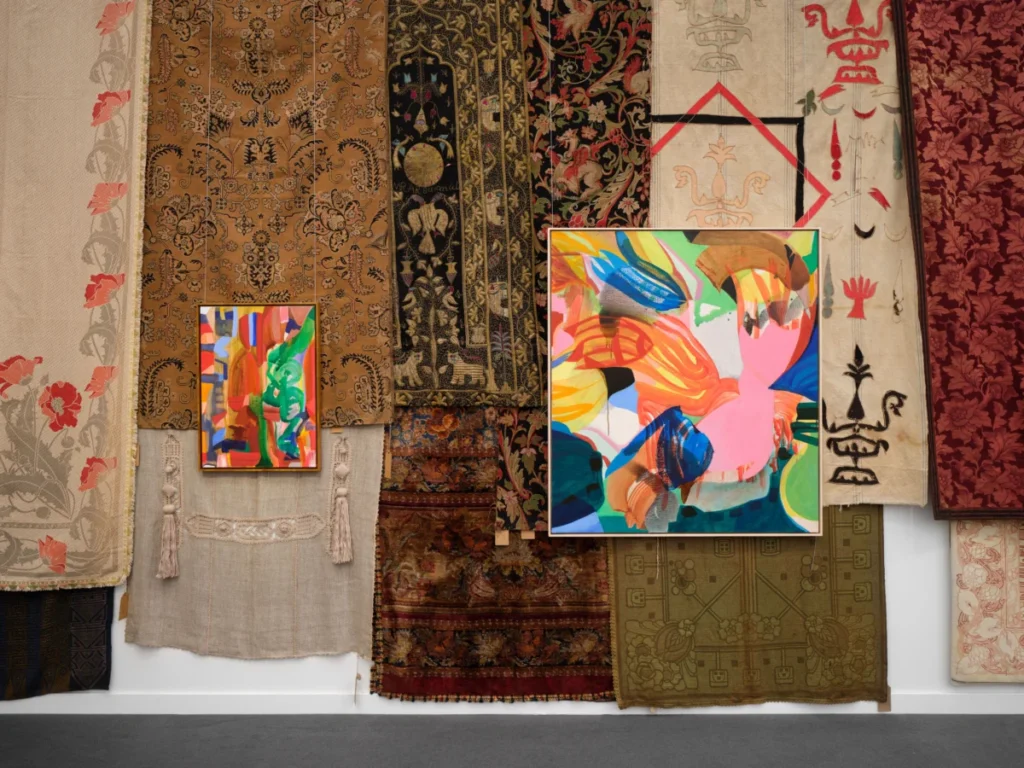
The most radical departure from the traditional "white cube" gallery format was found at the Parker Gallery booth, featuring the work of Marley Freeman. Freeman’s approach to textiles is deeply personal; her father, Paul Freeman, is the proprietor of Textile Artifacts, a renowned antique textile shop in Los Angeles. Freeman grew up surrounded by Central Asian rugs and handwoven fabrics, a background that informs her abstract painting practice.
For Frieze, Freeman transformed her booth into a curated bazaar, pairing her own paintings with antique carpets and textiles from her father’s collection. This installation collapsed the distance between the contemporary art market and the historic textile trade. By hanging her expressive abstractions against walls lined with intricately patterned rugs, Freeman created an environment that felt domestic and immersive rather than clinical.
"It was fun to bring my family into it and turn down the dial on the stress that I can feel at art fairs," Freeman remarked. The strategy proved successful both aesthetically and commercially; by the conclusion of the fair, every painting in the booth had been sold. This "bazaar" model suggests that collectors are increasingly interested in seeing art within a broader material context, moving away from the isolation of the traditional gallery wall.

Market Analysis and Implications
The prominence of textiles at Frieze Los Angeles is indicative of a broader shift in collector behavior. Data from recent auction cycles and international fairs suggest that the "textile sector" is experiencing a period of significant growth. This can be attributed to several factors:
- Price Accessibility and Upside: While top-tier textile works like those of Sheila Hicks are reaching high six-figure sums, many emerging textile artists offer an entry point for collectors who are priced out of the traditional blue-chip painting market.
- The "Labor" Premium: In an era of AI-generated imagery and digital art, collectors are placing a premium on works that demonstrate intensive manual labor. The time required to weave, stitch, or quilt a large-scale work provides a tangible sense of value.
- The Diversity Mandate: Institutions and private collectors are actively seeking to diversify their holdings. Because textiles have historically been the medium of choice for women and marginalized communities, the "discovery" of these artists allows the market to correct historical imbalances.
Broader Cultural Impact: The Future of Fiber
The "textile takeover" at Frieze Los Angeles is not a fleeting trend but a fundamental realignment of art-historical values. As artists like Yvonne Wells, Elise Peroi, and Marley Freeman continue to push the boundaries of the medium, the stigma of "craft" is being replaced by an appreciation for "material intelligence."
The implications of this shift extend beyond the walls of the Santa Monica Airport. It signals a move toward a more inclusive and tactile art world, where the domestic and the monumental are no longer seen as mutually exclusive. Whether used as a vehicle for political resistance, architectural exploration, or personal history, the thread has become one of the most powerful tools in the contemporary artist’s arsenal. As the fair concluded, the message from Los Angeles was clear: the future of high art is increasingly soft, woven, and inextricably linked to the fabric of human experience.