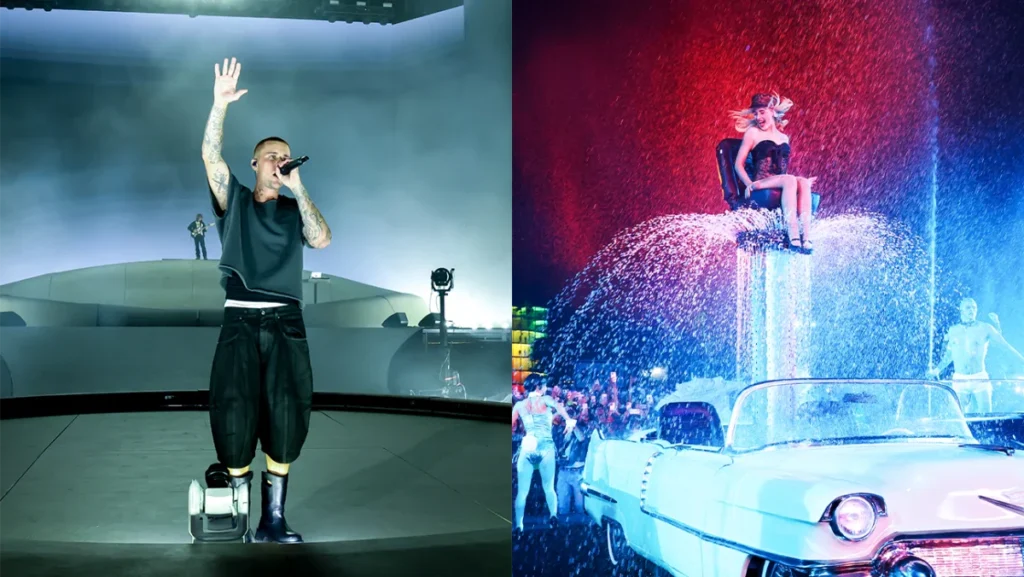

The recent Coachella Valley Music and Arts Festival witnessed a stark contrast in headlining performances, sparking a fervent social media debate regarding gendered expectations within the music industry. At the heart of this discussion lies Justin Bieber’s notably stripped-back Saturday night set, which, despite garnering praise from a segment of his fanbase, drew significant criticism for its perceived lack of production and effort, especially when juxtaposed against the highly theatrical and elaborate performance delivered by Sabrina Carpenter the preceding night. This divergence has ignited a broader conversation: could a female artist command a Coachella main stage with such a minimalist approach without facing overwhelming backlash, or are different standards applied based on gender?
Coachella’s Evolving Identity: A Canvas for Spectacle and Authenticity
The Coachella Valley Music and Arts Festival, held annually at the Empire Polo Club in Indio, California, has long been a cultural touchstone, renowned not only for its curated lineup of diverse musical acts but also for its reputation as a crucible for groundbreaking live performances. Since its inception in 1999, Coachella has grown from an indie rock haven into a global phenomenon, attracting hundreds of thousands of attendees and setting trends across music, fashion, and art. The festival’s main stages, particularly the coveted headliner slots, have become synonymous with spectacle, high production value, and career-defining moments. From Daft Punk’s iconic pyramid in 2006 to Beyoncé’s legendary "Beychella" in 2018, which redefined the scope of a festival performance with its elaborate choreography, live band, and cultural homage, artists are often expected to deliver an unforgettable, visually stunning experience commensurate with the festival’s grandeur and their top billing. This expectation has, over the years, implicitly raised the bar for all performers, particularly those occupying the prime-time slots.
The Contrasting Performances: Spectacle vs. Intimacy
The recent festival weekend presented two dramatically different artistic visions. On Friday night, pop sensation Sabrina Carpenter captivated audiences with a performance widely lauded for its maximalist approach. Her set was a meticulously crafted theatrical production, featuring multiple elaborate stage designs, intricate costume changes, a full retinue of backup dancers, and even unexpected acting cameos from Hollywood veterans like Sam Elliott, Susan Sarandon, and Will Ferrell. The grand finale, which saw Carpenter ascend from a car amidst a spectacular water fountain display, cemented her show as a benchmark for high-energy, visually opulent festival artistry. Her performance aligned perfectly with the prevailing expectation for Coachella headliners: a full-sensory, high-budget spectacle designed to leave an indelible mark.
In stark contrast, Justin Bieber’s Saturday night performance was characterized by its profound simplicity. The "Daisies" singer opted for a significantly stripped-back presentation, notably devoid of the elaborate stage designs, pyrotechnics, or extensive choreography often associated with a headlining act of his stature. Reports indicated minimal stage design and a conspicuous absence of backup dancers. A particularly polarizing moment involved Bieber sitting down for approximately 30 minutes in the middle of his set, playing snippets of his older classics, such as "Baby" and "Never Say Never," directly from YouTube on his laptop. This intimate, almost impromptu segment was a significant departure from the typical high-octane delivery expected from a global pop superstar commanding a main stage at one of the world’s most prominent music festivals.
The Genesis of the Debate: Social Media’s Candid Reactions
The immediate aftermath of Bieber’s performance saw social media platforms erupt with a torrent of candid and often contrasting reactions, quickly propelling the debate into the cultural zeitgeist. Critics were swift and vocal, lambasting Bieber’s set as "lazy," "underwhelming," and "unprofessional," particularly in light of his reportedly substantial paycheck for the engagement. Many pointed to the minimal production, the lack of dynamic stage presence, and the unusual "YouTube session" as indicators of a performance that fell far short of Coachella’s established standards and the expectations placed upon an artist of his global standing.
The comparisons to Sabrina Carpenter’s elaborate show were immediate and unflinching. Users frequently highlighted the perceived disparity in effort and investment, articulating a sense of frustration that such a bare-bones performance from a male artist could seemingly "get a pass" while female artists are consistently held to a higher, more demanding standard. One widely circulated post on X (formerly Twitter) articulated this sentiment succinctly: "Female artists give full effort: flying, high notes, fireworks, outfits. Meanwhile Justin Bieber, the most expensive Coachella performer, just sits in a plain tee, plays YouTube, no makeup, and still gets a pass? Switch the roles and a woman would get dragged immediately."
Another post drew parallels with other female headliners, stating, "Fans defending Justin Bieber’s mediocre Coachella performance, saying he’s 32 and it’s normal not to have the same energy anymore. Meanwhile Lady Gaga at 36," accompanying the text with a clip of Lady Gaga’s famously energetic and high-production 2017 Coachella headlining performance. These comparisons underscored a pervasive belief among many social media users that a double standard exists, where male artists are afforded a greater degree of artistic license and leniency regarding performance aesthetics, while their female counterparts are compelled to deliver a relentless spectacle to justify their headliner status and avoid severe criticism.
The Counter-Narrative: A "Healing" and Authentic Experience
Amidst the chorus of criticism, a significant contingent of Justin Bieber’s long-standing fanbase rallied in defense of his performance, offering a compelling counter-narrative. For many "OG Beliebers," the intimate, stripped-back nature of the set was not a deficiency but rather a poignant and "healing" experience, steeped in nostalgia and raw authenticity. These fans viewed the performance not through the lens of traditional festival spectacle, but as a deeply personal and vulnerable moment from an artist who has publicly navigated significant mental health challenges and the intense pressures of global superstardom from a young age.
Supporters on social media described the performance as a "healthiest kind of comeback," suggesting that Bieber’s choice to eschew elaborate production was a deliberate act of self-preservation and a rejection of the high-pressure demands that had previously led to burnout. One X user eloquently stated, "He did not force a high-production machine that could burn him out again. Instead he sat with his past, scrolling through old YouTube videos, dueting with his younger self, and mixing nostalgia with new chapters. That takes real courage when fame once broke so many pieces of you. It is a quiet reminder that healing is not always loud or flashy. Sometimes it is choosing peace, family, and honest storytelling over what the crowd expects. I am happy for Justin."
Another fan echoed this sentiment, writing, "Justin’s performance at Coachella was so much more than just music it was a full circle moment of healing. Watching him embrace his past and acknowledge that he finally has everything he ever wished for moved me to tears. I am so incredibly proud of his journey and the person." These reactions highlight a distinct shift in perspective, valuing emotional resonance and an artist’s personal journey over conventional performance metrics. For this segment of the audience, the authenticity and vulnerability displayed by Bieber resonated deeply, transforming what critics saw as a flaw into a powerful testament to personal growth and resilience.
Broader Implications: Gendered Expectations in the Music Industry
The debate surrounding Bieber’s Coachella performance is not an isolated incident but rather a microcosm of larger, systemic issues within the music industry concerning gendered expectations for live performances. Industry analysis frequently highlights a disparity in performance expectations, with female artists often facing greater scrutiny regarding stage production, choreography, vocal perfection, and costume changes, while male counterparts may be afforded more leeway for a "raw," "authentic," or "rockstar" presentation.
Historically, male rock stars and singer-songwriters have often built careers on minimalist stage setups, relying on their charisma, musicality, and lyrical prowess. Think of Bruce Springsteen’s marathon sets or Bob Dylan’s understated stage presence. These artists are often celebrated for their "authenticity" and ability to connect with an audience without elaborate theatrics. Conversely, female artists, particularly in the pop genre, have long been expected to deliver multi-faceted, high-energy shows that incorporate complex choreography, stunning visuals, and multiple outfit changes. From Madonna’s groundbreaking spectacles to Janet Jackson’s precision, and more recently, Beyoncé’s "Beychella" or Taylor Swift’s Eras Tour, the benchmark for female pop headliners has often been defined by immense production value and relentless physical exertion.
This phenomenon extends beyond pop. Even in genres like rock, female artists often contend with a different set of expectations. While a male rock band might simply plug in and play, a female-fronted act might still face implicit pressure to present a more polished or visually appealing show. This isn’t to say male artists don’t deliver high-production shows – many do – but the tolerance for a stripped-back approach often appears greater for them.
Financial Dynamics and Artist Autonomy
The financial aspect also plays a significant role. Reports of Justin Bieber’s "high paycheck" for the gig fueled critics’ arguments, suggesting that such compensation warranted a commensurate level of production. This raises questions about how festival organizers and audiences value different types of performances. Is the monetary investment primarily for the artist’s name recognition and drawing power, or is it also tied to the expected scale of the live production?
Furthermore, the debate touches upon artist autonomy. Should an artist, regardless of gender, have the freedom to define their performance style, even if it diverges from popular expectations or previous precedents? While festivals book artists based on their draw and presumed ability to deliver a compelling show, the artistic vision ultimately rests with the performer. Bieber’s decision to present a more intimate set could be seen as an exercise of this autonomy, prioritizing personal expression and connection over a predetermined spectacle. However, this autonomy is often viewed through a gendered lens, where a male artist’s "artistic choice" might be celebrated, while a female artist making a similar choice might be perceived as "lazy" or "underperforming."
The Role of Social Media in Shaping Discourse
The sheer volume and intensity of the reactions on social media underscore its increasingly critical role in shaping public discourse around live events. Platforms like X provide an immediate, unfiltered forum for opinions, allowing for rapid-fire comparisons and the quick formation of collective narratives. This instant feedback loop can amplify both praise and criticism, often overshadowing official reviews or nuanced interpretations. The decentralized nature of social media means that "public opinion" is fragmented and diverse, with different communities prioritizing different values – some valuing spectacle, others authenticity, and still others, social commentary on gender dynamics.
Lessons from Past Controversies: Frank Ocean’s 2023 Set
It is important to note that male headliners are not immune to widespread backlash when their performances fall short of expectations. Frank Ocean’s highly anticipated weekend one performance at Coachella in 2023 serves as a potent reminder. His set was marred by a late start, a shortened duration, technical difficulties, and an overall perceived lack of engagement, leading to significant disappointment and widespread criticism from both attendees and media outlets. This instance demonstrates that while there may be a perceived gendered disparity in baseline expectations, any artist, regardless of gender, can face severe repercussions when a high-profile festival performance fails to deliver on promises or expectations. However, the nature of the criticism often differs, with female artists more frequently critiqued on elements of physical performance, production, and perceived effort, whereas male artists might face criticism for issues like tardiness, technical problems, or overall disengagement.
Moving Forward: Redefining Performance Success
The Justin Bieber-Coachella debate is more than just a fleeting social media storm; it is a significant cultural moment that compels a re-evaluation of how success in live performance is defined, particularly in the context of gender. It challenges audiences, critics, and industry professionals to consider whether the pursuit of ever-greater spectacle has inadvertently created an uneven playing field.
As the music industry continues to evolve, the conversation around artist authenticity versus theatricality, and the underlying gendered biases in performance expectations, will undoubtedly persist. The diverse reactions to Bieber’s set suggest a growing appetite for different types of live experiences – some still craving the grand spectacle, while others yearn for raw, intimate connection. Ultimately, the lasting impact of this debate may be to encourage a more nuanced understanding of artistic expression and to foster an environment where all artists, irrespective of gender, are afforded the creative freedom to define their stage presence without being unfairly judged by arbitrary or biased standards. The true measure of a performance, perhaps, lies not solely in its pyrotechnics or choreography, but in its ability to connect, resonate, and provoke thought, even if that thought is about the very nature of performance itself.