
In the municipality of Lohja, situated approximately 40 miles from the Finnish capital of Helsinki, a 365-square-foot residential prototype is challenging the fundamental assumptions of the global construction industry. Known as the Tiny House Shadow, this matte black, avant-garde structure serves as a tangible response to the dual crises of climate change and shifting global demographics. Conceived by Matti Kuittinen, an architect and professor at Aalto University, the project represents a radical departure from traditional building methods, prioritizing mobility, modularity, and the intensive use of recycled materials to create a blueprint for the future of human habitation.

The Tiny House Shadow is not merely a design exercise in aesthetic minimalism; it is a calculated intervention in a sector responsible for a staggering portion of global environmental degradation. According to the International Energy Agency (IEA), the building and construction sector accounts for nearly 40% of energy-related carbon dioxide emissions and 36% of final energy consumption globally. Professor Kuittinen’s work is predicated on the urgent necessity of reversing these trends. By utilizing a combination of high-tech decarbonized steel and low-tech recycled components, the Shadow project achieves a 43% reduction in its construction footprint and enables its residents to reduce their personal carbon footprints by 53% compared to living in a conventional Finnish home.
The Architectural Genesis of the Shadow Project
The conceptual framework for the Tiny House Shadow was developed over several years of academic research at Aalto University, where Kuittinen focuses on the circular economy and the life-cycle assessment of buildings. The project transitioned from theory to reality through a strategic partnership between Kuittinen and several prominent Scandinavian industrial leaders, including Aulis Lundell, Vesivek, and the Swedish steel manufacturer SSAB.

The name "Shadow" is a deliberate homage to the 1933 essay In Praise of Shadows by Japanese author Jun’ichirō Tanizaki. In his writing, Tanizaki explores the beauty of darkness, simplicity, and the impermanence of structures—qualities that Kuittinen has integrated into the physical house. The matte black exterior absorbs light, allowing the building to blend into the dense Finnish forests, while its modular design ensures that the structure itself is "shadow-like" in its permanence. Unlike traditional houses anchored by deep concrete foundations, the Tiny House Shadow is mobile and can be dismantled, moved, and reassembled without leaving a lasting scar on the landscape.
Material Innovation: The Role of Decarbonized Steel
The most significant technical achievement of the Tiny House Shadow lies in its facade, which features SSAB Zero™ steel. This material represents a breakthrough in industrial manufacturing, as it is a recycled metal produced using fossil-free electricity and biogas, resulting in virtually zero fossil carbon emissions during the production process. Traditionally, steel manufacturing is one of the most carbon-intensive processes in the world, relying heavily on coal-fired blast furnaces. By incorporating this specialized steel, the Shadow project demonstrates that even heavy industry can align with net-zero objectives.

"This new steel manufacturing process will make a significant contribution to reducing emissions," Kuittinen stated during the project’s unveiling. "Steel is also an excellent material for a building designed to be moved and entirely prefabricated, as it offers both lightness and durability."
Beyond the steel facade, the house is a masterclass in the circular economy. Approximately 56% of the materials used in the entire build are recycled, which translates to the use of 85% fewer raw natural resources than a standard residential unit. The interior specifications further highlight this commitment to resource efficiency:

- Flooring: Manufactured from recycled plastic polymers.
- Ceilings: Constructed from repurposed automotive tires, providing unique acoustic properties and durability.
- Insulation: Blown-in material derived from recycled glassware.
- Glazing: Windows salvaged from decommissioned buildings, refurbished to meet modern thermal efficiency standards.
A Chronology of Development and Public Reception
The development of the Tiny House Shadow followed a rigorous timeline aimed at proving the viability of mass-produced, low-emission housing:
- 2019–2021: Professor Kuittinen conducts research on "Carbon-Neutral Housing Models" at Aalto University, identifying steel and wood hybrids as the most efficient path for modular construction.
- 2022: Formal partnership established with SSAB to test the application of Zero™ steel in residential architecture.
- Early 2023: Construction of the prototype begins in a controlled factory environment, emphasizing the benefits of prefabrication in reducing site waste and construction time.
- Mid-2023: The Tiny House Shadow is completed and transported to Lohja for its initial installation.
- 2024: The house begins a tour of major Scandinavian construction fairs and architectural exhibitions, serving as a "living laboratory" for researchers and policy makers.
The reception from the construction industry has been largely positive, though experts note that scaling such projects will require significant shifts in building codes and zoning laws, which often favor permanent, larger structures. However, as urban density increases and the "tiny house movement" gains traction as a legitimate solution to housing shortages, the Shadow project offers a high-end, technologically advanced alternative to the "do-it-yourself" aesthetic often associated with small-scale living.
.jpg)
Functional Minimalism: Interior Design and Lifestyle
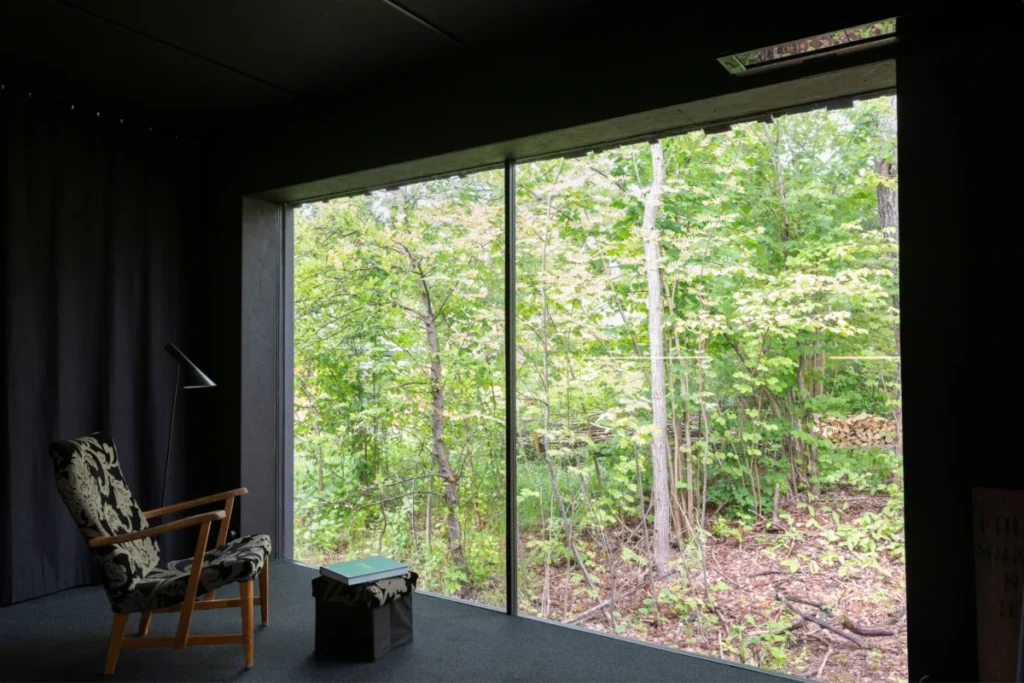
The interior of the Tiny House Shadow is a 365-square-foot exercise in "functional minimalism." The design philosophy suggests that sustainability is not just about the materials used to build a house, but the lifestyle the house facilitates. Kuittinen argues that the modern obsession with "wants" over "needs" has led to oversized, energy-inefficient homes that remain underutilized.
Inside the Shadow, every square inch is optimized. The kitchen features an open-plan layout that can be concealed behind curtains to maintain a clean visual field when not in use. Notably, the kitchen lacks a dishwasher—a deliberate choice intended to reduce water and energy consumption while forcing the inhabitant to engage more directly with their daily chores.

The sleeping quarters take inspiration from Japanese capsule hotels, offering a compact, cozy environment that prioritizes rest and thermal retention. Despite the small footprint, the house does not sacrifice Finnish cultural essentials; it includes a 22-square-foot wood-fired sauna. This inclusion serves a dual purpose: it provides a space for physical and mental detox and acts as a secondary heat source for the home during the harsh Nordic winters.
"Living in a tiny house doesn’t necessarily mean giving up comfort," Kuittinen explained in an interview with Architect Magazine. "It’s more about rethinking what we really need to live well—and how we can still build without destroying the planet."

Global Context: The 2 Billion Home Challenge
The imperatives driving the Shadow project are global in scope. Demographic projections suggest that the world’s population will reach nearly 10 billion by 2050, and as many as 2 billion new homes will be required by the end of the century to accommodate this growth and replace aging infrastructure. Simultaneously, the United Nations’ Intergovernmental Panel on Climate Change (IPCC) warns that emissions from the building sector must be slashed by 80-90% to avoid the most catastrophic effects of global warming.
These two goals—building more while emitting less—are fundamentally at odds under current construction paradigms. Traditional concrete and brick-and-mortar construction are too slow, too resource-intensive, and too carbon-heavy to meet this demand. The Tiny House Shadow addresses this contradiction by advocating for a "radically different" approach based on three pillars:

- Dematerialization: Using fewer materials through smarter design and smaller footprints.
- Decarbonization: Utilizing materials like SSAB Zero™ steel that do not rely on fossil fuels.
- Circularization: Ensuring that every component of a house can be recycled or reused at the end of its life cycle.
Broader Impact and Industry Implications
The Tiny House Shadow serves as a critical proof-of-concept for the "Housing as a Service" (HaaS) model. Because the house is mobile and modular, it challenges the idea of homeownership as being tied to a specific plot of land. In a future where climate change may force migrations or where urban land use must remain flexible, mobile housing could provide a level of resilience that permanent structures cannot.
Furthermore, the collaboration between an academic researcher and major industrial players like SSAB and Aulis Lundell suggests a new model for architectural innovation. By involving material scientists and manufacturers at the design stage, architects can ensure that their visions are grounded in the latest technological possibilities.

As a prototype, the Tiny House Shadow has already begun to influence policy discussions in Finland and the broader European Union regarding the "Right to Repair" for buildings and the mandatory use of recycled content in new constructions. While a single 365-square-foot house cannot solve the global climate crisis, the Shadow project demonstrates that the technology and materials needed to build a sustainable future already exist. The challenge remaining is one of scale, political will, and a cultural shift toward a more mindful, minimalist way of life.
The project stands as a silent, matte black sentinel in the Lohja woods, a reminder that the architecture of the future will not be defined by how much space it occupies, but by how little of a footprint it leaves behind. Through projects like the Tiny House Shadow, the "shadows" of our environmental impact may finally begin to recede.