
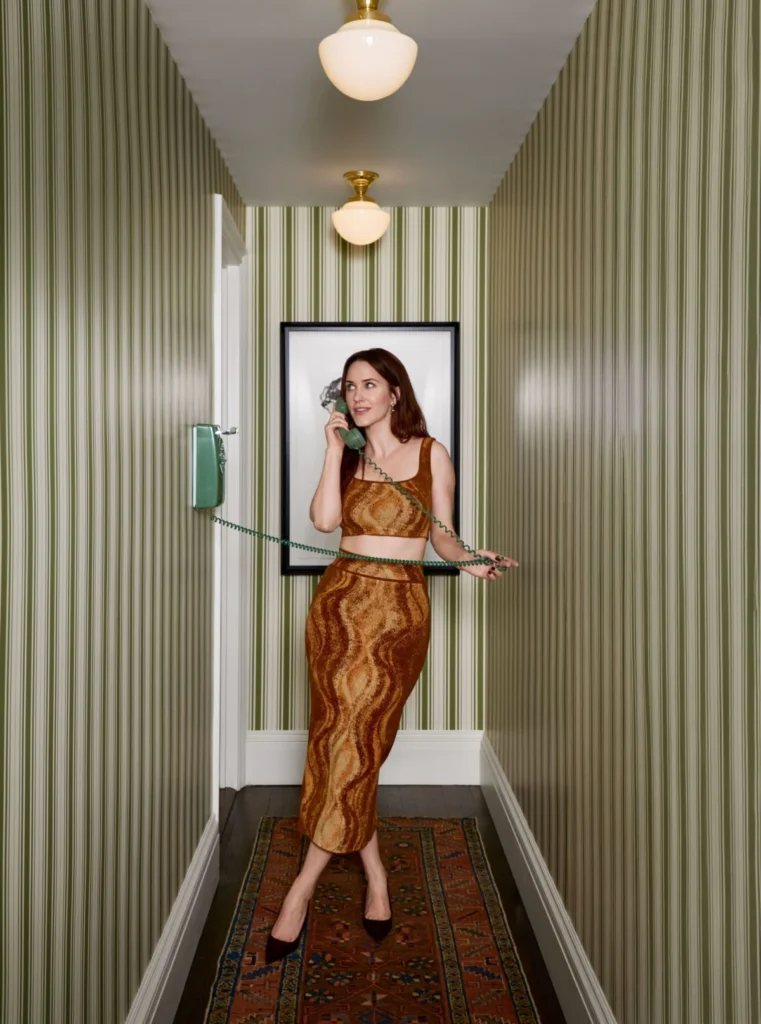

In the heart of Manhattan’s Upper West Side, where pre-war architecture meets the rapid-fire pace of the 21st century, an unexpected sound is echoing through the residence of Emmy-winning actress Rachel Brosnahan and her husband, actor Jason Ralph. It is not the sleek, polyphonic chirp of a smartphone or the vibrating hum of a tablet, but the mechanical, rhythmic trill of a 1950s rotary phone. As the couple completed the renovation of their "classic six" apartment—a project featured in the April issue of Architectural Digest—they made a deliberate choice to reject modern telecommunications in favor of mid-century relics. While Brosnahan, best known for her titular role in The Marvelous Mrs. Maisel, spearheaded the majority of the design decisions alongside Washington, D.C.-based designer Zoë Feldman, the telephonic direction was firmly the domain of Ralph.
The decision to install vintage landlines was born from a confluence of aesthetic preservation, a philosophical commitment to the "dumbphone" movement, and a pragmatic approach to emergency preparedness. In an era where the smartphone has become an inescapable appendage, Ralph’s insistence on rotary handsets represents a growing counter-cultural shift toward analog technology. Against the historic "bones" of their pre-war apartment, contemporary cordless sets were viewed not merely as a design mismatch, but as an intrusion of modern coldness into a space designed for warmth and character.
The Hardware of the Eisenhower Era
The couple’s apartment now features two primary functional artifacts from the mid-20th century: a moss-green coiled-cord rotary phone and a glossy black wall-mounted model. Both devices date back to the 1950s, produced by Western Electric and Northern Electric—the manufacturing arms of the Bell System that once dominated the North American telecommunications landscape. The moss-green unit is strategically positioned in the entry hall, where it serves as a visual anchor against the Baldwin Stripe wallpaper by Sarah Bartholomew for Lee Jofa. The second unit, a sleek black model, is perched within the breakfast nook, offering a tactile connection to the past during morning routines.
These phones are not merely decorative. They are fully operational landlines that require a different kind of engagement than a touchscreen. To place a call, one must physically rotate the dial for each digit, a process that forces a slower, more intentional pace of communication. For Ralph, this is the point. He has emerged as a vocal proponent of "dumbphones"—devices that lack internet connectivity and social media capabilities—at a time when digital fatigue is reaching a breaking point for many professionals in the high-pressure entertainment industry.
The Intersection of Aesthetics and Emergency Utility
While the visual appeal of a Western Electric 500-series phone is undeniable, Brosnahan emphasizes that the choice was also rooted in a deep-seated need for reliability. Having lived in New York City through various blackouts and infrastructure failures, she views the landline as a vital safety net. "I’ve been in New York a long time," Brosnahan noted during the AD tour. "I’ve been here through some emergencies. If you lose power, I want a landline."
This perspective is backed by technical reality. Traditional landlines, specifically those operating on Plain Old Telephone Service (POTS), are powered by the telephone company’s central office through the copper wires themselves. This means that during a local power outage, a traditional corded phone will often continue to function, whereas modern Voice over IP (VoIP) systems and cellular towers—which rely on local power grids and battery backups with limited lifespans—may fail. By integrating these vintage units, the couple has effectively secured a communication channel that remains independent of the modern digital grid.

Contractor Confusion and the Challenge of Integration
The path to analog integration was not without its hurdles. The modern construction industry is increasingly geared toward "smart home" automation, often at the expense of legacy infrastructure. Brosnahan recalled with amusement that their contractor repeatedly attempted to remove the telephone jacks and the vintage units during the renovation process. "Our contractor kept trying to take the phone out," she said. "Everybody was confused."
This resistance highlights a broader trend in interior design and construction where "old" is often equated with "obsolete." For Zoë Feldman, the designer tasked with harmonizing these elements, the challenge was to treat the phones as genuine design opportunities rather than quirky indulgences. Feldman argued that the presence of the rotary phone is "bigger than irony." She sought to move away from "new age-y, cold, and formulaic" technology in favor of something that serves as a sculptural talking point.
The Broader "Retrotech" Resurgence
The Brosnahan-Ralph apartment is a microcosm of a larger cultural phenomenon often referred to as the "Analog Resurgence." Just as vinyl records surpassed CD sales for the first time in decades, and film photography has seen a massive revival among Gen Z and Millennial hobbyists, vintage telecommunications are gaining a new foothold in the luxury design market.
Data from secondary market platforms like Etsy, 1stDibs, and eBay show a steady increase in searches for "vintage rotary phones" and "mid-century modern electronics." This trend is driven by two factors:
- Tactile Satisfaction: In an increasingly virtual world, there is a premium on objects that have weight, texture, and mechanical feedback.
- Digital Detox: The "dumbphone" movement is a response to the "attention economy." By relegating phone calls to a stationary object in the home, users can reclaim their focus from the constant notifications of a smartphone.
Feldman notes that client interest in analog objects is on the rise across the board. From transistor radios to instant cameras, these pieces push back against the "cold ubiquity of smart everything." Vintage phones occupy a unique "sweet spot" in this landscape, serving simultaneously as a functional tool, a sculptural form, and a cultural provocation.
Sourcing the Past: The Role of Old Phone Works
To find the specific models for the Manhattan residence, Feldman turned to Old Phone Works, an Ontario-based specialist dealer. The company’s mission is "saving the telephones of yesterday for tomorrow," and they have become a primary resource for set designers and high-end homeowners alike. Their inventory is not just about nostalgia; it is about restoration. Many of their phones are rebuilt with modern internals that allow them to work on digital lines while maintaining their original mechanical ringers and rotary dials.
The company maintains a significant presence in Hollywood, with their phones appearing in period-accurate productions such as Stranger Things, Jackie, and Hairspray. Fittingly, Old Phone Works also provided telecommunications props for The Marvelous Mrs. Maisel, creating a full-circle moment for Brosnahan as she transitioned from her fictional 1950s life to her real-world 1950s-inspired home.

Design Implications and Strategic Placement
For homeowners looking to emulate this look, Feldman offers specific advice on placement. She suggests that mid-century models work best in "artier, collected homes" where they don’t feel "on the nose" or overly thematic. Instead, they should feel like a "cheeky" addition to a sophisticated space.
Furthermore, vintage electronics offer a low-risk method for experimenting with color. While a client might be hesitant to purchase a bright orange or "persimmon" sofa, a vintage handset in a bold hue provides a pop of color that can be easily moved or changed. In the case of Brosnahan’s entry hall, the moss-green phone acts as a sophisticated complement to the room’s color palette, proving that utility and high design are not mutually exclusive.
Analysis: The Psychological and Social Impact
The decision to install a landline in 2024 is, in many ways, a radical act of domestic boundary-setting. In a world where the "work-from-home" era has blurred the lines between professional and private life, the landline re-establishes the home as a fixed location. When you call a landline, you are calling a place, not a person. This distinction is vital for creating a sense of sanctuary.
As Brosnahan aptly summarized, "There’s something about the idea of being attached to the ground that feels safe." This sentiment captures the essence of the current movement toward analog living. It is a search for grounding in a wireless, ephemeral world. By choosing to "plug in" to the infrastructure of the past, Brosnahan and Ralph are not just decorating an apartment; they are adopting a lifestyle that prioritizes presence, permanence, and the enduring charm of the mechanical age.
As the "classic six" apartment continues to garner attention for its masterful blend of historic preservation and modern luxury, the rotary phones stand as its most distinctive feature. They serve as a reminder that progress is not always linear, and sometimes, the most sophisticated technology is the one that allows us to disconnect.


![Megan Thee Stallion Discharged from Hospital After Falling Ill During Moulin Rouge! Performance [Updated]](https://thecelebnews.com/wp-content/uploads/2026/04/megan-thee-stallion-discharged-from-hospital-after-falling-ill-during-moulin-rouge-performance-updated-150x150.webp)