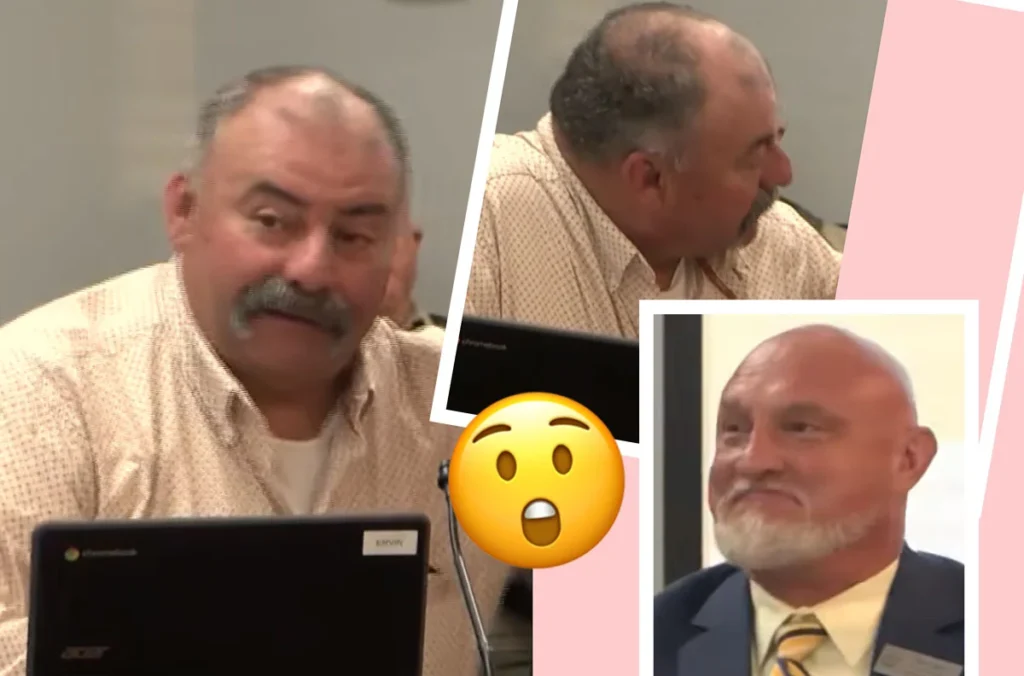

A Washington County, Tennessee school board official, Keith Ervin, is facing widespread condemnation and calls for his removal after making a sexually suggestive comment to a high school senior, who is a minor, during a publicly live-streamed board meeting on Thursday, April 11, 2024. The incident, captured on video, has ignited a fierce debate about the conduct of public officials, the safety of students, and the accountability of educational leadership. The controversy has not only drawn attention to Ervin’s actions but also raised questions about the immediate response of other board members who were present, many of whom were observed laughing or failing to intervene. This alarming event has quickly escalated from a local news story into a national conversation, prompting an emergency board meeting and a groundswell of community activism demanding greater accountability from elected officials.
The incident unfolded during a routine Washington County Schools board meeting, which, like many public forums, was broadcast live to ensure transparency and public access. During the proceedings, Ervin was observed wrapping his arm around a female student, identified as a high school senior and a minor, who was present as a student board member. In a moment that has since gone viral and sparked outrage, Ervin leaned in and told the student, "God you’re hot, you know that?" The remark was made clearly audible on the broadcast, leaving little room for misinterpretation of the words themselves. Following this deeply inappropriate comment, Ervin disturbingly asked the student, "Where do you go to school at?" The student, visibly uncomfortable, responded with a nervous laugh before revealing she attended David Crockett High School. Ervin then replied, "All right," as a smattering of laughter erupted in the room before the meeting ostensibly continued without further public challenge to his remarks from his peers. The lack of immediate intervention from other adult board members present has become a central point of public criticism, contributing to the perception of a systemic failure to protect a minor in a professional setting.
Immediate Fallout and Public Outcry
Within hours of the live stream, the clip of the interaction began circulating rapidly across social media platforms. The public response was swift and overwhelmingly negative, with thousands of individuals expressing shock, disgust, and anger at Ervin’s behavior and the board’s initial inaction. The video quickly became a symbol of perceived impropriety and a breach of trust between elected officials and the community they serve, particularly concerning the welfare of children. The incident resonated deeply with parents, educators, and advocates for child safety, who highlighted the power imbalance inherent in such an interaction between an adult authority figure and a minor.
The outrage swiftly moved beyond online discussions, culminating in the creation of a Change.org petition demanding the immediate removal of Keith Ervin from the Washington County Board of Education. The petition also called for the removal of Superintendent Jerry Boyd, citing his alleged laughter at the "utterly disrespectful remark" and his perceived failure to condemn the behavior in the moment. As of early this week, the petition garnered thousands of signatures, reflecting the profound public dissatisfaction and the urgent desire for decisive action. Brad Arnett, the creator of the petition, articulated the sentiments of many, stating, "As a father of both a boy and a girl, I was appalled by the video, as anyone who is a decent human being should be." Arnett further criticized the broader board, alleging a "good ole boy system" at play, where officials "protect each other" and fail to hold members accountable for misconduct. The petition specifically alleged that "this is not the first time Keith Ervin has been in trouble for inappropriate conduct," raising serious questions about the board’s historical approach to member accountability and ethical standards.
Keith Ervin’s Defense and Public Rejection
In the wake of the escalating controversy, Keith Ervin offered an explanation for his comments, which, for many, only exacerbated the situation. Speaking to local news outlet WJHL on Friday, April 12, Ervin claimed his remarks were a "big misunderstanding." He asserted that when he called the student "hot," he meant "hot" in the sense of being "smart" or "on fire" with impressive intellectual contributions, rather than physically attractive.
Ervin elaborated on his purported intent: "I had a student board member beside me, and we was talking, and she got up and was asking questions, and [she] just thoroughly impressed me and the other board members. I was. She was a top-notch student board member, and she was asking real smart questions. And I reached over, and I touched her on the shoulder, and I said, ‘You’re hot. You’re – you’re good. You’re one of the best I’ve seen.’" He insisted, "I didn’t mean nothing by it. She was just, she was on fire. She asked good questions, and I was bragging about her."
Further attempting to contextualize his behavior, Ervin invoked his personal background, stating, "And, you know, I’m old school. I’m an old farm boy. And I didn’t mean nothing by anything. I just was proud of her." He also suggested that a "lot of context missing" from the viral clip, urging viewers to "watch the whole meeting to see how impressive the student board member is."
However, these explanations have been largely dismissed by the public and fellow board members as unconvincing and inadequate. Critics argue that regardless of his claimed intent, the phrase "you’re hot" carries an undeniable sexual connotation, especially when directed by an adult male authority figure to a minor, particularly when accompanied by physical touch. The "old school" defense has been widely rejected as an unacceptable justification for inappropriate conduct, emphasizing that ethical standards for interacting with minors transcend generational or cultural norms. Education board chair Annette Buchanan later publicly agreed that Ervin’s comment "objectified and diminished" the student, a sentiment that directly contradicts Ervin’s defense of simply praising intellect. The consensus among the public and many officials is that no amount of context could render such a remark appropriate or excusable in a professional setting involving a minor.
Official Responses and Institutional Accountability
The Washington County Board of Education and its leadership have faced intense scrutiny regarding their response to the incident. Superintendent Jerry Boyd, whose perceived lack of immediate condemnation during the meeting drew criticism, issued a statement emphasizing individual responsibility: "As far as the comment made by the board member, just like any individual board member, whether it’s the vote they cast or the comments that they make, they need to be the ones to respond to questions about what their intent was in their comments or if it’s about a vote, they make it. They need to explain, as elected officials, what was behind their vote or their comment." While factually correct about the autonomy of elected officials, this statement was perceived by many as a deflection rather than a strong condemnation of the inappropriate behavior itself.
In contrast, Education Board Chair Annette Buchanan adopted a more direct stance. In an initial statement, she acknowledged the problematic nature of Ervin’s comment. Her position hardened as public pressure mounted, and she issued a subsequent statement that firmly rejected Ervin’s explanations: "Mr. Ervin knows his own intentions, but the rest of us have to judge his words and his actions. What we saw was shocking. He objectified and diminished a young woman publicly. No explanation can justify that. I anticipate the Board will consider and approve a motion to censure Mr. Ervin for his comment." This statement signaled a shift towards institutional action and a recognition of the severity of the breach of conduct.
The Washington County Board of Education collectively announced that an emergency hearing would be held on Wednesday, April 17, to specifically address the "grossly inappropriate comment." This formal step underscores the seriousness with which the board is now treating the matter, likely in response to the overwhelming public backlash and the need to restore public confidence. The hearing is expected to explore disciplinary actions, with a censure motion appearing to be the most likely outcome, as indicated by Chair Buchanan.
The Challenges of Accountability: Censure vs. Removal
The demands from the community for Ervin’s removal highlight the complexities of holding elected officials accountable. While public outcry is significant, the legal and procedural avenues for removing an elected school board member in Tennessee are considerably more stringent than a simple vote of no confidence or a board censure. A censure, while a formal reprimand that publicly condemns a member’s conduct, does not remove them from office. It serves as a strong symbolic message but allows the censured individual to retain their position and voting power.
For Keith Ervin, who is currently seeking re-election, a more drastic measure like removal from office would typically require a recall election. In Tennessee, initiating a recall election for an elected official is a challenging process. It generally requires a petition supported by a substantial percentage, often two-thirds, of registered voters who cast ballots in the last election for that office. This high threshold makes recalls difficult to achieve in practice, even in the face of widespread public dissatisfaction. The "good ole boy system" alleged by petition creator Brad Arnett suggests an entrenched political environment where internal accountability mechanisms might be weak, making external pressure from voters all the more critical, yet difficult to translate into immediate removal.
The upcoming emergency hearing will undoubtedly be a focal point for the community. In anticipation of the meeting, a protest has been planned to take place outside the venue, demonstrating the community’s resolve to push for stronger action than mere censure. This protest aims to amplify the voices of those demanding not only accountability for Keith Ervin but also a broader commitment from the entire board to foster a safe and respectful environment for all students.
Broader Implications and The Path Forward
This incident in Washington County, Tennessee, transcends a single inappropriate comment; it illuminates critical issues regarding the conduct of public officials, the protection of minors, and the efficacy of governance in local education systems. The power dynamic between an adult school board member and a high school student is inherently asymmetrical, placing a significant responsibility on the adult to maintain professional boundaries and ensure a safe, respectful environment. Ervin’s actions, and the initial passive response from other board members, represent a significant breach of this trust.
The controversy has sparked a broader conversation about ethical guidelines for individuals serving on school boards. These positions are entrusted with overseeing the education and welfare of children, demanding the highest standards of integrity and professionalism. When these standards are compromised, public trust in the entire education system can erode, impacting everything from community engagement to funding support.
For the student involved, such an experience can be deeply unsettling, potentially impacting their sense of safety and their willingness to participate in future public forums. The incident serves as a stark reminder of the vulnerability of students when interacting with authority figures and the paramount importance of adults acting as vigilant protectors.
As the Washington County Board of Education prepares for its emergency hearing, the decisions made will have far-reaching implications. A strong, unequivocal response from the board could help restore public confidence and set a clear precedent for acceptable conduct. Conversely, a perceived lenient response could reinforce cynicism about accountability and perpetuate the "good ole boy system" narrative. The community’s ongoing engagement, through petitions, protests, and sustained media attention, will be crucial in shaping the outcome and ensuring that the voices demanding ethical leadership and student safety are heard and acted upon. The situation in Washington County serves as a poignant case study in the ongoing struggle to ensure accountability and maintain public trust in local governance, particularly concerning the most vulnerable members of society: its children.