
The city of Sonoma, California, serves as a living museum of the state’s transition from a Mexican territory to an American frontier. At the heart of this historical landscape stands a single-room adobe structure that has endured for nearly 180 years. For Andrew Mariani, the founder of the acclaimed Scribe Winery, this run-down landmark was not merely a real estate acquisition but a decade-long exercise in patience and preservation. After a meticulous four-year renovation led by the multidisciplinary design firm Post Company, the 1847 adobe has been reborn as a flexible hospitality space and guest retreat, bridging the gap between mid-19th-century history and 21st-century luxury.

A Landmark of Northern California History
The property, situated just a few miles from the Scribe Winery vineyard, is recognized as one of the oldest surviving residential structures in Northern California. Its walls have witnessed the volatile birth of the state. Built in 1847, the adobe originally served as the residence of Sonoma’s mayor during a period of intense geopolitical shift. This was the era of the Bear Flag Revolt, a short-lived uprising in 1846 that preceded the Mexican-American War and ultimately led to California’s annexation by the United States.
The home’s historical pedigree is further cemented by its connection to William Tecumseh Sherman, the famed Union military leader. Local lore and historical records indicate that Sherman arrived at the adobe’s doorstep to place the town’s unruly mayor under arrest, a moment that captures the lawless and transitional nature of early California governance. Because of this rich heritage, the building is a protected landmark, meaning any modern intervention had to be executed with extreme sensitivity to the original fabric of the structure.

From Private Residence to Hospitality Hub
Andrew Mariani held the property for nearly ten years before breaking ground on its "second act." Initially, the vision for the site was fluid. Mariani at one point considered converting the historic structure into a primary residence for himself. However, as his family grew to include three children, the logistical constraints of a single-room 1847 adobe became apparent.
The pivot toward a hospitality and guest-centric model aligned more closely with the ethos of Scribe Winery. Known for its focus on the relationship between the land, history, and social connection, Scribe has built a brand that celebrates the "poetry" of the vineyard. The decision to transform the adobe into a site for winery events and a retreat for extended family allowed the design team to lean into a more atmospheric, "monastic" aesthetic that prioritized communal experiences over domestic utility.

Architectural Innovation: The "Skylight Seam"
The renovation, which was completed in 2025 after four years of intensive labor, presented a significant architectural challenge: how to add modern living amenities without touching the original landmarked walls. Preservation regulations in Sonoma are stringent, prohibiting any structural alterations that would compromise the integrity of the 19th-century adobe.
Leigh Salem, a partner at Post Company, developed a strategy that involved building a discreet, U-shaped wing tucked behind the original structure. This addition remains entirely invisible from the street, preserving the historic character of the Sonoma neighborhood. To comply with preservation laws, the new wing is technically independent. Rather than being bolted to the adobe, the two structures are joined by a "skylight seam"—a long, narrow glass aperture that runs along the side of the adobe.

This architectural maneuver serves two purposes. Structurally, it allows the new construction to exist without physically altering the 1847 walls. Aesthetically, it creates a dramatic transition point where guests can see the weathered texture of the original adobe alongside the clean, modern lines of the new wing.
Interior Design: Monastic Simplicity and Global Sourcing
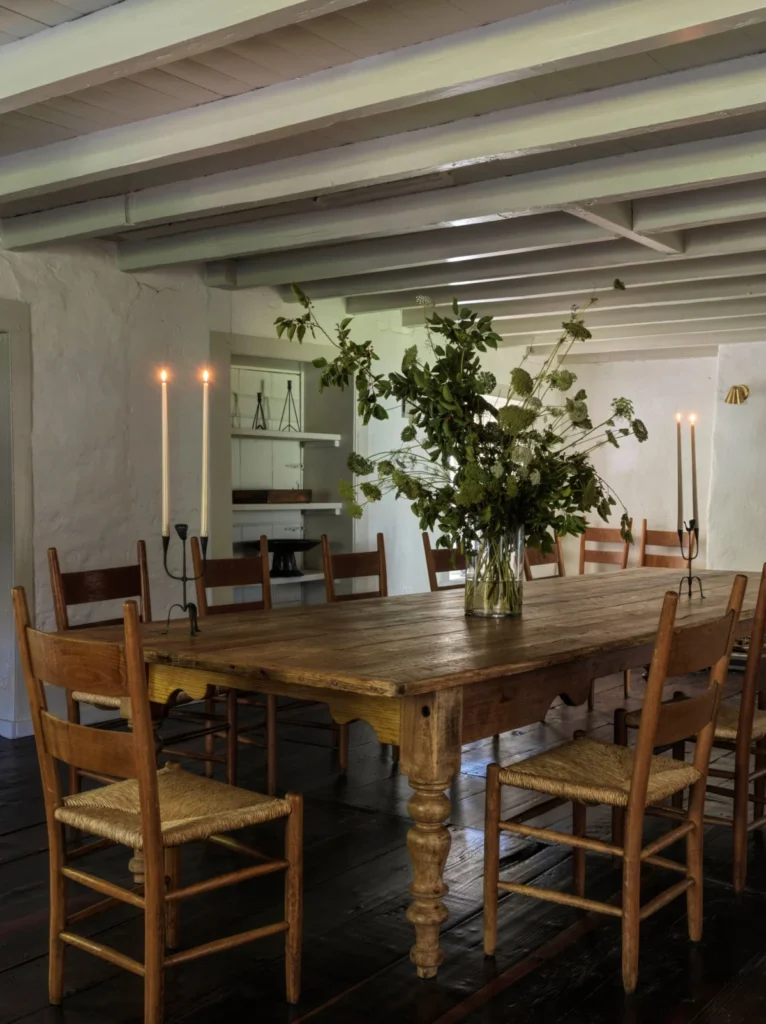
The interior of the adobe has been treated with what Mariani describes as an "honest" approach. The goal was to perform the minimum amount of intervention necessary to make the space functional while maintaining its raw, historic palette. The walls were finished with a light limewash—specifically the shade "Blondie" by Portola Paints—which provides a soft, chalky texture that complements the original mud-brick construction. The ceilings were painted in Farrow & Ball’s "Drop Cloth," a muted tone that draws the eye to the original timber framing.

The centerpiece of the main room is a 13-foot-long vintage dining table, which reinforces the building’s new identity as a destination for intimate gatherings. The sourcing of the furniture reflects a global, curated sensibility:
- The Dining Table: Sourced from the famous antiques fair in Round Top, Texas.
- The Chairs: Vintage pieces originally from a Dutch church, procured through Amsterdam Modern.
- Lighting: To maintain a "monastic" and moody atmosphere, the design eschews overhead lighting. Instead, brass sconces by Hector Finch and candlelight provide illumination.
The kitchen, located in the new wing, features hand-painted cabinetry from Plain English. The choice of English Shaker-style cabinets might seem a departure from California adobe tradition, but Salem notes that the visible brushstrokes and "element of the hand" in the cabinetry play off the enduring, handcrafted quality of the 1847 structure.

Preserving the "Tiny Attic" and Hidden Details
Perhaps the most evocative space in the home is the adobe’s tiny attic, accessible via a narrow staircase. Post Company converted this cramped space into a tucked-away lounge that serves as a literal time capsule. During the renovation, the team uncovered layers of centuries-old newspapers used as insulation within the walls. These were left intact, allowing the building’s history to remain visible to those who retreat to the attic.
The lounge is furnished with a mix of high-design pieces that bridge the gap between old and new, including a Noguchi pendant lamp, a leather sofa by Living Divani, and a coffee table from Post Company’s own collaboration with Roll & Hill.

The Modern Wing and Outdoor Integration
While the original adobe is dedicated to communal dining and historical reflection, the new wing provides the functional "engine" of the home. It contains two bedrooms and three bathrooms, all designed with a minimalist aesthetic that does not compete with the historic section. The primary bathroom is a highlight of modern craftsmanship, finished entirely in tadelakt—a traditional Moroccan lime plaster that is both waterproof and visually soft. A freestanding Waterworks bathtub sits beneath a Workstead pendant, offering a view of a private water feature in a small, enclosed courtyard.
The rear of the property opens into a spacious courtyard that facilitates an indoor-outdoor flow. The new wing is clad in aged cedar siding with steel-framed picture windows, a material choice that feels distinctly Californian. This courtyard acts as the choreographic center of the home, allowing guests to move between the historic dining hall and the modern living quarters while always remaining connected to the Sonoma landscape.

Broader Impact: Heritage and the Future of Wine Country
The completion of the Scribe Adobe project represents a growing trend in the Napa and Sonoma valleys: the move away from "faux-historic" chateaus in favor of authentic adaptive reuse. As the wine industry faces increasing competition and a changing climate, brands like Scribe are finding value in deep-rooted historical narratives.
By preserving one of the oldest structures in Northern California, Mariani has not only created a unique hospitality asset but has also contributed to the cultural preservation of the region. The project demonstrates that landmarked buildings, despite their rigid constraints, can be successfully integrated into modern use through clever architectural solutions like the "skylight seam."

As Sonoma continues to evolve, the 1847 adobe stands as a reminder of the town’s origins. It is no longer a "run-down" relic of the Bear Flag Revolt, but a functional, beautiful space that honors its unruly past while serving as a hub for the next generation of California’s culinary and viticultural explorers. The project serves as a blueprint for how history can be maintained—not as a static museum, but as a living, breathing part of the contemporary landscape.