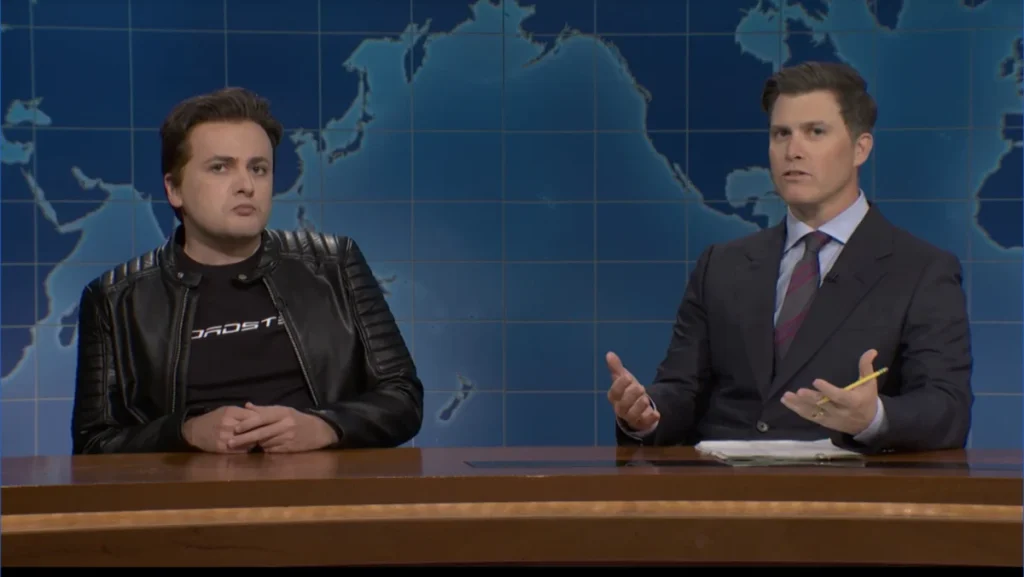

Elon Musk recently discovered that financial dominance does not automatically translate into political success, enduring a bruising sequence of electoral outcomes that cost nearly half a billion dollars. The tumultuous week culminated in a scathing Saturday Night Live parody on Weekend Update, where actor Jeremy Culhane stepped into the role of the tech billionaire. The sketch arrived on the heels of a disastrous political cycle that saw nearly all of Musk-backed midterm candidates defeated at the ballot box, compounding a public relations nightmare that included the official commercial failure and discontinuation of the Cybertruck.
The television appearance underscored a dramatic shift in how mainstream entertainment and the public perceive the world’s wealthiest individual. While Musk attempted to spin his electoral setbacks in the real world as confirmation of conspiracy theories regarding the 2024 elections, the Weekend Update desk offered no such refuge. Instead, the program utilized satire to dissect the billionaire’s public persona, contrasting his grand, futuristic rhetoric with a series of very tangible, high-profile failures across the automotive, political, and corporate landscapes.
Anatomy of a Satirical Takedown
During the Weekend Update segment, host Colin Jost confronted the satirical Musk regarding his astronomical campaign investments. Culhane’s portrayal relied on a precise comedic imitation of the billionaire’s halting delivery style, non-sequitur tangents, and abrupt shifts toward futuristic concepts that continuously failed to materialize. When Jost noted that the tech magnate had wasted half a billion dollars on midterm races where virtually every supported candidate lost, the character deflected with characteristic enthusiasm about a separate automotive disaster.
“I’m in the news because my car did a flip… it was like a freaking Hot Wheel,” the fictionalized Musk responded, brushing past the multi-million-dollar political losses to focus on a vehicular accident.
The dialogue quickly pivoted to the geopolitical irony of Musk’s recent relocations. Jost highlighted that the billionaire had originally fled California specifically because the state was governed by Democrats, only to watch Texas trend similarly in recent political cycles. When asked how that demographic and political shift made him feel, the character replied simply with “Bad,” before descending into another barrage of trademark hesitant vocalizations and disjointed conversational pivots.
The sketch reached its comedic peak when the writers introduced Grok, Musk’s artificial intelligence chatbot, into the bit. Asked to deliver an “epic vulgar-roast,” the AI simulation unleashed a relentless barrage of insults targeting the billionaire’s background, television presence, and family life. Among the chatbot’s scripted jabs were remarks labeling him the worst export from South Africa, comparing his television appearances to a fictionalized program titled Hate on the Spectrum, and suggesting that fathering a hundred more children might finally yield one who chooses to speak to him. The segment concluded with Jost delivering a deadpan summary of the prevailing public sentiment: an expression of sheer disbelief that such an erratic figure currently holds the title of the world’s wealthiest person.
A Chronology of Mounting Pressures
The satirical roast on national television is merely the latest chapter in a turbulent and relentless news cycle surrounding Musk, his corporate entities, and his polarizing public engagements. The events of late 2026 paint a portrait of an empire facing friction on multiple fronts.
Earlier in the week, automotive industry analysts and regulatory reports confirmed that the Cybertruck—alongside the Cybercab initiative—had officially been designated a commercial failure, leading to a scaling back or discontinuation of certain flagship production lines. This automotive blow arrived concurrently with the culmination of the midterm elections, where political action committees and aligned candidates heavily funded by Musk’s fortune suffered sweeping rejections from voters across key congressional and gubernatorial races.
Simultaneously, the broader cultural ecosystem has begun scrutinizing the billionaire’s legacy with unprecedented intensity. Acclaimed documentary filmmaker Alex Gibney recently released a comprehensive four-hour investigative feature deconstructing the mythology surrounding the mogul. Gibney’s project argues that beneath the cartoonish public antics and erratic social media presence lies a strategic, highly influential figure whose sweeping corporate power poses profound systemic dangers.
Corporate Maneuvers and Geopolitical Friction
Beyond his domestic political expenditures and automotive setbacks, Musk’s expansive corporate footprint has continued to generate intense regulatory and international scrutiny. In recent months, the billionaire has aggressively expanded his portfolio by acquiring vast swaths of telecommunications spectrum and funneling approximately $1 billion into a high-stakes financial stake in Skydance Media.
These corporate acquisitions run parallel to ongoing international controversies. Most notably, defense analysts and government officials have raised serious concerns regarding the operational control of Starlink and Starshield terminals. Allegations that satellite communications were disrupted or selectively deactivated during critical operational phases in Ukraine sparked intense diplomatic fallout, drawing sharp criticism from international allies who accused the billionaire of exercising unchecked geopolitical leverage through private infrastructure.
Furthermore, the satirical portrayal on Saturday Night Live touched upon a recurring theme highlighted in Gibney’s documentary: Musk’s historical ability to weaponize absurdity. By maintaining a posture of cartoonish unpredictability, the billionaire has frequently succeeded in having his more serious policy interventions and market disruptions dismissed as mere eccentricity, thereby shielding himself from the rigorous accountability typically demanded of traditional corporate and political titans.
The Evolutionary Arc of Saturday Night Live and the Mogul
The relationship between Saturday Night Live and Elon Musk has been fraught with tension and controversy for years. Five years prior to the recent Weekend Update segment, Musk’s decision to host the legendary sketch comedy program sparked severe internal backlash. The booking led to an open boycott from multiple cast members, reports of emotional distress behind the scenes, and widespread criticism that the show was actively sanitizing and humanizing a toxic public figure.
In the years following that controversial hosting gig, the program’s approach to parodying the tech executive has evolved significantly. Prior to Culhane’s grounded and understated performance, comedian Mike Myers repeatedly portrayed the billionaire during cold open sketches. Myers’ interpretation relied heavily on broad, scenery-chewing caricatures, featuring manic declarations to “Legalize Comedy” alongside political figures like Donald Trump and Volodymyr Zelenskyy, complemented by unhinged physical comedy and energetic dancing.
While the Myers portrayal leaned into the theatrical absurdity of the public persona, Culhane’s recent Weekend Update appearance offered a sharper, more restrained critique. By focusing on the cognitive dissonance between the billionaire’s grandiose ambitions and his mounting real-world failures, the show’s writers sought to reposition the satire away from mere spectacle and toward a more pointed examination of accountability.
Implications and Broader Cultural Impact
The convergence of multi-million-dollar political losses, failed product launches, sweeping investigative documentaries, and prime-time satire marks a notable turning point in the public narrative surrounding Elon Musk. For years, the billionaire’s brand was successfully built upon an aura of inevitable technological triumph and infallible market disruption. However, the events of the current political and cultural cycle have exposed deep vulnerabilities in that overarching narrative.
Industry analysts suggest that while satirical depictions on programs like Saturday Night Live risk continuing the cycle of transforming serious policy and corporate power into mere entertainment, they also serve a vital function in puncturing the untouchable aura of modern tech monopolies. As regulatory bodies continue to scrutinize the consolidation of telecommunications spectrum, space infrastructure, and media assets, the cultural consensus appears to be shifting away from awe and toward critical skepticism.
Whether these cumulative pressures—ranging from electoral rejections and commercial write-offs to international scrutiny over satellite infrastructure—will fundamentally alter Musk’s approach to business and politics remains to be seen. What is clear, however, is that the era of unquestioned reverence for Silicon Valley’s most prominent titan is facing its most formidable test to date, both at the ballot box and on the comedy stage.