
American actress Rachel Zegler has recently articulated her profound appreciation for her extraordinary balcony performance during her West End debut in the musical Evita, describing the experience as both "amazing" and "innovative." Speaking on BBC One’s The Claudia Winkleman Show, the 24-year-old star reflected on the unique staging that captivated thousands of onlookers outside the iconic London Palladium last year, a spectacle that garnered her widespread critical acclaim and solidified her status as a formidable presence in live theatre.
The Evita Revival: A West End Spectacle
Zegler’s foray into London’s prestigious theatrical landscape saw her taking on the titular role of Eva Perón in Sir Tim Rice and Lord Andrew Lloyd Webber’s seminal production of Evita. The musical, which originally premiered in 1978, tells the compelling and controversial story of Perón’s meteoric rise from a poor Argentinian girl to the powerful and influential First Lady, a journey marked by ambition, charisma, and immense public adoration. Known for its intricate score and poignant narrative, Evita features some of musical theatre’s most enduring songs, including "Don’t Cry for Me Argentina," which became synonymous with Perón’s public image and political rallies.
The London Palladium, a venerable institution in the heart of the West End, served as the grand backdrop for this particular revival. With a seating capacity of approximately 2,286, the Palladium has historically hosted a pantheon of legendary performers and groundbreaking productions, making it a fitting stage for a star of Zegler’s calibre. Her casting as Eva Perón was met with considerable anticipation, given her burgeoning film career and powerful vocal talent previously showcased in cinematic blockbusters. The production aimed to bring a fresh perspective to the classic, leveraging Zegler’s contemporary appeal while honoring the musical’s timeless themes.

An Unprecedented Balcony Performance
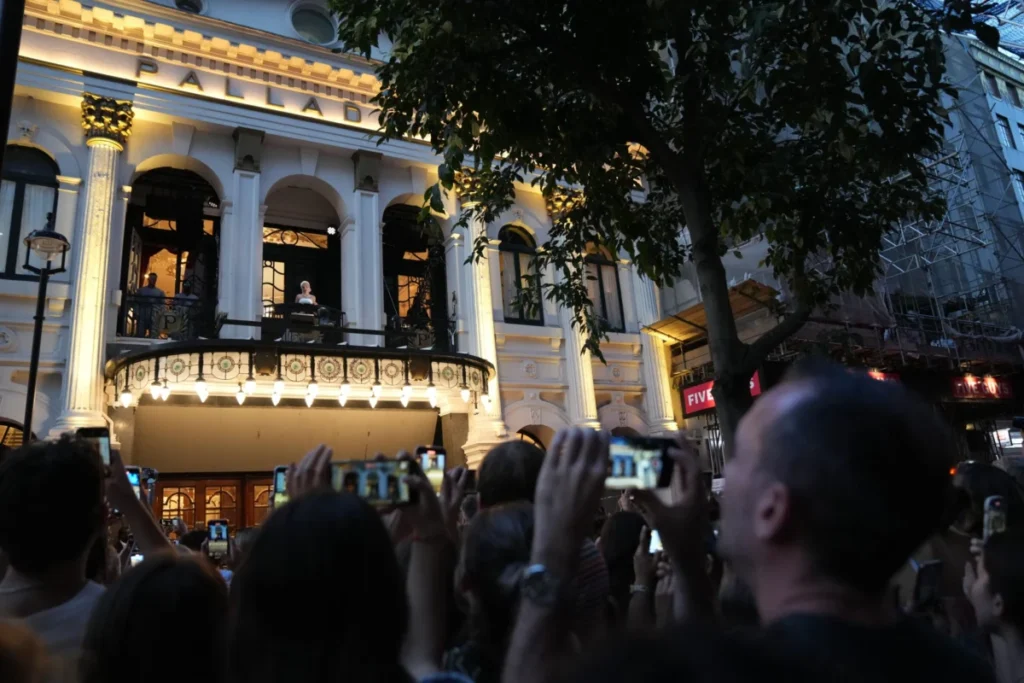
The highlight of Zegler’s Evita run, and a moment she clearly cherishes, was her balcony performance of "Don’t Cry for Me Argentina." This innovative staging saw Zegler delivering the musical’s most iconic number from an external balcony of the London Palladium, directly addressing an enormous outdoor crowd. This creative decision transformed a traditional theatrical experience into a public spectacle, blurring the lines between the hallowed interior of the theatre and the bustling streets of London.
Recounting the event on The Claudia Winkleman Show, Zegler expressed her awe: "I thought it was the most amazing, innovative thing that’s ever happened." She vividly recalled the immense scale of the audience that gathered outside the Palladium, particularly on closing night. "There were more people at closing night outside, than there were sat inside… it went all the way down to the Ikea," she stated, emphasizing the unprecedented turnout. The reference to the nearby Ikea on Oxford Street paints a picture of a crowd stretching hundreds of meters, potentially eclipsing the Palladium’s internal capacity and creating a truly unique urban theatre experience. This impromptu street performance allowed countless individuals, who might not have secured tickets for the sold-out run, to witness a piece of West End history. The sight and sound of Zegler’s powerful vocals resonating through the streets, accompanied by the iconic melody, created an electrifying atmosphere that resonated deeply with both theatre enthusiasts and casual passersby. Such an innovative approach not only celebrated the enduring power of live performance but also demonstrated a dynamic way to engage with a broader public, fostering a sense of shared cultural moment.
Critical Acclaim and Industry Recognition
Zegler’s portrayal of Eva Perón, particularly her show-stopping balcony moment, did not go unnoticed by industry critics and award bodies. Her performance garnered "high critical acclaim," with many reviewers praising her vocal prowess, dramatic intensity, and ability to embody the complex character of Eva Perón with a fresh perspective. This recognition translated into significant accolades, underscoring her successful transition from Hollywood screens to the demanding West End stage.
The actress recently collected a prestigious WhatsOnStage Award for her work in Evita, an honour voted for by the theatre-going public, signifying widespread appreciation for her performance. This was complemented by a prize at the Stage Debut Awards, which celebrates emerging talent in British theatre, further cementing her arrival as a major force in the theatrical world. These awards are a testament to her dedication and the profound impact she made during her relatively brief but memorable run.

Adding to the narrative of her exceptional success, Zegler also made a bold claim regarding her tenure in Evita. She stated that she broke the record for the "longest-standing ovation in the West End." While specific verifiable data for such records can be elusive and often subjective, her assertion speaks volumes about the rapturous reception she received from audiences night after night. A standing ovation, particularly one of extended duration, is a powerful indicator of an audience’s emotional connection and profound appreciation for a performance, highlighting the indelible mark Zegler left on the London stage.
Rachel Zegler’s Ascending Star: From Screen to Stage
Rachel Zegler’s Evita triumph is but the latest chapter in a rapidly unfolding and highly impressive career. She first shot to international prominence as Maria in Steven Spielberg’s critically acclaimed 2021 remake of West Side Story. Her nuanced portrayal and breathtaking vocal performance in the iconic musical film earned her a Golden Globe Award for Best Actress – Motion Picture Comedy or Musical, making her the youngest recipient in that category at just 20 years old. This breakout role immediately established her as a talent to watch, showcasing her powerful voice and acting chops to a global audience.
Following her West Side Story success, Zegler was cast in another high-profile project: the live-action remake of Disney’s Snow White And The Seven Dwarfs. This casting, however, sparked considerable debate and "backlash on social media." As an actress of Colombian background, her selection for a character traditionally described as having a complexion "as white as snow" ignited discussions about representation, faithfulness to source material, and evolving interpretations of classic narratives. Zegler handled the scrutiny with grace, focusing on her artistic commitment to the role and the opportunity to bring a diverse perspective to a beloved character.
Her career trajectory continued its upward climb with a significant role in The Hunger Games prequel film, The Ballad Of Songbirds And Snakes. In this highly anticipated installment of the popular franchise, Zegler demonstrated her versatility by tackling a more dramatic and action-oriented role, proving her capabilities extend beyond musical performances. Her numerous stage roles, prior to and including Evita, further underscore her commitment to live theatre and her desire to cultivate a multifaceted career across various mediums. The success of her Evita run, particularly the innovative balcony performance and the industry awards, unequivocally solidifies her position as a formidable stage actress, capable of commanding both intimate theatre spaces and grand, public spectacles.

The Claudia Winkleman Show Appearance
Zegler’s enthusiastic reflections on her Evita experience were shared during her appearance on The Claudia Winkleman Show, a popular BBC One programme known for its engaging celebrity interviews. The show, which aired on March 20 at 10:40 pm on BBC One and was also available on iPlayer, featured a lively panel of guests alongside Zegler, including singer Niall Horan, comedian Guz Khan, and fellow comedian Joanne McNally.
During the broadcast, the conversation was punctuated by moments of humour, particularly when McNally quipped about her own experiences at the London Palladium. Responding to Zegler’s record-breaking ovation claim, McNally playfully interjected, "I too played the London Palladium and broke a record… it was for wine sold. Maybe they wanted to stand for me too Rachel, but they couldn’t because they were too pissed." This lighthearted exchange provided a comedic counterpoint to Zegler’s impressive accomplishments, showcasing the camaraderie among the guests. For her television appearance, Zegler presented a sophisticated image, opting for a sleek, black strapless zip-up dress, accessorized with a striking gold choker and understated make-up, reflecting a blend of modern elegance and youthful confidence.
Implications for West End Theatre
Rachel Zegler’s Evita balcony performance, and her subsequent enthusiastic recounting of it, carries significant implications for the future of West End theatre and live performance generally. The decision to stage a key musical number from an external balcony, drawing a crowd that potentially surpassed the indoor audience, represents a bold and "innovative" approach to audience engagement. In an era where cultural institutions are constantly seeking new ways to connect with diverse audiences, this method offers a compelling blueprint.
Firstly, it highlights the power of iconic musical numbers to transcend the traditional theatre setting. "Don’t Cry for Me Argentina" is universally recognized, and its performance in a public space created an accessible cultural moment for those who might not typically attend a West End show. This kind of "street theatre" element can foster community engagement, democratize access to high-art performances, and generate unparalleled buzz, turning a theatrical run into a city-wide event.

Secondly, it underscores the adaptability and creative potential of historic venues like the London Palladium. By utilizing architectural features in novel ways, productions can redefine the audience experience, breaking down the conventional barriers between performer and spectator. This could inspire future productions to experiment with immersive or hybrid formats that blend indoor and outdoor elements, offering multi-sensory experiences that captivate both ticketed and non-ticketed audiences.
Furthermore, Zegler’s experience serves as a testament to the enduring allure of live theatre in a digital age. While film and television offer global reach, the immediacy and shared experience of a live performance, especially one that spills out onto the streets, creates an irreplaceable sense of occasion. It reminds audiences of the unique magic and communal spirit that live performance fosters, potentially drawing new generations to the theatre. The success of this innovative approach could encourage producers to explore more daring and public-facing theatrical ventures, ensuring that the West End continues to evolve and remain a vibrant, dynamic cultural hub.
Looking Ahead
As Rachel Zegler continues to navigate her multifaceted career, her Evita performance stands as a significant milestone, solidifying her reputation not just as a film star but as a formidable and celebrated theatrical talent. Her ability to command both the screen and the stage, coupled with her willingness to embrace innovative performance concepts, positions her as a leading figure in the next generation of entertainers. The legacy of her "amazing" and "innovative" balcony performance at the London Palladium will undoubtedly resonate within the West End for years to come, potentially inspiring a new wave of creative risk-taking and public engagement in live theatre. As she continues to take on diverse roles and challenge conventional boundaries, Zegler’s career remains one to watch with keen interest.