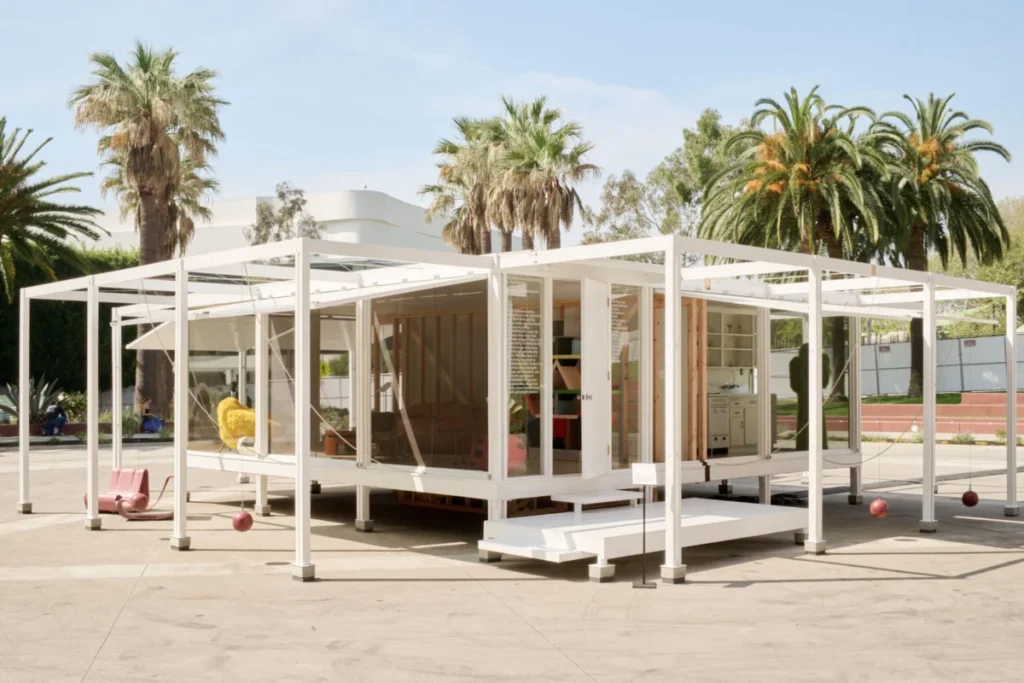

The intersection of mid-century architectural rigor and contemporary cultural curation has found a new focal point at the Pacific Design Center in West Hollywood, where Paul Rudolph’s 1952 Walker Guest House has been installed as the centerpiece of a three-day immersive event. Hosted by the digital marketplace Basic.Space, the event, titled Own the Future, presents the 75-year-old modernist landmark not merely as a historical artifact, but as a functional, shoppable environment curated by musician and creative director A$AP Rocky. This activation marks a significant moment in the convergence of high-end real estate, collectible design, and celebrity-driven commerce, as the house itself is currently offered for sale at a listing price of $2 million.
The Walker Guest House is widely regarded as one of the most significant examples of the Sarasota School of Architecture, a regional movement that adapted European International Style modernism to the subtropical climate of Florida. Designed for Dr. Walter Walker, the structure is a 24-by-24-foot glass-and-steel pavilion characterized by its ingenious system of adjustable exterior wooden panels. These panels, operated by a series of 77-pound red-painted iron cannonball counterweights, allow the inhabitant to toggle between a fully enclosed, private residence and an open-air pavilion shaded by wooden canopies. This mechanical flexibility was revolutionary at the time of its construction and remains a hallmark of Rudolph’s early career before he transitioned into the monumental Brutalism of his later years, such as the Yale Art and Architecture Building.

The Architectural Significance of the Walker Guest House
Paul Rudolph’s design for the Walker Guest House was predicated on the idea of the "flexible box." By utilizing industrial materials and a strict geometric framework, Rudolph created a space that maximized its small footprint through transparency and movement. The house’s arrival in West Hollywood represents a rare opportunity for the public to engage with a structure that has spent the better part of the last six years in climate-controlled storage. The current owner acquired the residence at a Sotheby’s auction in 2018, but subsequent logistical challenges, including pandemic-related construction delays, kept the home from public view until this weekend’s collaboration with Basic.Space.
Architectural historians note that the Walker Guest House is a masterclass in economy of scale. Every element of the structure serves a dual purpose: the floor-to-ceiling glass walls provide views and light, while the wooden shutters act as both security and climate control. The house’s move from its original site on Sanibel Island to a temporary installation in Los Angeles highlights a growing trend in the "collectible architecture" market, where significant small-scale structures are treated as transportable works of art rather than fixed real estate.
A$AP Rocky and the Launch of Hommemade
For the current activation, Basic.Space partnered with A$AP Rocky, who utilized the event to provide the first significant public presentation of his furniture and interior design studio, Hommemade. Rocky, whose influence spans music, fashion, and entrepreneurship, has long been a collector of high-design objects. His curation of the Walker Guest House reflects a philosophy he describes as "storytelling through space," blending historical importance with a lived-in, eclectic sensibility.

Within the white-painted wood and glass frame of the Rudolph house, Rocky has integrated pieces from his personal collection alongside contemporary acquisitions. Notable items include a 2021 Tom Sachs Shop Lounge Chair, a 1971 Super Studio Onos Bed, and a marigold-colored Bolotas sofa by Estudio Campana. The interior also features psychedelic Gaetano Pesce dining chairs from the 1990s and a vibrant, oversized Gufram Cactus, a staple of Italian Radical Design. By placing these diverse, often whimsical pieces within Rudolph’s rigid modernist grid, Rocky creates a tension between the disciplined architecture of the 1950s and the expressive, postmodern furniture of the late 20th and early 21st centuries.
In a statement regarding the collaboration, A$AP Rocky emphasized the importance of intentionality in design, suggesting that spaces should feel both luxurious and real. His goal for the Hommemade studio is to allow consumers to experience design with the same level of immersion found in music. This approach aligns with the broader mission of the event, which seeks to democratize access to high-level design by making every item within the installation available for purchase through the Basic.Space platform.
The Basic.Space Model and the Market for Design
Jesse Lee, the founder of Basic.Space and the owner of the Design Miami collector’s fair, has positioned this event as a bridge between the past and the future of retail. The "Own the Future" theme suggests that "newness" in the design world is not limited to recently manufactured goods but includes the discovery of vintage masterpieces that remain relevant. Basic.Space operates as an invite-only shopping platform that curates objects from over 80 participating designers, artists, and galleries, offering a mix of physical and digital commerce.

This is not the first time Lee’s platform has handled the sale of significant 20th-century architecture. Last year, Basic.Space facilitated the sale of a Jean Prouvé-designed gas station for $1.5 million. The $2 million price tag for the Walker Guest House reflects both its historical pedigree and its status as a mobile asset. The sale includes the structure itself and its original furnishings, though the additional items curated by A$AP Rocky are sold separately.
The decision to host the event in Los Angeles was strategic. Lee noted that the city’s climate and its culture of creative collaboration make it an ideal environment for "inside-outside" living concepts. The Pacific Design Center’s outdoor plaza provides the necessary space for the house to be viewed in a manner that mimics its original Florida setting, allowing the cannonball-weighted panels to be fully deployed.
Provenance and Chronology of the Structure
The timeline of the Walker Guest House is a testament to the enduring appeal of mid-century modernism. Built in 1952, it remained in the possession of the Walker family for over six decades. During this time, it became a pilgrimage site for architecture students and fans of Rudolph’s work. Following the 2018 Sotheby’s sale, the house was carefully disassembled and moved. Its reassembly in Los Angeles represents a meticulous effort to preserve the original materials while introducing the structure to a new generation of collectors.

- 1952: Construction completed on Sanibel Island, Florida.
- 1950s-2010s: The house serves as a guest residence for the Walker family, gaining international recognition in architectural journals.
- 2018: The house is put up for auction by Sotheby’s and purchased by a private collector for approximately $1.1 million (including fees).
- 2019-2024: The structure is kept in storage as plans for a permanent location or public exhibition are delayed by global events.
- 2025: Basic.Space and A$AP Rocky partner to present the house in West Hollywood, marking its first public appearance in six years and its listing for $2 million.
Cultural Implications and Market Analysis
The activation of the Walker Guest House by a figure like A$AP Rocky signals a shift in how high design is marketed. Traditionally, architectural masterpieces of this caliber were the domain of specialized historians and wealthy estate collectors. However, by integrating the house into a multi-hyphenate creative’s portfolio and making it "shoppable" via a digital platform, the barrier to entry—or at least the barrier to awareness—is lowered.
Industry analysts suggest that the "celebrity-curator" model is becoming essential for reaching younger, affluent demographics who value the intersection of different creative disciplines. The presence of Tom Sachs, Gaetano Pesce, and Memphis Milano pieces within the house caters to a "hype-adjacent" design market that treats furniture with the same fervor as limited-edition sneakers or contemporary art.
Furthermore, the sale of the Walker Guest House as a movable object highlights the increasing value of "portable" heritage. As traditional real estate markets become more volatile, the ability to own a significant piece of architectural history that can be relocated to different sites offers a unique form of flexibility for global collectors.

The event at the Pacific Design Center also underscores the resilience of the Los Angeles design scene. By blending an invite-only shopping experience with a public architectural installation, Basic.Space has created a hybrid model that serves both the exclusive world of high-end collecting and the broader public interest in modernist history. As the three-day event concludes, the future of the Walker Guest House remains a topic of significant interest. Whether it finds a new permanent home or continues its life as a traveling icon of modernism, its stint in West Hollywood has successfully reanimated Paul Rudolph’s vision for a new era.