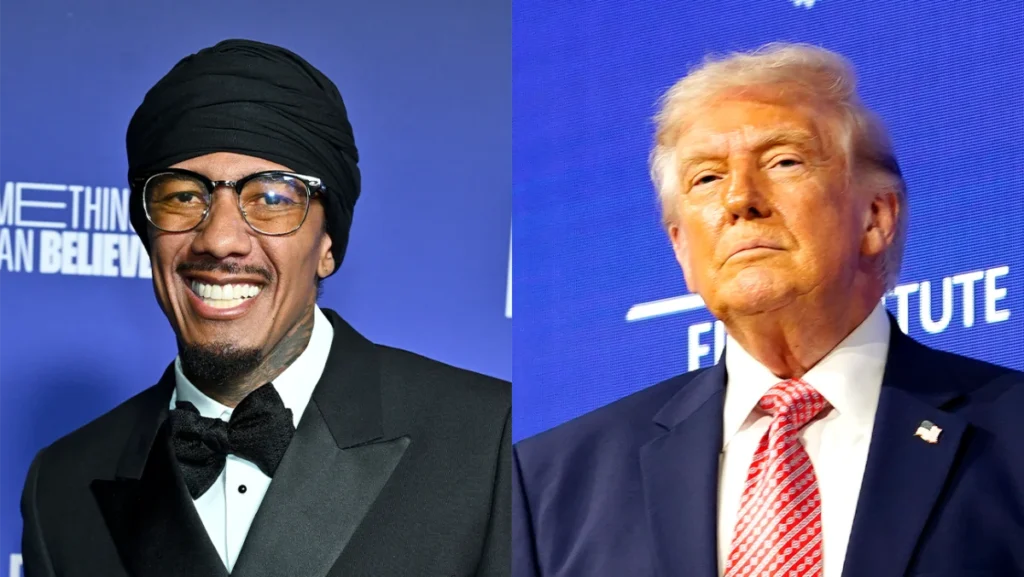

In a recent episode of his show, Big Drive, comedian and producer Nick Cannon made a series of provocative political statements, asserting that the Democratic Party is "the party of the KKK" and expressing enthusiastic support for former President Donald Trump. These remarks, made during a discussion with model Amber Rose, have ignited considerable debate across social media, political circles, and historical discourse, highlighting the increasing prominence of celebrity political commentary and the challenges of historical accuracy in public rhetoric.
The Incendiary Claims and Endorsements
The conversation, which quickly gained traction online, saw Cannon and Rose delve into their perspectives on American political parties. Rose initiated the discussion by claiming that Democrats "don’t care about Black people, don’t care about people of color and the Republicans do." Cannon swiftly agreed, stating, "I agree with you 100 percent." He elaborated on this by asserting, "People don’t know that the Democrats are the party of the KKK. People don’t know that the Republicans are the party that freed the slaves." He further distanced himself from traditional party affiliations, invoking W. E. B. Du Bois: "I don’t subscribe to either party. I rock with W. E. B. Du Bois, when he said there’s no such thing as two parties. It’s just one evil party with two different names."
The discussion then pivoted to Donald Trump. Rose, who stated she is "not married to any party," revealed she voted for Donald Trump in the 2024 U.S. presidential election, deeming him "by far the better option for us." She expressed satisfaction with how Trump’s "second term is going," a remark made ahead of the actual election results. Cannon enthusiastically affirmed this sentiment, exclaiming, "motherfucker’s cleaning house. He’s doing what he said he was gonna do." He added a more colorful analogy, stating, "We got the Gulf of America now. He’s like the club. He’s charging a $5 million bottle service fee to get into the country. I f*** with Trump." These unfiltered comments from Cannon, a prominent figure in entertainment known for his multifaceted career in music, film, and television, underscore a growing trend of public figures openly aligning with or critiquing established political narratives, often challenging conventional wisdom about party allegiances, particularly within minority communities.
Historical Context and Fact-Checking
The claims made by Cannon regarding the historical ties of the Democratic Party to the Ku Klux Klan and the Republican Party’s role in freeing slaves are a frequent point of contention in modern political discourse. While partially rooted in historical facts, these assertions often oversimplify a complex and dynamic political evolution over centuries.
The Democratic Party and the KKK: The original Ku Klux Klan was indeed founded in Pulaski, Tennessee, in December 1865, by six Confederate veterans. Its membership, particularly in the post-Civil War South, largely comprised individuals who identified as Democrats. At the time, the Democratic Party was the dominant political force in the Southern states, and its platform was largely aligned with white supremacy, states’ rights, and opposition to Reconstruction-era policies aimed at racial equality. The KKK emerged as a terrorist organization dedicated to maintaining white supremacy and resisting Black enfranchisement, often through violence and intimidation. However, it is crucial to note that the KKK was not an official arm of the Democratic Party, nor was it founded by the party’s formal leadership. Instead, it was an extremist group whose members often happened to be Democrats due to the prevailing political landscape of the South. Over time, particularly with the Civil Rights Movement of the mid-20th century, the Democratic Party underwent a significant transformation, shedding its segregationist wing. The passage of the Civil Rights Act of 1964 and the Voting Rights Act of 1965, championed by Democratic President Lyndon B. Johnson, marked a pivotal moment, leading many Southern Democrats (the "Dixiecrats") to abandon the party and eventually align with the Republican Party, which then began to appeal to a more conservative, often white Southern base.
The Republican Party and Abolition: Conversely, the Republican Party was founded in 1854 primarily as an anti-slavery party. Its foundational principle was to prevent the expansion of slavery into new Western territories. Abraham Lincoln, the first Republican President, issued the Emancipation Proclamation in 1863, which declared enslaved people in Confederate states to be free. Following the Union victory in the Civil War, the Republican-controlled Congress played a crucial role in passing the 13th, 14th, and 15th Amendments, which abolished slavery, granted citizenship to all persons born or naturalized in the United States (including former slaves), and guaranteed voting rights regardless of race, respectively. For several decades after the Civil War, African Americans largely supported the Republican Party, often referred to as the "Party of Lincoln," due to its historical stance against slavery and its efforts during Reconstruction. However, this allegiance began to shift in the early 20th century, particularly during the Great Depression, when President Franklin D. Roosevelt’s New Deal policies offered economic relief that appealed to many Black voters, moving them towards the Democratic Party. This realignment was further solidified by the Democratic Party’s embrace of civil rights in the mid-20th century.
Cannon’s invocation of W. E. B. Du Bois’s critique of the two-party system ("one evil party with two different names") reflects a long-standing sentiment among some political observers and activists who believe that both major parties ultimately serve similar entrenched interests, regardless of their stated ideologies. Du Bois, a prominent civil rights activist, sociologist, and historian, was a vocal critic of racial inequality and capitalist exploitation, and his views on political parties were often informed by his broader socialist leanings and his skepticism about the capacity of the existing system to deliver true liberation for Black Americans.
The Broader Context of Celebrity Political Influence
The statements by Nick Cannon and Amber Rose are not isolated incidents but rather part of a growing trend of celebrities engaging directly and often controversially in political discourse. In an era dominated by social media and direct communication platforms, public figures like Cannon and Rose have unprecedented reach, allowing them to bypass traditional media gatekeepers and speak directly to their audiences. This amplified voice means their opinions, however historically nuanced or factually precise, can influence millions.
The influence of celebrity endorsements in elections is a subject of ongoing academic and political debate. While some studies suggest that celebrity endorsements have a limited direct impact on voter behavior, especially among well-informed voters, they can be highly effective in generating media attention, mobilizing specific demographics, and shaping the broader cultural conversation around political issues. For younger or less politically engaged audiences, celebrity opinions might serve as an initial entry point into political discussions, even if those opinions are contentious or historically debatable.
In the context of the 2024 U.S. presidential election, Donald Trump has historically garnered support from a diverse array of public figures, some of whom challenge traditional political alignments. His populist appeal and anti-establishment rhetoric have resonated with certain segments of the population, including some within minority communities who may feel disillusioned by the mainstream political offerings of both parties. Cannon’s description of Trump "cleaning house" and his "bottle service fee" analogy for immigration policy reflect a perception among some supporters that Trump is a decisive, unconventional leader who prioritizes national interests and delivers on promises, regardless of the controversy his methods might generate.
Anticipated Reactions and Implications
The remarks by Nick Cannon and Amber Rose are expected to elicit a range of reactions from various stakeholders:
- Political Commentators and Historians: Experts are likely to highlight the historical inaccuracies or oversimplifications in Cannon’s statements, particularly concerning the KKK and party realignments. They will likely emphasize the importance of understanding the fluid nature of political ideologies and party platforms over time, rather than applying modern labels to historical contexts.
- Democratic Party Officials: Democratic strategists and elected officials will likely condemn the characterization of their party as "the party of the KKK," arguing that such claims ignore the party’s modern stance on civil rights and its efforts to promote racial equality. They may point to the significant support the party receives from African American voters as evidence.
- Republican Party Officials: Republican figures might subtly or overtly welcome the endorsements from Cannon and Rose, leveraging them to challenge the narrative that the Republican Party is exclusively for a white conservative base. They may highlight these statements as proof of the party’s growing appeal across diverse demographics, even if they choose not to directly endorse the historical claims made.
- Civil Rights Organizations: Groups dedicated to civil rights and racial justice may issue statements cautioning against the spread of potentially misleading historical narratives, emphasizing the dangers of historical revisionism, and reiterating the importance of accurate historical education.
- Public and Social Media: The statements will undoubtedly continue to fuel intense debate on social media platforms. Supporters of Cannon and Rose may laud their bravery in expressing unconventional views, while critics will likely accuse them of spreading misinformation or being politically naive. The discussion will likely feature arguments about freedom of speech versus responsibility in public commentary.
The implications of such high-profile celebrity interventions extend beyond immediate political reactions. They contribute to a broader environment where historical facts are increasingly contested and narratives are shaped by influencers rather than solely by academic consensus or traditional media. This phenomenon can exacerbate political polarization, making it more challenging for the public to engage in informed civic discourse. Furthermore, it underscores the persistent efforts by various political actors to win over minority voters, using diverse rhetorical strategies and appeals that sometimes revisit contentious historical interpretations.
Ultimately, Nick Cannon’s comments on Big Drive serve as a potent reminder of the intersection of entertainment, politics, and history in contemporary society. As public figures continue to use their platforms to voice strong political opinions, the responsibility to critically evaluate such statements, understand their historical context, and discern fact from rhetoric becomes ever more crucial for the public. The episode highlights the ongoing battle for narrative control, particularly concerning the complex and often painful history of race and politics in America.