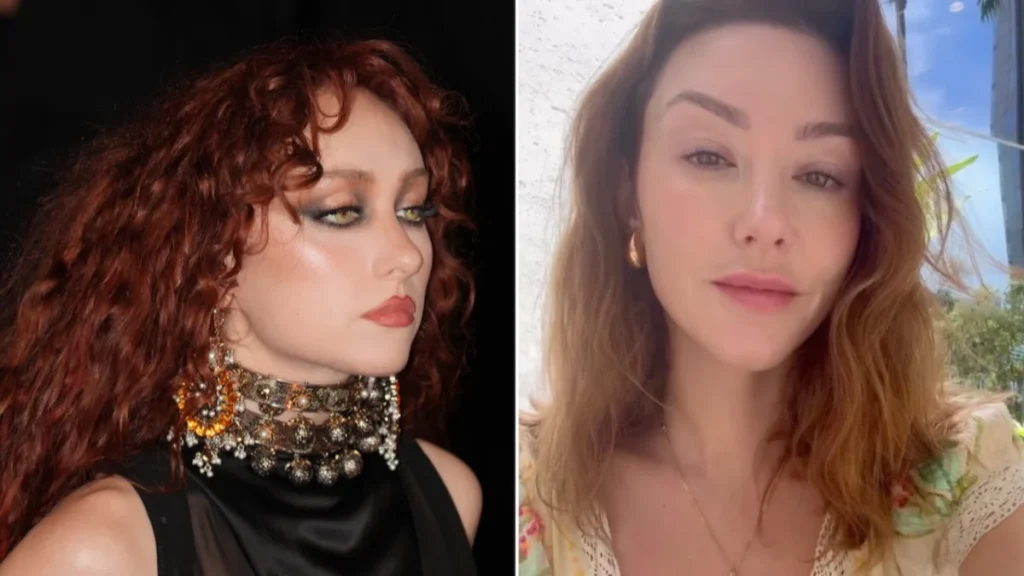

The ongoing controversy involving rising pop sensation Chappell Roan, her security detail, Italian football star Jorginho Frello, and his 11-year-old stepdaughter has taken a new turn as Catherine Harding, the mother of the girl at the center of the incident, has publicly shared her detailed account. The event, which reportedly transpired during breakfast at a São Paulo hotel, has ignited discussions about celebrity privacy, fan interactions, and the responsibilities of public figures for the conduct of their staff.
The Incident’s Genesis: A Glimpse and a Confrontation
The saga began with reports surfacing earlier this month regarding an encounter between an 11-year-old girl, the stepdaughter of Arsenal midfielder Jorginho Frello, and a security guard associated with Chappell Roan. The girl had reportedly attempted to catch a glimpse of the artist during breakfast at a hotel in São Paulo, where both parties were staying. Following the initial reports, Roan herself issued a statement, asserting that the individual in question was not her "personal security" and expressing her love for her fans and children. However, Catherine Harding’s recent statement challenges aspects of this narrative and provides a starkly different perspective on the severity of the confrontation.
Harding’s account, delivered with a tone of frustration and disbelief, delves into the specifics of the security guard’s affiliation and the nature of his interaction with her and her daughter. While acknowledging Roan’s assertion that the guard was not her "personal security," Harding expressed strong doubts about him being a hotel employee. "100% this security guard was not a security guard of the hotel. That’s what I can say," she affirmed, adding, "He looks after artists, so. I don’t know if it was her personal security guard, but he was with her. So that’s all I know." This distinction, while seemingly minor, raises critical questions about who was responsible for the guard’s actions and under whose authority he was operating.
Unraveling the Chain of Command: Authority and Responsibility
Harding further probed the ambiguity surrounding the security guard’s mandate, questioning whether Roan had directly instructed him to intervene. "Did she send him to do it? Again, I don’t know," Harding stated, reflecting a common public concern regarding celebrity accountability. She articulated a broader principle: "Look, I would like to hope not, but at the same time, I think that you have a responsibility when you are a celebrity to make sure, I guess, that the people that work for you and that act on your behalf are acting on your behalf." This perspective underscores the expectation that public figures maintain oversight over their entourages, especially when their actions reflect directly on the celebrity’s brand and public image.
Harding emphasized the potential reputational damage if the guard acted without Roan’s explicit authority but was perceived as representing her. "Would he do that if he didn’t have her authority to do so? I don’t know if he does; then obviously that’s a big problem because then he’s representing her in a way that she doesn’t want to be represented. So I think that’s really important for her to notice and realize that’s not correct." This statement highlights the precarious balance celebrities must strike between personal privacy and public relations, and the critical role their support staff plays in shaping public perception.
A Detailed Chronology of the Breakfast Encounter
Catherine Harding meticulously recounted the events of that morning, painting a picture of an innocent fan encounter that escalated unexpectedly. "Literally, we were staying in the same hotel. We were at breakfast. And we noticed a girl walk past with long red hair, very curly. And I said to my daughter, ‘Oh, do you think that’s Chappell Roan?’ and she looked and she said, ‘Oh my God, Mum, do you think it’s her?’"
The initial curiosity was entirely natural for an 11-year-old admirer. Harding described her daughter’s actions as minimal and respectful: "And so she said, ‘I’m gonna go and have a look outside,’ and she was sat just outside in the garden area which we were also free to go into; the door was open." The crucial detail, according to Harding, is that her daughter did not engage in any intrusive behavior. "She didn’t have her phone, she didn’t try to take a picture, she didn’t approach her. She literally didn’t do anything; she just looked at her and smiled, and she came back and she actually said to me, ‘Mum, I don’t know if it’s her.’"
The girl’s uncertainty stemmed from Roan’s stage persona often involving elaborate costumes and makeup, making her appearance in a casual setting less immediately recognizable. "Because obviously she looks like—you know, with her costumes and everything—she looks a little bit different. So my daughter said, ‘Oh my gosh, I’m not—I’m not sure if it was her. I think it was her, Mum. It really, really looks like her, but I don’t know; maybe it’s her sister.’ She said, ‘Maybe it’s her sister,’ and I said, ‘Oh, I don’t know, darling,’ and that was it. We continued our breakfast." This seemingly innocuous interaction, a child’s quiet moment of curiosity, was the precursor to the confrontation.
The Confrontation: An Intimidating Scolding
The tranquility of their breakfast was shattered when the security guard approached their table. Harding described his demeanor as "very aggressive," echoing her husband’s earlier assessment. She found the interaction to be a significant "overstep of a boundary," particularly given the guard’s imposing physical presence. "He is quite an intimidating—he is very large. So for him to come over to a table with just a woman and her daughter eating breakfast to kind of like berate and scold us and say that he was going to complain, and tell me that I should be teaching my daughter to be better and that she’s badly educated and we should respect people’s privacy and we should not harass people and all of these other things."
Harding attempted to de-escalate the situation and explain her daughter’s innocent intentions. "And I did try and explain to him the situation—that she’s a child and she was just very excited to see an artist and singer that she admires—and can he not understand that was all she was doing?" She further highlighted her family’s familiarity with public life, given her husband’s profession as a prominent footballer. "I explained to him also that my husband is also very well-known and that we’re very—she’s very used to being around people that are well-known and she would never cross someone’s boundaries or overstep a mark. She very much knows the limits; not to ever, you know, be rude or make anyone feel—she understands; she understands very well."
Despite her explanations, the guard remained steadfast in his reprimand. "And I tried to explain this to him, and then he just kept saying, ‘Well, if you—if—if that’s the case, then you should know better. You should know how it is. You should know how it is, so you should teach your—you should teach her to be better. You shouldn’t allow her to be like this.’" Harding expressed her shock at his unyielding stance and her eventual defiance. She asserted their rights as paying guests in a public area: "And I was—I was shocked. And I did actually say to him at the time, I said, ‘Well, if this is the case that she doesn’t even want people to look at her, she is very welcome to eat breakfast in her room because this here is a public area and I am a paying guest as well as her. So if I want to walk past someone’s table and look at them, I have every right to do so. I am not approaching her. I’m not doing anything to make her feel intimidated or nothing—like this 11-year-old child.’"
The Aftermath: A Missed Birthday Celebration
The emotional toll of the incident was significant, particularly for Harding’s daughter. The family had traveled to São Paulo specifically to see Chappell Roan perform at Lollapalooza Brasil, with tickets serving as a special birthday gift for the young fan. "It was my daughter’s birthday present; she actually asked for tickets to come for her birthday present," Harding revealed. However, due to the distress caused by the confrontation, they ultimately decided not to attend the concert, turning a highly anticipated celebration into a source of disappointment. This outcome underscores the profound impact such encounters can have on fans, especially young ones who look up to artists.
Chappell Roan’s Response and the Broader Context of Celebrity Security
In her initial statement regarding the incident, Chappell Roan clarified her position, stating she was "unaware of the entire incident" at the time it occurred. She strongly emphasized, "I do not hate people who are fans of my music. I do not hate children." Roan’s statement reflects a common challenge faced by celebrities: managing their public image and fan relations while delegating security responsibilities to a team that may not always align with the artist’s personal values or approach to fan interaction.
The incident highlights the complexities of celebrity security, particularly in semi-public spaces like hotel restaurants. While celebrities are entitled to privacy and protection from harassment, hotels also serve as public accommodations for all paying guests. Security personnel are often tasked with enforcing boundaries, but the manner in which these boundaries are enforced can vary widely and, as seen in this case, can sometimes be perceived as overly aggressive or disproportionate to the perceived threat.
Typical security protocols for high-profile individuals in hotels often involve designated safe zones, clear communication with hotel staff, and a discreet presence. The objective is usually to prevent direct approaches, photography, or prolonged staring that could make the celebrity uncomfortable. However, the interpretation and execution of these protocols are left to individual security guards, who may prioritize perceived threats over general guest experience. The ambiguity of the security guard’s affiliation in this scenario further complicates the issue, blurring the lines of accountability between the artist, their management, and the hotel.
Navigating Celebrity and Privacy in the Digital Age
This incident also taps into a broader societal discussion about celebrity culture, fan behavior, and the boundaries of privacy in an increasingly connected world. With the rise of social media, the line between public and private life for celebrities has become incredibly thin. Fans, empowered by instant communication and the constant stream of celebrity content, often feel a heightened sense of access and familiarity. While most fan interactions are positive and respectful, the pressure to "go viral" or capture a unique moment can sometimes lead to boundary-pushing behavior.
However, as Harding’s account illustrates, even seemingly innocent acts of admiration can be misconstrued or met with an excessive response. The challenge for celebrities lies in fostering a positive relationship with their fanbase while also safeguarding their personal space and mental well-being. This requires clear communication from the artist, consistent training for their staff, and a nuanced understanding of fan psychology.
Implications for Public Figures and Their Teams
The fallout from this incident carries significant implications for Chappell Roan and her team. Firstly, it underscores the critical importance of vetting and clearly defining the roles and conduct expectations for all personnel associated with a public figure, regardless of whether they are "personal security" or hired for specific events. The actions of staff, even those peripherally connected, can directly impact the artist’s reputation and public perception.
Secondly, it highlights the need for transparent and timely communication in crisis management. While Roan’s statement expressed her general stance, the ongoing detailed account from Harding has kept the story alive and continues to prompt questions about accountability and empathy.
Finally, the incident serves as a cautionary tale about the delicate balance between maintaining privacy and alienating fans. While security is paramount, the manner in which it is executed can either foster goodwill or generate significant negative publicity. For an artist like Chappell Roan, whose career is currently experiencing a meteoric rise, maintaining a positive connection with her fanbase is crucial. This incident, therefore, presents a valuable opportunity for her team to review and refine their approach to fan interactions and security protocols to prevent similar misunderstandings in the future.
The incident between Chappell Roan’s security detail and Catherine Harding’s daughter remains a poignant reminder of the complexities inherent in the celebrity ecosystem. It poses critical questions about the invisible lines between public admiration and personal space, and the significant responsibility held by public figures and their teams in navigating these often-blurry boundaries with grace and professionalism. The lingering impact on Harding’s family, coupled with the ongoing public discourse, suggests that this incident will continue to serve as a case study in celebrity-fan relations for some time to come.