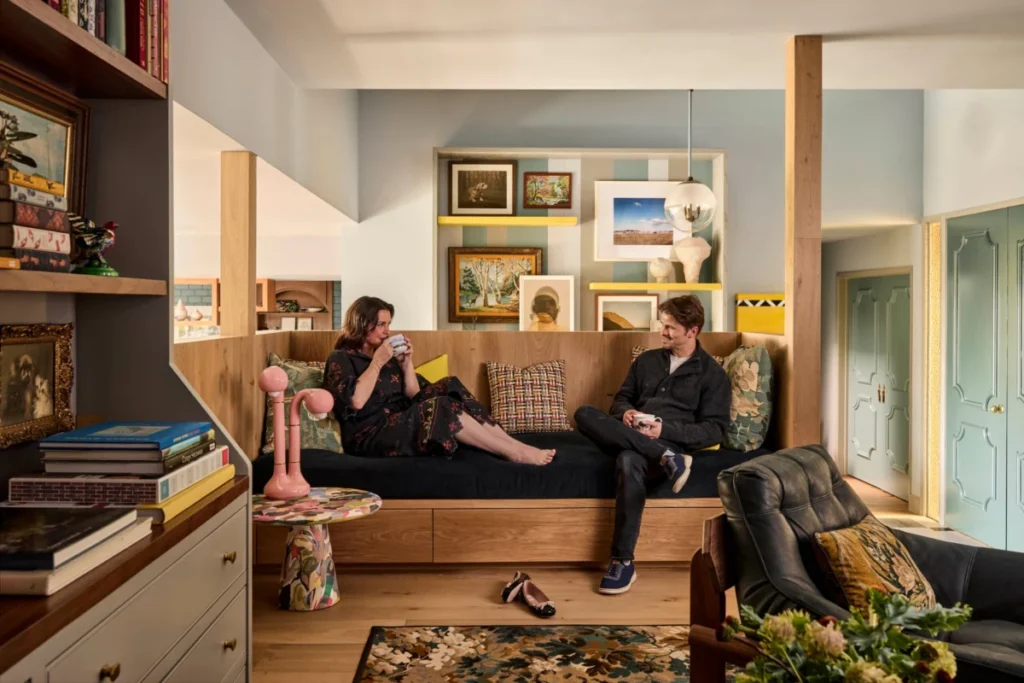

The pursuit of residential comfort often requires a delicate balance between architectural structure and personal history, a challenge recently navigated by Emmy-nominated actress Melanie Lynskey and her husband, actor Jason Ritter. Their 3,200-square-foot Los Angeles residence, a space that initially felt emotionally distant despite its physical warmth, has undergone a comprehensive interior transformation. Orchestrated in collaboration with designer Jason Martin, founder of the Los Angeles-based studio Martin & Brockett, the project serves as a case study in how heritage, extensive personal collections, and bold color palettes can converge to create a functional family sanctuary.

The Evolution of a Vision: From Cold Tile to Cozy Soul
Lynskey, a New Zealand native whose career has seen a significant resurgence with her acclaimed performance in the Showtime series Yellowjackets, lived in the residence for several years before initiating the redesign. Her primary motivation was a perceived disconnect between the house’s "lovely feeling" and its material finishes. Specifically, the presence of "cold tile" throughout the home conflicted with the family’s desire for an environment that felt as "cozy as its soul is."
The decision to renovate was also born of a retrospective realization. Lynskey noted that after leaving her previous residence of 13 years, she felt she had only truly begun to live in it toward the end of her tenure. Determined not to repeat this pattern, she and Ritter committed to a full-scale personalization of their current home.

Initially, Lynskey was hesitant to enlist professional design services, citing a clear personal vision and a fear that an external expert might override her instincts. However, after managing a complex kitchen renovation independently, she recognized the logistical demands of a whole-house project. "One room was enough," Lynskey remarked, acknowledging the transition from DIY management to professional collaboration.
Strategic Collaboration: The Role of Martin & Brockett
The introduction to Jason Martin proved to be the catalyst for the home’s successful transformation. Martin’s approach was not to impose a pre-determined aesthetic but to "elevate and edit" the ideas Lynskey had already cultivated. This synergy allowed for a design process that Martin described as one of the most "adventurous" of his career.

A significant portion of the project’s success relied on Martin’s ability to integrate Lynskey’s massive, pre-existing collection of art and textiles. Rather than sourcing new items to fit a trend, the design was built around the artifacts of the couple’s lives. This methodology aligns with a broader shift in high-end interior design toward "curated maximalism," where the value of a space is measured by its personal narrative rather than its adherence to minimalist uniformity.
Cultural Heritage and the Art of New Zealand
Central to the home’s identity is Lynskey’s collection of art, almost exclusively sourced from New Zealand. These pieces serve as a visual bridge to her heritage, featuring works by Māori and Pacific Island artists. For Lynskey, the art is more than decoration; it is a visceral connection to the landscapes of Wellington and the cultural markers of her home country, such as moko tattoos.

Key works featured in the residence include:
- Henrietta Harris: Her pieces, including Everything, Everything and Quack, are positioned in high-traffic areas like the living room and primary bath.
- Kelcy Taratoa: The work Whare-kura provides a bold punctuation mark on the family room’s blue brick wall.
- Ahilapalapa Rands: An embroidered work titled Entwined adds a tactile dimension to the collection.
- Ray Ching: A wildlife painting in the dining room reflects a traditional New Zealand naturalistic style.
By prioritizing these artists, Martin ensured that the home remained a reflection of Lynskey’s identity, providing a sense of grounding within the fast-paced environment of Los Angeles.

Materiality and the Use of Legacy Textiles
One of the more unconventional aspects of the renovation was the use of Lynskey’s "weird boxes of fabric." Over the years, the actress had accumulated bolts of high-quality textiles from sources like Liberty London, often purchasing them during sales without a specific end use in mind.
Martin utilized these stockpiles for lampshades, pillows, and custom upholstery. To prevent the mix of patterns—ranging from florals and dense tapestries to punchy geometrics—from becoming chaotic, Martin anchored the designs with fabrics from pedigreed houses, including:

- Watts of Westminster: Known for historic and ecclesiastical patterns.
- Pierre Frey: A French house celebrated for its eclectic and color-rich designs.
- Dedar: An Italian textile firm that blends technical innovation with classic luxury.
- Maharam: Specifically using "Wool Check" by Paul Smith for window treatments.
This layering of high-end commercial fabrics with Lynskey’s personal finds created a "neutral" palette that, while vibrant, felt cohesive through its shared natural and animal motifs.
Room-by-Room Breakdown: Function and Form
The renovation addressed several architectural "confusions" left by a previous 1990s-era renovation that had favored beige travertine and open, underutilized spaces.

The Kitchen
The kitchen, which Lynskey oversaw herself, sets the tone for the home’s color story. It features a Wolf range with its signature red knobs, set against a backdrop of glossy emerald subway tile. The cabinetry, finished in a soft blue-gray, provides a traditional contrast, while color-blocked Louis Poulsen pendants introduce a mid-century modern playfulness.
The Living Room and Family Room
The living room was previously a source of frustration for Lynskey, who admitted to moving furniture "probably 12 times" in an attempt to make the layout work. Martin resolved the spatial issues by creating a configuration optimized for "game nights," a primary directive from the couple. The space now features a custom daybed, built-ins for art display, and a lavender coffee table by Martin & Brockett.

The Snug
A small, confusing room downstairs was reimagined as a "snug." Lacquered in a deep, rich red, the room serves as a dedicated space for Lynskey to read scripts. It features a built-in daybed and views of a garden redesigned by landscape designer Fi Campbell. This room exemplifies the project’s goal of assigning specific, cozy purposes to every square foot of the residence.
The Dining Room
The dining room became a site of playful compromise. When Lynskey and Martin could not agree on lighting, the decision was left to Jason Ritter, who, without knowing which option belonged to whom, chose Martin’s suggestion: pink Murano glass chandeliers. The room also features a custom oak table and chairs by Martin & Brockett.

Emotional Anchors and Family Legacy
While the house is filled with high-end custom furniture and international art, its most significant piece is an overstuffed sofa in a leafy green pattern. The sofa belonged to Jason Ritter’s late father, the legendary actor John Ritter. Martin noted that there was "no question" the design would work around this piece, recognizing its immense sentimental value to the family.
Ritter, who describes his own creative input as "the white nothing area in The Matrix," trusted Lynskey’s vision implicitly, stepping in only when requested. This dynamic allowed the home to become a unified expression of their shared life, incorporating Ritter’s childhood furniture alongside Lynskey’s New Zealand treasures.

Broader Impact and Interior Trends
The Lynskey-Ritter renovation reflects a growing trend in the luxury real estate and design sectors: the move toward "soulful" interiors. As the "minimalist gray" aesthetic that dominated the 2010s begins to fade, homeowners are increasingly seeking spaces that prioritize emotional resonance and historical depth.
Data from the interior design industry suggests that "cluttercore" and "maximalism" are more than just aesthetic choices; they are psychological responses to a desire for comfort and stability. By using personal collections and heritage-based art, Lynskey and Ritter have created a home that functions as an extension of their biographies.

Furthermore, the project highlights the importance of the designer-client relationship. Lynskey’s transition from an apprehensive DIYer to a collaborative partner with Martin underscores the value of professional editing in the realization of a complex personal vision. As the project concludes, both Lynskey and Martin expressed a sense of melancholy that the creative process has ended, a testament to the success of their partnership.
In the competitive landscape of celebrity homes, the Lynskey-Ritter residence stands out not for its scale or ostentation, but for its authenticity. It is a 3,200-square-foot testament to the idea that a home is most successful when it refuses to hold back on the elements that make its inhabitants unique. Through the strategic use of color, the honoring of family legacy, and a deep respect for cultural roots, the couple has finally turned their Los Angeles house into a home that is as warm and cozy as its soul.