

The intersection of personal trauma, societal standards of beauty, and the rapidly growing normalization of cosmetic modification has once again captured public attention. Recently, a young Japanese man named Yura became the center of widespread media discussion following his appearance on the ABEMA program Nanani Underground. During the broadcast, Yura detailed a deeply personal and financially intensive journey of transformation—one that involved investing the equivalent of tens of thousands of US dollars into extensive plastic surgery. His motivation, born from a combination of romantic rejection and professional exclusion, highlights the immense psychological pressure faced by individuals navigating a world that often places a high premium on physical aesthetics.
The Catalyst: Heartbreak and Professional Rejection
The sequence of events that fundamentally altered Yura’s perspective on life and appearance began during his college years. Prior to his transformation, Yura possessed an athletic build, developed through more than a decade of dedicated baseball training, and stood at an above-average height. However, his personal style was unassuming; he typically wore a conventional buzz cut and prescription eyeglasses, and he maintained little interest in fashion or cosmetic grooming. Like many young adults, his primary focus was academic and athletic pursuits rather than cultivating a polished or trendy aesthetic.
This routine existence was upended when Yura discovered that his college girlfriend had been unfaithful. The emotional fallout was severe, plunging him into a deep period of introspection and self-doubt. Rather than viewing the infidelity as a reflection of his partner’s character or the inherent complications of the relationship, Yura internalized the betrayal. He became convinced that his physical appearance was the root cause, developing a rigid belief that if he had been more traditionally handsome, the betrayal would never have occurred.

This newfound preoccupation with his looks coincided with a critical juncture in his life: entering the workforce. Seeking employment in an industry that explicitly traded on visual appeal, Yura applied for a position at a host club—a popular type of nightlife establishment in Japan where attractive male hosts entertain and socialize with patrons, often driving significant financial revenue through charm and appearance. His application, however, was met with blunt rejection. The owner of the establishment turned him down unequivocally, stating that the venue exclusively hired conventionally attractive men. This professional exclusion served as a second major blow to Yura’s self-esteem, cementing his conviction that his future success, both socially and professionally, depended entirely on a drastic alteration of his physical features.
The Financial and Surgical Chronology
Driven by a desire to reshape his identity and overcome the rejections of his past, Yura committed himself to a rigorous and costly journey of cosmetic surgery. Over time, he underwent multiple procedures designed to overhaul his facial structure and overall aesthetic. According to disclosures made during his television appearance, Yura ultimately spent approximately 5 million Japanese yen—roughly equivalent to $31,279 USD—on various surgical and non-surgical enhancements.
While specific medical details of every procedure remain private, transformations of this magnitude typically involve complex surgeries such as rhinoplasty, blepharoplasty (double eyelid surgery), contouring of the jawline or chin, and dental reconstruction, all of which are increasingly common within East Asia’s booming cosmetic surgery market. The timeline of Yura’s transition spanned several years, encompassing consultations with specialized clinics, the physical recovery periods associated with major facial surgeries, and the gradual adaptation to his new appearance. Financing such an extensive series of procedures required significant planning, saving, and potentially external support, marking a multi-year commitment to redefining his physical presentation.
The Broader Economic and Cultural Context
Yura’s experience is far from an isolated incident; rather, it reflects broader cultural and economic currents running through modern Japanese society and the wider East Asian region. The market for cosmetic procedures has experienced exponential growth over the past two decades, shifting from a secretive, stigmatized practice to an openly discussed, socially acceptable consumer choice. According to market research data from the International Society of Aesthetic Plastic Surgery (ISAPS), countries in the Asia-Pacific region consistently rank among the highest globally in terms of total cosmetic procedures performed annually.

This surge is closely tied to the concept of the "lookism" phenomenon—a form of discrimination where individuals are judged, valued, or disadvantaged based on their physical attractiveness. In professional environments, particularly in client-facing sectors like hospitality, entertainment, sales, and nightlife, physical appearance can directly correlate with earning potential and employability. Host clubs, the specific industry Yura initially targeted, operate on an extreme end of this spectrum, where visual presentation is the primary currency. Research into labor markets consistently demonstrates that attractive individuals often enjoy advantages in hiring, promotion, and salary—a phenomenon economists refer to as the "beauty premium." When individuals experience acute rejection tied explicitly to their looks, the economic and social incentives to alter one’s appearance can become powerful motivators.
Psychological Implications and Expert Analysis
Mental health professionals and sociologists who study the intersection of cosmetic surgery and self-esteem often view cases like Yura’s through a complex lens. On one hand, plastic surgery can serve as a tool for empowerment, allowing individuals to reclaim agency over their bodies and alleviate debilitating body dysmorphia or low self-confidence. For many, achieving a desired physical transformation correlates with measurable improvements in daily self-assurance and social interactions.
Conversely, clinical psychologists frequently caution against viewing plastic surgery as a guaranteed remedy for underlying emotional trauma. When procedures are driven by external validation—such as seeking revenge against an unfaithful partner or attempting to appease rigorous industry standards—the psychological relief can be temporary. Experts note that while changing one’s face can alter how the world responds, it does not automatically resolve internal insecurities rooted in past rejection. However, in Yura’s case, the transformation appears to have yielded the practical outcome he desired: public visibility, television exposure, and employment within the very industry that once turned him away.
Public Reaction and Current Status
The broadcast of Yura’s story on ABEMA generated substantial engagement across social media platforms, sparking intense debate among viewers. Online communities divided into various camps; some expressed sympathy for the emotional pain that initiated his journey, while others marveled at the financial investment and the stark contrast between his pre-surgery and post-surgery appearance. Many commenters noted that he is now virtually unrecognizable compared to the college student he once was.
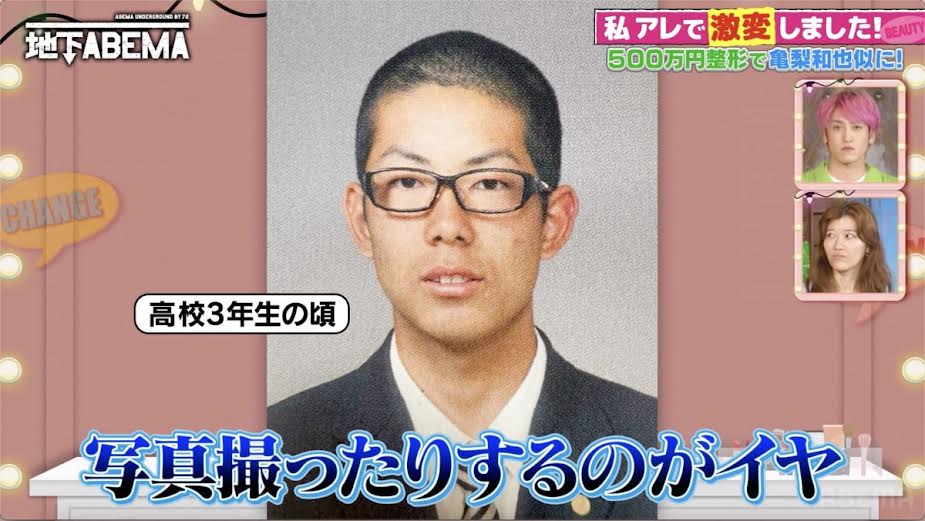
Today, Yura’s life reflects a complete pivot from his academic days. Evidence from his active social media presence, including his verified Instagram account, indicates that he successfully achieved his professional goal. Alongside managing social media marketing and promotional content for various businesses, Yura is currently employed as a host at a prominent nightlife establishment—the exact career path that was closed to him prior to his transformation. Furthermore, he has leveraged his dramatic narrative to build a personal brand, utilizing public speaking and media appearances to share his story with a wider audience.
As conversations surrounding body modification, mental health, and societal beauty standards continue to evolve globally, Yura’s journey stands as a striking testament to the lengths to which some individuals will go to redefine their place in society. Whether viewed as an inspiring tale of personal reinvention or a cautionary symbol of modern societal pressures, his experience underscores the profound impact that physical appearance continues to wield over personal destiny in the twenty-first century.