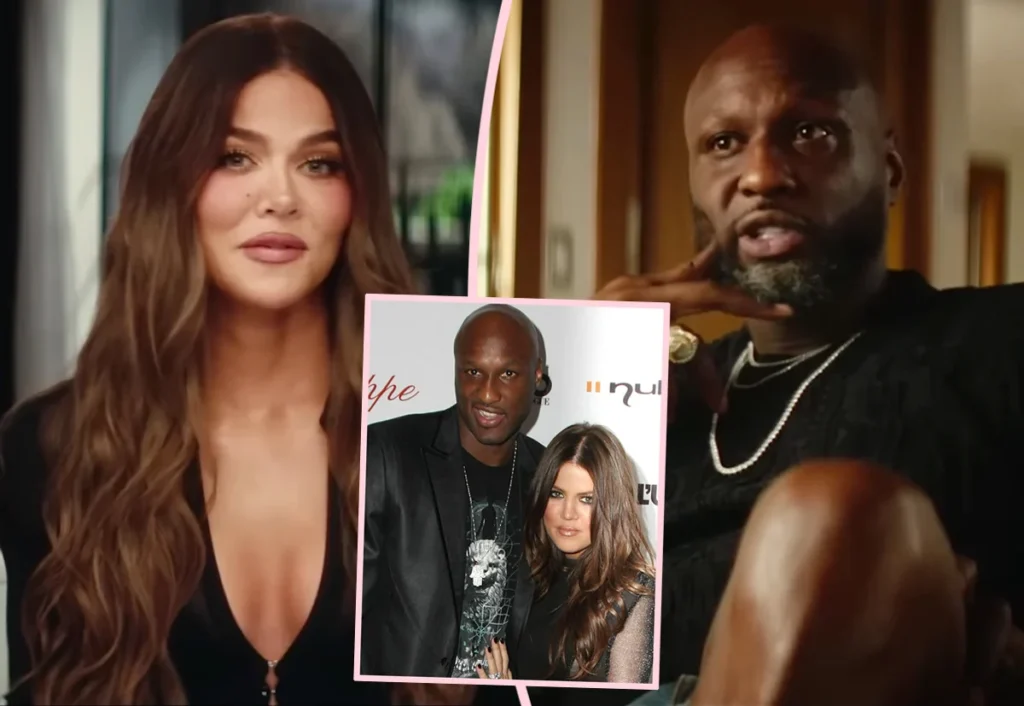

A new Netflix documentary, "Untold: The Death & Life of Lamar Odom," has pulled back the curtain on the tumultuous relationship between reality television star Khloé Kardashian and former NBA player Lamar Odom. Released on Tuesday, the film features a candid and emotionally charged interview with Kardashian, who offers a raw, unfiltered account of their whirlwind romance, Odom’s struggle with substance abuse, and the near-fatal overdose that almost claimed his life. Her revelations provide an intimate and often heartbreaking perspective on a high-profile marriage that captivated the public eye.
The "Untold" series, a popular documentary franchise from Netflix, has become renowned for its deep dives into critical moments in sports history and the lives of iconic athletes, often featuring interviews with key figures previously reluctant to speak. This latest installment, focusing on Odom, offered a unique opportunity for Kardashian to share her side of a story largely told through tabloids and reality television snippets. Her participation underscores the profound impact Odom’s addiction had on her life and her unwavering, albeit complicated, commitment to him during his darkest hours.
The Genesis of a High-Profile Union
The narrative begins with their unlikely first encounter, orchestrated by Lamar Odom’s former Los Angeles Lakers teammate, Metta World Peace (then Ron Artest). World Peace reportedly paid Khloé Kardashian $5,000 to appear at a party in Los Angeles. Kardashian, primarily motivated by her brother Robert Kardashian’s interest in attending, initially had no idea who Lamar Odom was. She recounted a memorable exchange from that night: "Prior to this party, I did not know who Lamar was. I remember he had a plastic bag, and I was like, ‘What’s in your bag?’ And he’s like, ‘Candy.’ I told him, ‘You’re such a liar. You probably have condoms in that bag.’" To her surprise, Odom "poured it out and it was all candy – and only candy," leaving her feeling "so stupid."
Lamar Odom, a two-time NBA champion with the Lakers and a beloved figure known for his amiable personality and versatile play, presented a different recollection of their initial interactions. He admitted, "The first night, I was trying to f**k her the first night. But she said, ‘It ain’t that type of party.’ We got together the next day, then the next day, then the next day, and then the next day." This rapid connection quickly escalated into a whirlwind romance. After just one month of dating, the couple announced their engagement in 2009, culminating in a wedding later that year. Their union, marrying a prominent reality television personality with an admired NBA star, instantly became a media sensation, catapulting them into the upper echelon of celebrity couples.
Navigating Reality Television
By the time she met Odom, Khloé Kardashian was already a fixture on E!’s "Keeping Up With the Kardashians," the reality show that cemented her family’s status as global celebrities. While many partners of reality stars shy away from the intense public scrutiny that comes with the territory, Odom, surprisingly, embraced it. Kardashian revealed that Odom "loves the camera" and actively sought to be part of her television world. She recalled an instance where she asked him to leave a photoshoot before her camera crew arrived, only for him to question, "Why do I have to leave?"
More significantly, Kardashian claimed that Odom was the driving force behind their own spin-off series, "Khloé & Lamar," which premiered in 2011. Despite her reservations, fearing it might "jeopardize the family brand" and spread her too thin, Odom’s persistence prevailed. "It was led very much by Lamar," she stated, adding that she "reminded him about his main career: the Los Angeles Lakers." The spin-off, offering viewers a glimpse into their married life, lasted for two seasons, further embedding their relationship into the pop culture consciousness and inadvertently setting the stage for public awareness of the struggles that would later unfold.
The Shadow of Addiction Emerges
Beneath the veneer of reality television fame and a seemingly idyllic marriage, a much darker reality was taking root. Lamar Odom’s battle with substance abuse began, according to his own admission in the documentary, when he took his "first hit of cocaine" with a woman and her husband, quickly becoming hooked. Khloé Kardashian initially misjudged the severity of his addiction, perceiving it as a "recreational thing" that "seemed responsibly done."
However, the facade began to crumble approximately two years into their marriage when Odom mysteriously disappeared. "I really thought maybe something happened to him," Kardashian recounted, describing frantic attempts to locate him by "calling anyone and everyone." When he eventually returned, Odom offered a heartbreaking justification: the passing of his infant son, Jayden, from Sudden Infant Death Syndrome (SIDS) at just six months old. "He did come home, and I don’t want to say he blamed a lot [on this], but his reasoning for why this happened was because of [his infant son] Jayden’s passing," Kardashian explained. This moment marked a turning point for her, as she realized, "That was the first time I was like, ‘OK, this is something I’ve never experienced. This is a dark situation, and I don’t know what to do.’" The tragedy of Jayden’s death in 2006 had undoubtedly left an indelible scar on Odom, a profound grief that, according to Kardashian, he used to rationalize his spiraling drug use.
Infidelity and Betrayal
Compounding the challenges of Odom’s addiction was a devastating pattern of infidelity. Kardashian first learned of his cheating in a particularly brutal manner: a call from one of Odom’s mistresses while he was high. Odom corroborated this, stating, "One night I [was] going to Big Bear, California, and I’m getting high out of my f**king mind. The girl that I was with at the time, she must have been so blown back by it that she must have took my phone and contacted my wife."
Khloé’s account echoed his: "Out of the blue, I get this call, and she said, ‘Hi, I’ve been fking your husband. He is so fked up, and he just keeps wanting money and drugs, and I gotta get off this ride. So will you come and pick him up?’" While Kardashian admitted to having "suspicions," she "never had anything tangible" to confirm Odom’s infidelity until that harrowing phone call. This revelation not only exposed Odom’s betrayal but also highlighted the depth of his addiction, as it led to his secret life being exposed in the most public and painful way.
A Desperate Struggle: The Intervention and Overdoses
As their marriage progressed, Odom’s drug use intensified, becoming "worse and worse." Kardashian described a harrowing existence marked by Odom’s frequent disappearances, sometimes for days, and his inability to stay in rehab facilities. "There were many times Lamar would go for 12 hours or two days and escape rehab," she recalled. "He would go on a drug bender, and no one could find him. I was either looking for him in alleys or looking for him in motels. He would have tinfoil cutouts or spoons, and he was freebasing things and leaving things everywhere."
The Good American founder confessed to feeling like an "enabler without knowing I was an enabler," often having "to go to hotel rooms to clean up after him." She added, "But I just felt such a responsibility to cover this up, hold it together and protect him." This sense of responsibility was immense, especially given her youth at the time, navigating her first serious love while trying to protect his public image and career. The pressure to maintain secrecy was fueled by Odom’s fear of losing his career, a threat that resonated deeply with Kardashian, who at 24, was still establishing her own financial independence and public identity. "When I really discovered that there was a problem, he was like, ‘You cannot tell anyone, I’ll lose it all. And if I lose it, where are we going to live?’" she remembered. "I didn’t sleep for years."
The situation became "monstrous" after Odom was traded from the Los Angeles Lakers to the Dallas Mavericks in 2011, a period marked by significant professional upheaval. "I’ve just never seen so many drugs in such a dark spot, and it was just such a dark aura around us," Kardashian stated. She detailed how Odom exploited loopholes in drug testing protocols, focusing on painkillers that were not routinely screened. "He was freebasing painkillers… He was locked in the hotel bathroom for maybe four days just doing drugs. Has no concept of time. He was horrible because he was so f**ked up and high."
Despite these severe issues, they kept Odom’s addiction private to safeguard his career. This intense secrecy, however, came at a great personal cost to Kardashian. "I was fighting every single day either to protect him to not let him get caught… I was trying to make sure his image, how he looked and how he presented himself to the outward world was still that Lamar Odom."
The periods when Odom was out of season proved particularly dangerous, leading to multiple overdoses. "He spiraled again and did crazy drugs. He overdosed a few times. I had to pump his stomach – all privately. I got him help at home and detox centers. We did everything we could." The gravity of the situation eventually necessitated a formal intervention. Kardashian recounted the advice from the interventionist: "’You’re going to go in there and you’re going to tell him he needs to go to rehab. If he doesn’t stay for a three-month program, you are going to say you’re getting a divorce.’" Despite the widespread belief among their circle that Odom would never accept a divorce, his reaction was stark. "He’s like, ‘OK, all I want is my passport and let’s get the fking divorce.’ I didn’t want the divorce. Lamar left immediately. He was like, ‘We’re getting the fking divorce, and I’m never coming back here again.’"
The Near-Fatal Overdose and Lingering Devotion
Following Odom’s defiant departure, Khloé Kardashian filed for divorce in 2013 after four years of marriage. However, their legal separation was put on hold two years later when Odom suffered a near-fatal overdose at a brothel in Nevada in October 2015. The incident left him in a coma, enduring "12 strokes and six heart attacks," a critical health crisis that shocked the world. Despite their bitter separation, Kardashian immediately rushed to his bedside, demonstrating an unwavering commitment to his well-being. She remained his primary caregiver and decision-maker during this harrowing period.
In the documentary, Odom himself expressed profound gratitude for Kardashian’s presence, stating she "never left the hospital" for "about four months." He shared an incredibly vulnerable detail: "I had no control of my bowels. My wife helped wipe some of the s**t up." Kardashian’s dedication extended beyond the hospital, as she set up a home for his recovery. However, her limits were ultimately tested when she discovered Odom using drugs again after his miraculous recovery. She also alleged that he feigned the severity of his condition to maintain his lifestyle.
"He was in his bedroom sitting on the edge of the bed and smoking crack," Kardashian recounted, describing her breaking point. "I just punched him in his face. I just put my life on hold to f**king take care of you. He was better than I knew. He was playing me so I can continue this lifestyle for him." The betrayal was too much to bear. "I said, ‘By Monday, you need [to be] out of this house. I’m done. I’m not paying for a thing and I never want to speak to you again.’"
Finality and Reconciliation
In the wake of this final betrayal, Khloé Kardashian re-filed for divorce in 2016, which was finalized by the end of that year, officially ending their tumultuous marriage. The journey from their fairytale wedding to this definitive split was fraught with emotional devastation, public scrutiny, and private heartache.
Despite the profound pain and anger, time has seemingly allowed for a degree of healing and reconciliation. Years after their divorce, Kardashian and Odom reunited during an emotional episode of "The Kardashians" on Hulu last year, demonstrating that a civil, if complex, relationship could still exist. Her willingness to participate in Odom’s Netflix documentary further solidifies this evolving dynamic, providing a testament to the deep, albeit complicated, bond they once shared and the lasting impact they had on each other’s lives. The documentary offers viewers an unprecedented look into the personal turmoil that often remained hidden beneath the surface of their public personas, revealing a story far more intricate and painful than previously understood.
Broader Implications
The revelations from Khloé Kardashian in "Untold: The Death & Life of Lamar Odom" offer significant insights into the challenges faced by celebrity couples, particularly when one partner grapples with severe addiction. The narrative highlights the immense pressure to maintain a public image, the isolation experienced by those trying to manage a loved one’s substance abuse privately, and the complex dynamics of codependency and enabling. Kardashian’s candidness about her role as an "enabler" without realizing it serves as a crucial point of discussion for families impacted by addiction, underscoring the subtle ways well-intentioned support can sometimes perpetuate destructive cycles.
Moreover, the documentary sheds light on the often-hidden struggles of professional athletes, whose careers are frequently cut short or marred by personal demons away from the spotlight. Odom’s story, set against the backdrop of his celebrated NBA career, serves as a poignant reminder that fame and success offer no immunity from the devastating grip of addiction. The narrative also sparks broader conversations about the role of reality television in exposing, and sometimes exacerbating, personal crises, and the ethical considerations involved in documenting such raw, human experiences for public consumption. Ultimately, Khloé Kardashian’s powerful testimony in "Untold" provides a comprehensive and deeply personal account of love, loss, betrayal, and the enduring hope for recovery and peace.
If you or someone you know is experiencing substance abuse, help is available. Consider checking out the resources SAMHSA provides at https://www.samhsa.gov/find-help/national-helpline or check out StartYourRecovery.org.